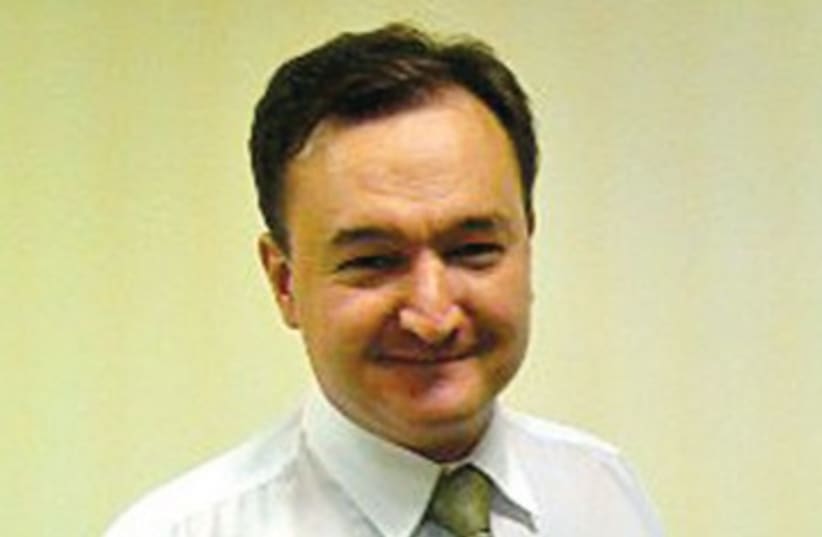
Magnitsky was a tax lawyer who uncovered the largest tax fraud in Russian history and paid for it with his life.
By IRWIN COTLERSergei Magnitsky 390(photo credit: Courtesy)
This week, Russian President Vladimir Putin made an important state visit to Israel, where, understandably, the issues of Iran and Syria were at the fore. The case and cause of Sergei Magnitsky were not on the agenda.Admittedly, Sergei Magnitsky is not a household name in Israel, let alone on the Israeli foreign policy radar screen. But his story raises significant questions about the culture of corruption and impunity in Russia, its flawed judiciary and the ruling regime’s abuse of the rule of law.Magnitsky was a tax lawyer who uncovered the largest tax fraud in Russian history and paid for it with his life. He blew the whistle on widespread government corruption, involving senior officials from six Russian ministries.The very officials against whom he testified then arrested and detained him, beginning a nightmare in which he was thrown into a prison cell without bail or trial, and systematically tortured for one year in an attempt to force him to retract his testimony.Despite the physical and psychological pain Magnitsky endured from his captors, he refused to perjure himself, even as his health deteriorated.Denied medical care for the last six months of his detention, he died in excruciating pain at the age of 37, having developed a severe pancreatic condition while being held in the Butyrka prison – a notorious Czaristera jail in Moscow that that also held Aleksandr Solzhenitsyn and Raoul Wallenberg.While Magnitsky’s death has fueled international outrage – including condemnations from US Secretary of State Hillary Clinton and UK Foreign Secretary William Hague – inside Russia the corrupt government officials responsible have never been brought to justice. In fact, they have even been rewarded for their criminality. Indeed, several of the officials responsible for Sergei’s death have been granted top government awards for their “expert investigative work.”The Wall Street Journal described Magnitsky’s death as a “slow assassination.” The Moscow Public Oversight Committee called it a “murder to conceal a fraud.”The anti-corruption watchdog Transparency International posthumously awarded Magnitsky its prestigious Integrity Award, stating that “Sergei Magnitsky did what to most people seems impossible: battled as a lone individual against the power of an entire state. He believed in the rule of law and integrity, and died for his belief. Magnitsky, his heroic fight and the ideals he stood for must never be forgotten.”Condemnations from the European Union and European parliaments continue, as legislatures contemplate additional actions. On Tuesday, the US Senate’s Foreign Relations Committee unanimously passed a bill named after Magnitsky, which would ban officials allegedly involved in Magnitsky’s death from entering the US, and impose restrictions on their financial activities inside the country.Regrettably, the first foreign policy statement made by Putin after his election was to reject these findings of fact – and conclusions of law – even from the human rights community in Russia. Indeed, he issued an Executive Order as follows: “Hereby I instruct to carry out active work to prevent the introduction of unilateral extraterritorial sanctions by the USA against Russian legal entities and individuals,” a clear reference to the Magnitsky case and sanctions that have resulted from it in the US, EU and elsewhere – and have which been proposed in other jurisdictions, including in Canada.One might well ask, what is the Israeli connection to all this? While the issue is largely unknown in Israel, it should not slip under the radar screen. Indeed, the Knesset – like other democratic parliaments in the US and Europe – should take the requisite steps to encourage Russian respect for the rule of law, and justice for Magnitsky.First, Israel – and other countries that have yet to act – should join with the European Union, Canada and the United States in bringing awareness and action to this case and cause – and to international efforts to date. As the great Soviet dissident Andrei Sakharov once said to me: “I do not know what will help the cause of human rights; I do know it will not be helped by silence.”Second, the “naming and shaming” process to identify the perpetrators involved must continue. US Sen. Benjamin Cardin – and the US Helsinki Commission – as well as UK and European parliamentarians – have released a list of 60 senior Russian officials and related documentation detailing their responsibility.The ongoing impunity – and indeed rewarding – of Russian officials is as scandalous as it is shocking.Third, the Knesset might consider holding hearings on this case, and – following the lead of the US Senate committee this week – consider adopting individual sanctions against those involved, through visa restrictions and asset freezes. The fact that there have been no consequences for any senior Russian officials who were part of this heinous web of corruption resulting in murder is simply unacceptable.Finally, the most important action is that which must be taken by Russia itself – to hold the perpetrators to account. A comprehensive and transparent inquiry so as to bring the perpetrators to justice and to promote adherence to international standards of due process and the rule of law should be the goal of every nation, including Canada, the US and Israel, and the EU.Tragically, Sergei Magnitsky is but the latest in a list of Russian heroes who lost their lives standing up for principle and truth. We can do no less than stand up for him.The writer is a Canadian Member of Parliament and a former minister of justice and attorney- general of Canada. He has a long history of defending political prisoners in the former Soviet Union and Russia, and recently introduced legislation titled “An Act to Condemn Corruption and Impunity in Russia in the Case and Death of Sergei Magnitsky.”
if(catID != 151){
var cont = `Take Israel home with the new Jerusalem Post Store