Principle and pragmatism demand an end to Gaza blockade
Thursday marked the fifth anniversary of Israel’s imposition of a complete siege on the Gaza Strip.
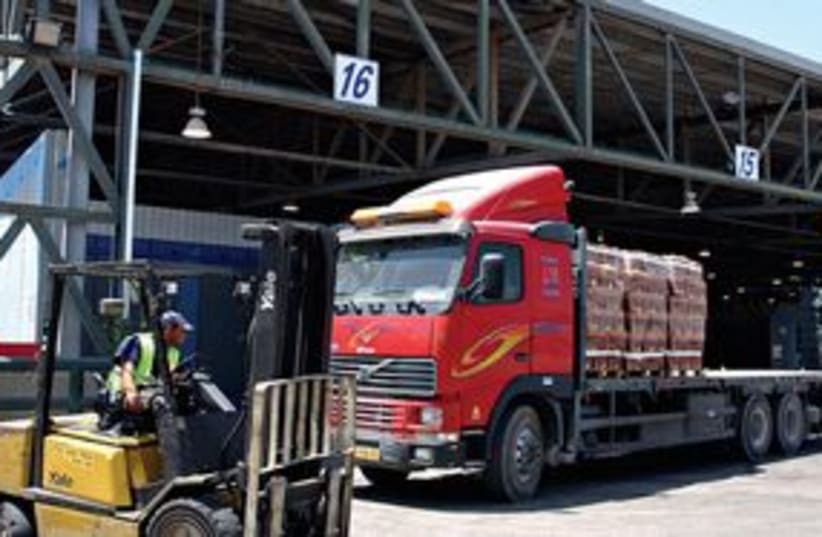
By KHALED DIAB311_Gaza crossing(photo credit: Ariel Jerozolimski/The Jerusalem Post))
Thursday marked the fifth anniversary of Israel’s imposition of a complete siege on the Gaza Strip. Although the land, sea and air blockade has not made Israelis any safer or enhanced Israel’s security, it has had a clear humanitarian and economic impact on Gazans.Take Khaleel Zaanin, 45, a once-thriving Palestinian farmer who has been reduced to subsistence farming because most of his land (37 out of almost 45 acres) falls within the buffer zone, or access-restricted area, which Gazans are not allowed to enter.“I had a great business in citrus, my life was very good. I used to employ 30 workers and export to Israel, Jordan and the West Bank,” recalls Zaanin, one of a number of Gazans profiled by a coalition of international development agencies.“Now, I work by myself, just planting vegetables for local sale.”Zaanin’s situation is hardly unique. In fact, an estimated 35 percent of Gaza’s already limited arable land and most of its fishing waters lie within the buffer zone. In addition, the Israeli blockade, through severe restrictions on imports and exports, has triggered the almost complete collapse of Gaza’s industrial sector.One study estimates that the blockade costs Gaza’s 1.6 million residents, over half of whom are children, nearly $2 billion a year. This has created a dependence on aid where little existed before. A decade ago, only one in 10 Gazans required assistance from UNRWA, the UN agency tasked with caring for Palestinian refugees. Today, some three-quarters are dependent on aid for their survival.THE SERVICE sector has been hit just as badly as manufacturing, with perhaps the only people turning a handsome profit being those who run the smuggling networks.Small businesses have been hit hard, with many going under and even the most resourceful entrepreneurs struggling to stay afloat.Take Hind Amal, a divorcee and mother of four, who runs a beauty supply store as part of her grand plan to “move forward” and “be a provider and role model for my children.” Her business was such a roaring success after she first set it up in 2006 that she was able to pay back the loan she had taken out to set it up and turn a profit.However, the blockade meant that she was unable to import the cosmetics her business sold and her customers were unable to afford them. With necessity driving this mother to invention, Amal started producing her own homemade cosmetics in a bid to keep her head above water and provide for her family.Though the Israeli public tends to associate Gaza with dangerous men in beards and blood-curdling fanaticism, the vast majority of the Strip’s residents are very ordinary people living under the extraordinary circumstances of almost complete isolation from the outside world.In fact, the hopes, fears and aspirations of the average Gazan are so mundanely human that it would be difficult for Israelis not to be able to relate to them.“My dream is for the Gaza airport to open again, to have open borders so we can travel,” admits Alaa al-Najjar, 23, and not because he wishes to go on holiday or see the world, but “to get treatment for my brother whom I love very much.”Like for Israelis, family is foremost in the minds of Palestinians in Gaza.“My dream was to give [my five children] a good and decent life. But I couldn’t do any of that,” says Jamal al-Za’aneen, 60, who regrets that he was unable to help his children get married and find homes for themselves.On the back of the blockade and following the pummeling Gaza received during Israel’s Operation Cast Lead, the Strip is suffering a severe housing crisis. International organizations estimate that Gaza needs at least 71,000 additional housing units, mainly to accommodate natural population growth, but also to rebuild homes destroyed during Israeli military operations. For example, one recent survey found that 15,000 people who lost their homes during Cast Lead remain displaced.And it is this very tragic human impact of the blockade that should appeal to the common humanity that stretches across even enemy lines and awaken Israelis from their lethargy toward the crimes being committed in their name in Gaza.Since Israel imposed its blockade, there has been a heated debate over whether or not it is illegal. Questions of legality aside, the real question should be whether or not it is just. As someone who opposes collective punishment, including the blanket Arab cultural boycott of Israel, I believe the blockade is unethical and immoral.Of course, there will be those who will immediately raise objections and say that the embargo is only in place to protect Israel’s security. Though Israeli concerns over the safety of communities bordering Gaza are valid, how exactly does banning tinned fruit while permitting tinned meat and tuna protect Israel? Is the mighty IDF worried that Palestinian militants, short on rockets, will start firing expired peach chunks across the border? There are those who argue that the blockade is in place to contain or even destroy Hamas. If that is the intention, then the plan has dramatically backfired.Tightening the screws on Gaza led from a situation in which Hamas won 44.45% of the votes and had to share power with Fatah to one in which it became the only show in town in Gaza. This is partly because, as Israelis well know from personal experience, a people which feels that it is unfairly under attack tends to close ranks and band together.Additionally, economic destitution and despair usually lead to greater radicalization and extremism, not the opposite. It is in Israel’s interest to live next door to Palestinians who are materially comfortable and in contact with the outside world.Moreover, Israel has imposed severe restrictions on Gazans since at least 1991, when it began its permanent closure policy in the Strip, yet what effect have these had? Far more productive, as even a growing number of Israelis are now arguing, would be to engage with Hamas and empower the pragmatists within the movement who are willing to accept a Palestinian state on the pre-1967 borders.Israelis pride themselves on their sense of morality, which they believe the world unfairly ignores. Well, it is time for them to display this sense of Jewish integrity and demand en masse that their government lift the blockade. It’s the only principled thing to do – and it is in Israel’s own self-interest, to boot.In a short story by an Israeli boy from Sderot, he imagined accidentally flying his remote-controlled plane over Gaza where he inadvertently bombed – or, more accurately, bon-bonned – the Palestinians with his payload of sweets, which led to such joy that everyone dropped their weapons, and peace reigned.Though this may appear “naïve” to seasoned and cynical adults, this boy had the right idea: the key to this conflict lies in human kindness, not inhumane hostility.The writer is an Egyptian journalist based in Jerusalem.
if(catID != 151){
var cont = `Take Israel home with the new Jerusalem Post Store