As the restive population in Libya begins to rise, the dictator’s desire to survive will be tested by those willing to die to remove him.
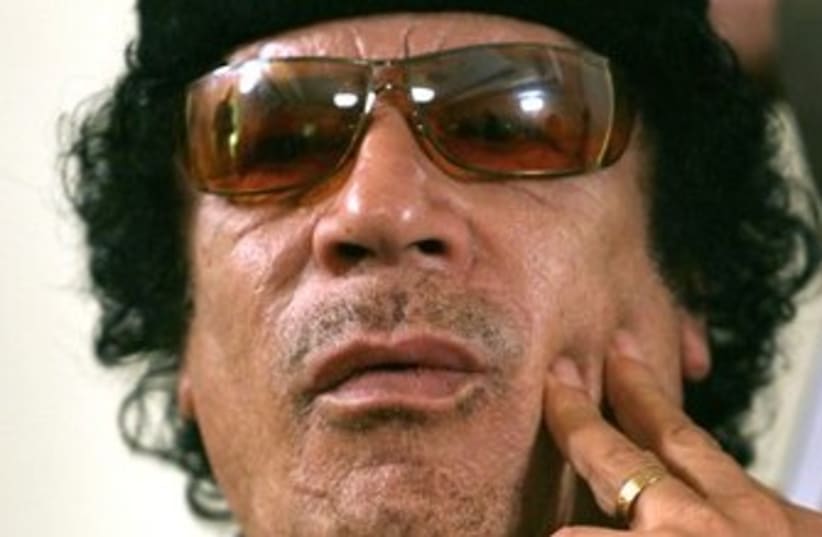
By MOHAMMAD ASLAMGadhafi(photo credit: ASSOCIATED PRESS)
Forty-two. That is how many years the Arab world’s longest-serving ruler has been in power. Muammar Gaddafi, technically only the guide of the 1969 revolution which overthrew the incompetent King Idris, is a brutal maverick of a dictator who has ruled the oil- and gas-rich North African country with a combination of fear and terror.The recent fall of two neighboring dictators, including his despotic counterpart Hosni Mubarak, has enshrined the idea of popular protest in Libya, a country of nearly six million.Although rumbles of discontent started in Tunisia, Libya’s tiny western neighbor, and were witnessed in Algeria, Jordan and Yemen, the thought of Libya following suit was a surreal and distant idea to many.Simply put, however, the writing has been on the wall for some time in Egypt and Tunisia, but in military republics like Libya, where a dreaded army and secret police run every level of the state’s institutions, the despotic nut is harder to crack.Gaddafi’s reaction summed it all up. In a smug but controlled manner, he spoke of how Zine El Abidine Ben Ali’s ouster was a great loss, and a harbinger of chaos. In effect, he was trying to say Libya was enjoying peace and tranquility; to follow in the footsteps of Tunisia was to invite danger and thus catastrophe.The question on everybody’s mind now is whether the regime is panicking. Was Gaddafi’s speech meant to put off any Libyan who dreamed of regime change? Suddenly, on Tuesday, February 15, broadcasts on Arabic stations began to spread the news that Libya’s second largest city, Benghazi, was awash with rebellion.Almost as quick as the news came in, reports of soldiers firing into crowded areas and mass detentions – not unusual in dictatorships – began to come through.It summed it up perfectly. Ordinary Libyans, long economically deprived – with two-thirds living below the poverty line – were roaring for change, while the regime, led by a man who deserves the dubious honor of being one of the world’s most erratic tyrants, was scurrying for survival.On February 17, a “day of rage” was called, as a longsubdued population struggling to free itself from tyranny began to make the regime truly nervous with a blatant call for an end to fear.The very day on which some 50 people were reported killed, demonstrations were being held in the country’s eastern cities, such as like Benghazi, Al Bayda and Tobruk – which have a history of antagonism toward the regime. Police stations, courthouses and security headquarters were burned, a regional security chief was sacked, a statue of the leader with his Green Book was toppled, and round-the-clock arrests to keep a domino effect from reaching Tripoli – the capital – began in earnest. But the Libyan people, as patient as they are, did not yield.As I write, the uprising has spread to the country’s west, crucially in and around Tripoli. Meanwhile, state television gives the impression of a nation in love with its leader. In reality, the regime has sent its goons to kill without mercy, with reports of African mercenaries being brought in to slaughter rioters infuriating the crowds. While human rights organizations said between 100 and 200 have been killed (in a country where the regime has gone beyond blocking Internet sites and mobile phone connections, and completely shut off electricity to areas where demonstrations are rampant), the true figure is likely to be much higher.THE REGIME is feeling the heat. The latest reports speak of towns in the east being under opposition control; speculation is rife that Benghazi airport has been closed and surrounded by anti-government demonstrators.Massacres at funerals, slaughter in hospitals and counterattacks on military barracks give an idea of the intensity of the situation.In Islam, the country’s official religion, for every death there is a mourning period of 40 days. In conservative Libya, there is no question this will be adhered to.The question on Gaddafi’s mind is that if 40 days of mourning are required for every one of the citizens he puts to death, not only is this nation going to be in constant grief, but with every death is he not digging the hole beneath him even deeper? This battle is for Libya’s future. The real question on the Libyan people’s minds is how many martyrs – 10, 100 or 100,000 – will it take before the leader is finally brought down?The writer is a PhD candidate in in Political Violence at the Department of Middle East and Mediterranean Studies at King’s College, London.
if(catID != 151){
var cont = `Take Israel home with the new Jerusalem Post Store