What’s wrong with the European human rights system?
The answer to this apparent dilemma can be found in the emerging practice of the European Court of Human Rights.
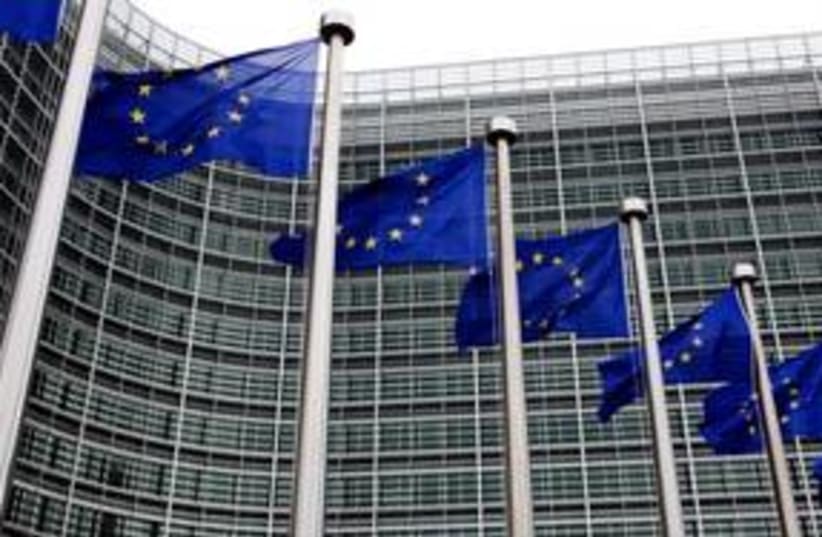
By PAULINA NEUDINGEuropean Union flags in Brussels 311(photo credit: Thinkstock/Imagebank)
Why do efforts to expand and strengthen human rights at the same time provoke policies that undermine the very democratic functions that serve as a bulwark protecting human rights? The answer to this apparent dilemma can be found in the emerging practice of the European Court of Human Rights – guardian of human rights for 800 million citizens throughout Eurasia.The European Convention on Human Rights (ECHR) – an institution of the Council of Europe, not to be confused with the EU – is in a sense a unique success as a promoter of international human rights. Drafted in 1950, it has been under the rule of the European Court of Justice in Strasbourg, France, since 1959. Today, 47 states – from Scandinavia and Britain to Turkey and Russia – are party to the convention, which lays out fundamental human rights and freedoms, such as the Right to Life and prohibition of torture.It has been one of history’s most successful human rights initiatives, but today it is struggling with fundamental problems. In late April, ministers and top diplomats from 47 countries assembled in Brighton, England, to stake out the way forward. The resulting Brighton Declaration has been criticized by leading NGOs, notably Amnesty International, for undermining the European Human Rights System. But the main problem is not the declaration that came out of the Brighton meeting, but the fact that the problems at the core of the European Human Rights System once again were not addressed.Unlike other post-Auschwitz agreements concerning human rights, the ECHR has the status of law in the signatory states, and even more uniquely the Strasbourg Court’s rulings are generally both respected and implemented.The court has put real pressure on Russia and Turkey in cases of torture and forced disappearances, and last year Russia was sentenced to pay 8,727,199 euros in damages to victims.The European Council is currently monitoring the implementation of 171 rulings against Russia for human rights abuse in Chechnya. The Court seems to have put a stop to the practice of sterilization of Roma women in Slovakia, by ruling in 2009 that sterilizations are unlawful if there is any doubt that the women’s consent was not properly given.ONE REASON for this success is the Court’s wide legitimacy: Strong democracies like Britain and the Scandinavian countries have agreed to submit to its jurisdiction.Another reason is the possibility for individual citizens to take their complaints directly to Strasbourg.Strasbourg is, however, not as readily accessible as the Israeli Supreme Court. Before appealing to the court, all available domestic legal routes must have been tried. Further, the matter of complaint must directly affect a plaintiff. Unlike the Supreme Court in Jerusalem, with its famous open door policy, the European Court of Human Rights is thus a last resort for citizens who have suffered abuse.Like the Israeli Supreme Court the European Court has taken on an activist role. And just like in Israel, this has raised questions of the legitimate scope of power of unelected judges.The British Prime Minister David Cameron has taken action to limit the Court’s jurisdiction, with the objection that some of the court’s rulings have a “corrosive effect” on the support for human rights. Britain, currently chair of the European Council, initiated the Brighton meeting. Among other things, the resulting declaration aims at making it more difficult to access the Court, by shortening the time for appeal from six months after the final ruling in domestic court, to four.It also underscores that member state courts actually are bound by the ECHR, and need to closer follow its precedents.Another problem is the European Court’s caseload.Presently 150,000 cases are pending, and with every year the number is growing. It takes years for a complaint to reach the court. Add to this that a plaintiff must exhaust all domestic courts and authorities before turning to the court, and it can easily be a decade before a human rights issue is settled. And as the Strasbourg Court itself has repeatedly admonished member states with slow legal processes: justice delayed is justice denied.But the caseload also reflects an ideological problem that is not unique to Europe. There has been a fundamental shift in the global human rights discourse, toward ideas that are very different from those that shortly after the Holocaust resulted in the ECHR and the UN Declaration of Human Rights: Ever more policies and entitlements are deemed fundamental human rights.Olivier De Schutter, the UN Special Rapporteur on the Right To Food, illustrated this point recently, when he argued that climate change must be regarded as a human rights issue (The Guardian, April 29th). The neglected implication of this shift has striking potential consequences for democracy. As human rights issues incorporate a growing share of the political domain, the powers of elected officials are correspondingly weakened in favor of unelected watchdogs. In the case of Europe, the watchdog is the European Court in Strasbourg.This concept of inflated human rights is reflected in the case law of the European Court. For instance, the Court has ruled that Swiss name laws, preventing a man to use his wife’s family name before his own, violated the Right To Family and Private Life and the Prohibition Against Discrimination.A woman living close to a nightclub in the Spanish city of Valencia claimed that the loud music violated her Right To Family and Private Life – and won. It is not a farfetched thought that the growing number of pending complaints reflects the European public’s growing expectations with regard to what constitutes a human right. So far these growing expectations are being encouraged by the court’s rulings.As power moves from elected officials to unelected judges, there are some pivotal questions that must be raised: How do we distinguish between policies we find desirable, and actual human rights? At what point does a human rights regime lose its democratic legitimacy? At the same time it is important to keep in mind that the discussion extends beyond the court’s legitimacy in democracies of long standing. The rulings against states such as Russia, Turkey and Slovakia serve as a reminder that it is crucial to save the European human rights system.If inflated human rights are allowed to demoralize the system, it is in these nations the effects will be noticed.The writer is a lawyer and editor in chief of the Swedish magazine Neo. She is a co-founder of the newly formed Freedom Rights Project.
if(catID != 151){
var cont = `Take Israel home with the new Jerusalem Post Store