Egypt is making every effort to ensure that stability is maintained.
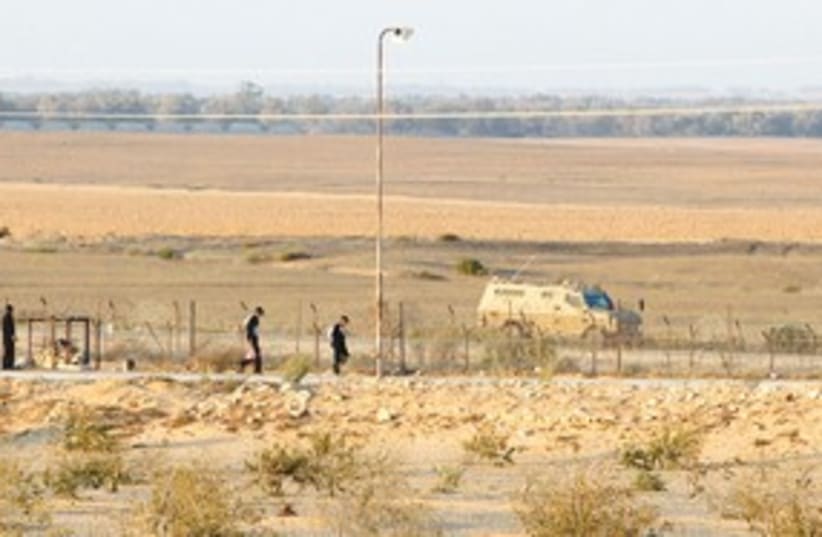
By DANIEL NISMANEgypt border 311(photo credit: Asmaa Waguih/Reuters)
Despite the post-revolution lawlessness currently gripping the Middle East’s most populous nation, the Egyptian government’s actions in Sinai prove that it is still very much in control of the country, even if a transition to real democracy eventually proves to be wishful thinking on the part of the international community.One glance at the headlines in local newspapers illustrates a grim picture of the post-revolution struggles facing Egypt. Sectarian strife, familial disputes ending in massive instances of domestic violence, civil union strikes, power outages, contaminated water supplies, dismal economic performance and societal- religious disagreement over the framework of a future constitution are threatening to pit Islamists and secular Egyptians against each other in a brutal, protracted conflict. Unfortunately these are just a few of the problems gripping the North African state since the fall of Hosni Mubarak.Egypt’s political situation is both fluid and volatile. At the moment, it is practically impossible to predict which candidate or party will take power in the coming elections. Commentators in the West and in Israel have been quick to condemn the future makeup of the Egyptian government as one that will be dominated by an Islamic and fundamentalist agenda, and for good reason.The Muslim Brotherhood and Salafist Al-Nour parties possess considerable influence over common Egyptians.
Egypt’s secular parties are still struggling to carve out concrete identities and unify in hopes of becoming an effective and influential political mechanism.How much sway do the Islamists possess, exactly? The answer is really unknown, since no credible polls of Egypt’s 80 million plus citizens were ever taken during Mubarak’s rule. However, one telling example is the Islamist hijacking of the July 29 “Day of Unity” protest in Tahrir Square, originally organized by liberal Egyptian reform parties. The rally was originally intended to put pressure on the transitional government to speed up trials of regime officials and end military tribunals for civilians. However, it was quickly infused with a fundamentalist Islamic agenda after Salafists took control of the demonstration, effectively commandeering the three main podiums and physically removing the liberal protesters camped out in Tahrir Square. Indeed, the sound of hundreds of thousands of bearded Islamists in Tahrir Square chanting “Sharia law for Egypt” was truly disconcerting.SO WITH all of this madness occurring against the backdrop of collapsing Arab nations such as Yemen or Syria, why should we think that there is any hope for Egypt? The answer may be found in the launch of Operation Nesr (Eagle), which is the Egyptian military’s attempt to root out the militants in northern Sinai who are targeting the natural gas pipeline in the area, threatening one of the only remaining staples of Egypt’s struggling economy. Several days after this operation began, a crossborder raid by Sinai terrorists into Israel’s South caused a political earthquake in the region.Suddenly the Sinai became a central issue in Egyptian discourse, both domestically and internationally. Western nations observed anxiously to see how Egypt would respond in returning law and order to this strategically vital piece of territory. The Supreme Council of the Armed Forces (SCAF) responded immediately by directing its forces south to the central mountainous area of the peninsula, where it began extensive patrols on the border with Israel.Just as it seemed that the hostilities between Gaza militant groups and Israel would spiral out of control, Egypt rushed to implement a unilateral ceasefire – several, actually – among the various Gaza factions engaged in firing rockets at Israel’s South.Even as Egypt worked behind the scenes, it was clear that the Israeli government knew it would be unwise to be dragged into another major operation in Gaza. In addition, a high-ranking SCAF official recently stated the very real possibility of the creation of a 5- kilometer buffer zone with Israel, while local sources in Rafah reported the arrival of heavy machinery meant to destroy tunnels leading to Gaza.IN ADDITION to concrete military action, the Egyptian government has announced new measures to improve the Sinai infrastructure and improve the quality of life for the nearly 350,000 (mostly Beduin) inhabitants there. A new investment council was created strictly for the purpose of improving the quality of life in Sinai.This move was a direct response to the realization that local Beduin tribes need to be convinced that there are better, more lucrative options for making a living than resorting to arms smuggling or human trafficking.Although Operation Eagle and the various investment/social projects being implemented in Sinai are still in their early stages, the Egyptian leadership has taken concrete steps to demonstrate that they are capable of responding to real crises in a relatively responsible fashion. From an Israeli perspective, one can’t help but focus on the multitude of diplomatic incidents that took place following Israel’s alleged killing of five Egyptian security personnel during the Sinai attacks. These events should be taken within the context of the new Egyptian reality.First and foremost, the SCAF must tread cautiously, balancing the appeasement of Egyptian public opinion, which is more relevant than ever in post- Mubarak Egypt, and maintaining the peace with Israel for security and financial purposes. The SCAF did a decent job of escaping the Sinai debacle unscathed on both ends: It allowed demonstrations to take place outside of the embassy, but shut them down before they expanded to a point of critical mass. Setting the Israeli perspective aside, if we look at Egypt in the wider context of the Arab Spring, we can reasonably assume that it has the highest probability of emerging as a stable – if not fully democratic – nation.Unlike Libya, Yemen, or Iraq, Egypt is not a colonialist creation. Even if the population is largely impoverished and uneducated, Egyptians tend to highlight collective nationalism as a staple of the greater Egyptian national conscience.Faith and goodwill in the SCAF, although it is being increasingly criticized, also remains fairly strong among the Egyptian public.These developments contrast with scenarios in Libya or Yemen, where tribal identity trumps nationalism, or Iraq, which is divided among sectarian- religious lines first, with nationalism coming second. Even the Coptic Christians and Salafists still consider themselves Egyptian, viewing nationalism as a powerful part of their own identities. These two parties have always expressed willingness – whether genuine or otherwise – to work out their differences for the sake of the nation. Even the Jemma al Islamiya, Egypt’s most extremist Salafist group, announced the inclusion of Coptic Christians in the list for its newly formed political party.These attributes, as well as the Egyptian government’s unwavering efforts to ensure stability is maintained, have provided a glimmer of hope for the outcome of Egypt’s post-Mubarak revolution.Unfortunately the same sentiments can’t be expressed for Libya, Yemen or Syria. The writer is an Argov Fellow for Leadership and Diplomacy at the Inter-Disciplinary Center in Herzliya. He works for Max-Security Solutions, a security consulting firm based in Tel Aviv and is co-founder of Friend a Soldier.
if(catID != 151){
var cont = `Take Israel home with the new Jerusalem Post Store