Recent events in Europe suggest that the time has come to add de-tabooization of anti-Semitic discourse.
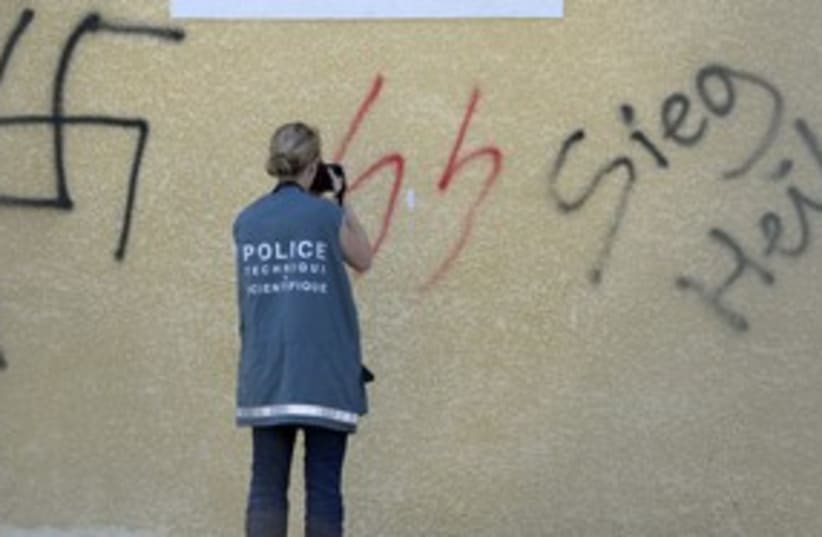
By DENIS MACSHANEFrench police photograph neo-Nazi graffiti 311 (R)(photo credit: REUTERS)
Natan Sharansky famously described the three “D’s” of hostility to Israel and Jews – Demonization, Double standards and Delegitimization. Recent events in Europe suggest that the time has come to add some more, as observers grapple with the rise of a new anti-Semitism and deepening hatred of Israel.What we are witnessing in European politics today is the accelerating erosion of the taboo against anti-Semitic discourse which has been in place since 1945. This detabooization – a ugly neologism for an ugly politics – is part of a broader global ideological drive against Jewishness. John Galliano may have been fired by Dior, but only after Natalie Portman said she would quit as the French firm’s public face. Before that threat, the fashion house looked as if it wanted to ride out the storm. Wikileaks boss Julian Assange has accused critics on The Guardian of being part of a “Jewish” media conspiracy against him, even if none of the journalists he named, including the paper’s editor, Alan Rusbridger, is Jewish.Or how do we deal with Laurent Wauquiez, secretary of state for European affairs in President Nicolas Sarkozy’s government, who announced that Dominique Strauss-Kahn does not have “roots” in France? Strauss-Kahn, who is currently head of the IMF in Washington, is likely to be the French Socialist Party’s candidate against Sarkozy next April. Another right-wing minister in Paris said the socialist did not represent “the soil of France.”French rightists have yet to call Strauss-Kahn “cosmopolitan” or make direct reference to the fact that he is a Jew, but the noise they are making is a lot louder than a dog whistle, and no one in France has any doubt about the insinuation.And there is the German social democrat, Thilo Sarazzin, until recently a member of the board of Germany’s central bank. He told the paper, Welt am Sonntag last year that “all Jews share a certain gene... that makes them different from other people.”This flashback to pre-war pseudo-genetics was echoed by Karel de Gucht, the powerful European Union Trade Commissioner who said last year: “Don’t underestimate the power of the Jewish lobby” and “it is not easy even with a moderate Jew to have a conversation” about Israel. Germany’s Social Democratic Party says there is no reason for Mr. Sarazzin to give up his party card. Brussels has not sanctioned Mr. de Gucht in any way.IN SHORT, as with Galliano, Assange, or the questionable anti-Jewish outbursts of actor Charlie Sheen, we are seeing the slow re-entry of anti-Semitism into public discourse. The British Member of the European Parliament, Nick Griffin, is a notorious Holocaust denier. In a by-election for the Commons held in March, Griffin’s British National Party won more votes than the mainstream Liberal Democrats who are in coalition with David Cameron. As with the openly anti-Jewish Jobbik Party in Hungary, voters no longer feel nervous about voting for anti-Semitic policies.The second “D” is the Devaluation of the Holocaust, or the “Double-genocide” thesis now advanced across Eastern and Baltic Europe. This does not deny the Holocaust, but argues that Hitler was no different from Stalin in his murderous intent. According to this argument, the mass starvations under communism – especially in the Ukraine in the 1930s – or the murders and deportations of Baltic peoples amounted to crimes against humanity on a par with the Shoah.Stalin’s crimes and Soviet cruelties deserve a high place in European school-teaching, but they were not the same as the Holocaust – the high-tech, industrial and logistical transportation of Jews from all over Europe to death camps because of an anti-Jewish ideology.As Professor Timothy Snyder, author of Bloodlands: Europe Between Hitler and Stalin, writes: “the Germans deliberately killed about 11 million non-combatants” (including 5.4 million Jews shot or gassed) and “the Soviets approximately six million.”This Double-genocide revisionism, while not the same as out-and-out Holocaust denial, seeks to relativize the death of Jews, and is widely supported by anti-Semites.In Latvia there is an annual commemoration of the Waffen SS Latvian division which took part in many anti-Jewish atrocities. A court in Lithuania has declared the swastika to be a national symbol. Jewish partisans who fought German Nazis and their collaborators in Lithuania have found themselves on trial as war criminals. Of course, there are many decent politicians in Baltic states who want to condemn Soviet crimes without condoning anti-Jewish acts. But when eight EU ambassadors were moved recently to write a letter to the Lithuanian government about attacks on Jewishness in the country, then the EU has a problem with one of its member states.Richard Beeston, foreign editor of The London Times, who knows both the Arab world, France and, like all distinguished editors at The Times, knows the dinner parties of London, told the BBC World Service this month that while criticism of Israel is legitimate, some of it – especially in Arab countries– is little better than “anti-Semitism by the back door.”It is the intellectual denial of this backdoor anti-Semitism underlying hatred of Israel that is final new “D.”The writer is MP for Rotherham and was Minister of Europe. His book Globalising Hatred: The new Antisemitism is published by Weidenfeld and Nicolson.
if(catID != 151){
var cont = `Take Israel home with the new Jerusalem Post Store