Some here ascribe all sorts of fabricated evils to Israelis.
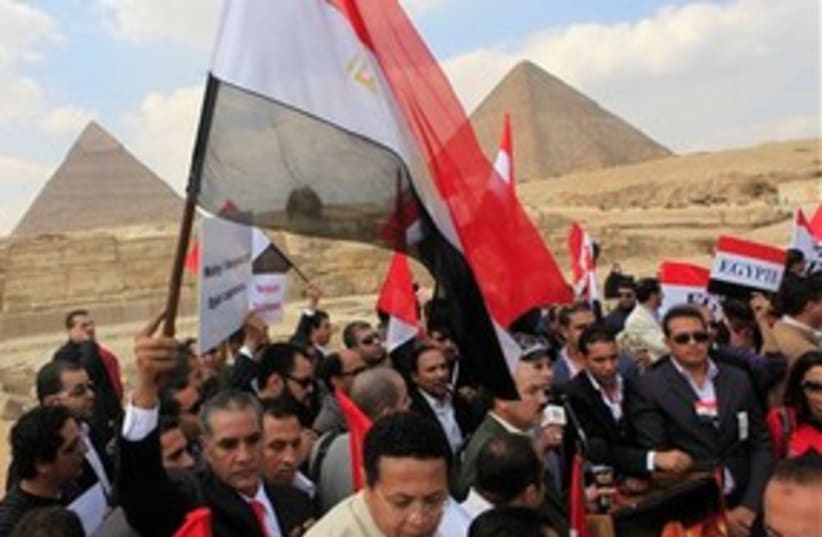
By SETH J. FRANTZMANEgyptian protesters with flags at pyramids 311(photo credit: AP Photo/Amr Nabil)In a recent article on Egypt, Larry Derfner repeats an unoriginal theme when he ascribes to “us” all sorts of values and opinions merely to place himself above and outside our society. “It’s not that we’re against democracy, goes the Israeli line on Egypt, it’s that we’re afraid of the Islamists and radical Arab nationalists taking over... we’ve taken sides against popular revolts that could hardly have cared less about the Israeli-Arab conflict... we’re tarring the Egyptian masses now as radicals... We have no problem supporting dictators or opposing democrats... We were doing to other people what we’d always hated other people doing to us.”“We” is used no less than 48 times. And yet surely Derfner is not suggesting he is responsible; he isn’t speaking as someone who actually was part of the “we,” such as the government officials who met with their South African counterparts in the 1970s. What he really means is “they” – the bad Israelis, the Israelis to whom he ascribes all these things. But by saying “we,” many in Israel ascribe terrible sins to “us” only to take part in some banal self-flagellation and present themselves as lone righteous voices.There is this never-ending self-lashing, this “oh, woe is me... we are so evil... our society is so terrible....”To ascribe all these uniquely obnoxious traits to their own society, they portray that society as a distorted nightmare, like some Picasso drawing. Yossi Sarid, a former education minister, writes in Haaretz: “This was a civil uprising [in Egypt], one that did not suit the wild and violent image we insist on ascribing to all Arabs and to all Muslims... if only Israeli flags had been burned in the streets, we could frighten ourselves and the whole world, saying we were right again... can only Israel enjoy its limited democracy? The Exodus from Egypt, from slavery to freedom, is for Hebrews only, not for Arabs... finally we fit into the region.”What is Sarid getting at? When he says “we,” does he mean that when he was education minister he worked hard to promote democracy in the Arab world, or does he mean that he too viewed the Arabs as insufferable extremists?Well it seems he neither promoted democracy nor held this racist view. So who is “we”?What he means is “they” – those bad Israelis, the ones who hate Arabs. Which Israeli ever said freedom is for Jews only? Yet suddenly that outlandish view becomes “we,” merely so “we” can be racist and hateful and reactionary.Anshel Pfeffer writes, also in Haaretz, “are we afraid we won’t be able to bask in the title of ‘the only democracy in the Middle East’? Doesn’t Egypt deserve democracy too?” Which “we” is this? Where, ever, did someone complain that we won’t be able to bask in the title of the only democracy in the Middle East? Never were such words uttered, and yet this apparently becomes the normal notion of so many of “us.”Bradley Burston writes on his blog on Haaretz.com: “I want you [Egyptians] to show us the last thing we expected to see. Because it is only when we see our best consensus assessments proven dead wrong, when the wholly unanticipated stuns us, when the inconceivable turns overnight into the inevitable, that change comes to this place... why has this Israeli government done its best to emulate in two years repressive measures Hosni Mubarak took 30 years to refine?”At the end of his column Burston explains, “We deserve to build settlements because we have suffered and the Arabs are violent.” Once again, “we” is not the author, and the actual people referred to, the settlers, would never describe their reasoning this way.TO TURN “us” into the a bogeyman, reality must be skewed so that the labels of “we” and “us” can be placed on it. Haaretz’s Akiva Eldar writes, “True, in Israel they do not arrest bloggers for insulting the president’s honor. On the other hand, Egypt does not hold for more than 43 years millions of people under military occupation.”Eldar, like all his fellow travelers, imagines an Egypt that is democratic and an Israel that is a dictatorship. Egypt, he forgets, has had decades of emergency rule and lives under military dictatorship even today.Derfner argues that our fears are “part of the story of why the incredibly brave people in Egypt inspire just about everyone in the world except us.”Yet he knows very well that many people in the Gulf states, Iran, China and all over the world are not so inspired by Egypt, and he also knows that in Israel the Egyptian uprising inspired many. So he misleads on two accounts, he makes “us” into freedom haters, and makes the world into something it is not.Why does Sarid write that Israel has “limited democracy”? He knows all too well, from having been in the Knesset, that this is a fabrication. In the Hebrew press it is the same: “we, us, ours, all of us.”Part of the reason for the plethora of “we” that oozes into every piece of punditry is simply group think. In two of four February 13 op-eds in Haaretz, “Orientalism” is the topic. That isn’t coincidence; it stems from the same people all sitting around and telling the same nonsense to each other; “we live in a racist society, Orientalism finally is proven wrong by Egypt’s democracy, we believe democracy is only for us...”And the readers, do they suffer from a mass psychosis? They should know very well that “we” is a stand in for “they.”The over-emphasis on “we” stems from a prophetic tradition, but also betrays a deeper self-hate. In Judaism the child at Passover who indicates inclusion is “wise,” while the one who places himself outside is “wicked.”Not wanting to be wicked, many of those who truly abhor Israel ascribe all sorts of nonsense and evils to it and its people. They style themselves “we” and “us,” when they do not actually view themselves as one of us, for they have only contempt for our society, which they paint as brutish, racist, savage and ignorant. The writer has a PhD from Hebrew University and is a fellow at the Jerusalem Institute for Market Studies.
if(catID != 151){
var cont = `Take Israel home with the new Jerusalem Post Store