Israeli, Asian fellows urge cleantech partnerships
‘What really drives the seed of innovation is the mentality of constantly being unsatisfied,’ says Chinese student at TAU.
By SHARON UDASINIsrael-Asia Center(photo credit: Flash 90)
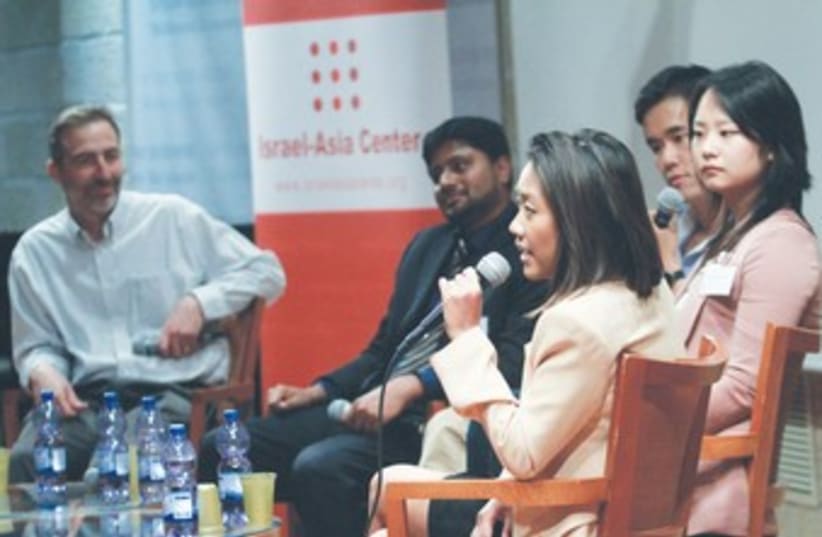
Israeli clean-tech and agricultural firms should prioritize partnerships with colleagues in Asian nations, where their innovative expertise can be exported to a wider market, several Asian graduate students pursuing degrees in Israel agreed on Tuesday.The students were participating in the closing evening event of a year-long Israel-Asia Leaders Fellowship Program, organized by the Israel-Asia Center in Jerusalem. The program acts as a supplement to Asian students already studying in Israel and serves as a part-time networking platform among them.While many of the 12 fellows this year were involved in subjects such as religious studies and conflict resolution, about half were pursuing degrees in environmental or agriculture-related fields.“There is kind of this tendency of Israel to focus west, because that’s what’s familiar and that’s been our image of where the market is,” said Saul Singer, former Post oped editor, author of the book Start-Up Nation: The Story of Israel's Economic Miracle and moderator of an hour-long panel discussion among four of the students. “We need to start looking in another direction.”In the eyes of Sharon Teo, a 27-year-old from Singapore, Israel should begin looking more in the direction of her country, particularly in the clean-tech and innovation realms.“We already have a very close relationship based on defense,” Teo told The Jerusalem Post during a sitdown interview before the panel and the awards ceremony.“There is so much potential for Israel and Singapore beyond defense. We have one of the best business environments in the world.”Teo is pursuing her master’s degree at Tel Aviv University’s Porter School of Environmental Studies. Before this year-long program, she earned a bachelor of business management degree from Singapore Management University and has also lived and worked on projects in Spain, Sudan, Mongolia, Kuwait, Switzerland, Cyprus and Sierra Leone. For her “mini-thesis” project at the Porter School, she is working on solar energy independence strategies for the West Bank, and investigating what solar policies might be beneficial for developing markets, she explained.“Every business should start considering how they can be a bit more environmentally focused, sustainable, from how they hire people to solutions, to how they cater to the market,” Teo said.Singapore is the ideal gateway through which Israel can spread its green technologies globally, according to Teo. As Singapore has already identified clean-tech as an industry of growth for the next 10 years and has invested millions in honing research and development as well as manpower, by taking advantage of what Singapore has to offer, “Israel can go beyond conflict through economic power,” Teo said.“Singapore is a great headquarters for Asia,” she continued.By setting up clean-tech incubators in Singapore, which can provide a test-bed from conceptualization to commercialization, Israel can certainly expand its reach, Teo explained.For another student, Howe Wang, 26, from China, it is crucial that Israeli clean-tech firm executives learn how to better communicate directly with the heads of potential Chinese partner companies, rather than going through government officials.“They don’t know who they can talk to in China,” Howe told the Post. “The thing people in Israel need to understand is that the Chinese government only has so much say and you need to really engage the companies themselves.”Howe is an environmental management master’s candidate at the Yale School of Forestry & Environmental Studies, who has for eight months been a Yale University Fox International Fellow at Tel Aviv University.While in Israel, and through the Israel-Asia Leaders Fellowship, Howe is aiming to enhance environmental technology and economic collaborations between China and Israel – particularly from a direct businessman to businessman perspective.He has a long family history with Israel, as his father, a professor in developmental economics, used to work with the Israeli government.“What really drives the seed of innovation is the mentality of constantly being unsatisfied,” he said, praising Israelis’ tendency to constantly question.Howe has been consulting with the Chief Scientist’s Office in the Industry, Trade and Labor Ministry to teach Israeli firms how to engage and communicate with Chinese investors – showing them how to make use of, for example, Chinese social networks that such people tend to surf.One Israeli clean-tech firm that has done a particularly good job in attracting Chinese investment is the Ness Ziona-based HelioFocus, which recently unveiled its solar-thermal technology in the Negev.“That case is representative, it didn’t come from government or anything,” Howe said, noting just how important it is for Israeli companies to “really interact with the Chinese company – go there and leverage the connection you have.”Some of the Indian students also said they hoped that Israel would continue to export its clean-tech and agricultural know-how.“It’s really growing,” said Srivignesh Sundaresan, from southern India, about the Indian-Israeli relationship.Sundaresan, 27, is pursuing his PhD in plant science at the Hebrew University’s Robert H. Smith Faculty of Agriculture, Food and Environment, where he also earned his master’s degree.Previously, he earned his bachelor’s degree in horticulture from Tamil Nadu Agricultural University and a master’s degree in plant science from the Hebrew University.He is studying the flowering mechanisms of tomatoes, but hails from a 7-hectare (17.3-acre) Indian farm, where he intends to bring back some of the techniques he has honed in Israel.While the relationship between India and Israel is certainly growing, Sundraesan said that even back during his undergraduate days, professors were always referring to the Jewish state as an agricultural expert.“They said, ‘This technology came from Israel,’” Sundraesan said. “Come on guys, let’s move the class to Israel.”During his time in Israel, he has been building contacts with both Israeli government officials and their Indian counterparts who have come to visit, and have been much more accessible to him in Israel than at home in India, he said.Dr. Akhilesh Kumar, a 32- year-old plant biotechnologist from the opposite side of India, Uttar Pradesh, also said he felt that India was the perfect place for Israelis to bring their agricultural technologies – particularly involving water purification along the River Ganges.After completing his master’s degree in Bundelkhand and earning his doctorate in Kolkata West Bengal as well as a post-doctoral fellowship in New Dehli, Kumar came to Israel’s Agricultural Research Organization at the Volcani Center as a Foreign Ministry Mashav fellow from 2010 to 2011. Afterward, he stayed on to continue working on his project, involving transgenic research on potatoes, and intends to complete a second post-doctoral fellowship at the Volcani Center.“I just wanted to gain the exposure to how they manage such excellence in field agriculture,” he said, adding that with minimum sources, Israel achieves maximum output.More Israeli firms need to get involved with cleaning the Ganges, a project to which the World Bank is giving $2 billion, taking part in projects such as solar-powered-building greenhouses along the riverbanks, making compost from worship flowers and purifying the water of chromium, from the leather industry, according to Kumar.“I want to spread Israeli technology into states that don’t already have it,” hesaid.
if(catID != 151){
var cont = `Take Israel home with the new Jerusalem Post Store