‘Oil shale: A sound way to achieve energy independence'
Private initiative releases its final assessment on environmental impact to pave way for pilot drilling and production.
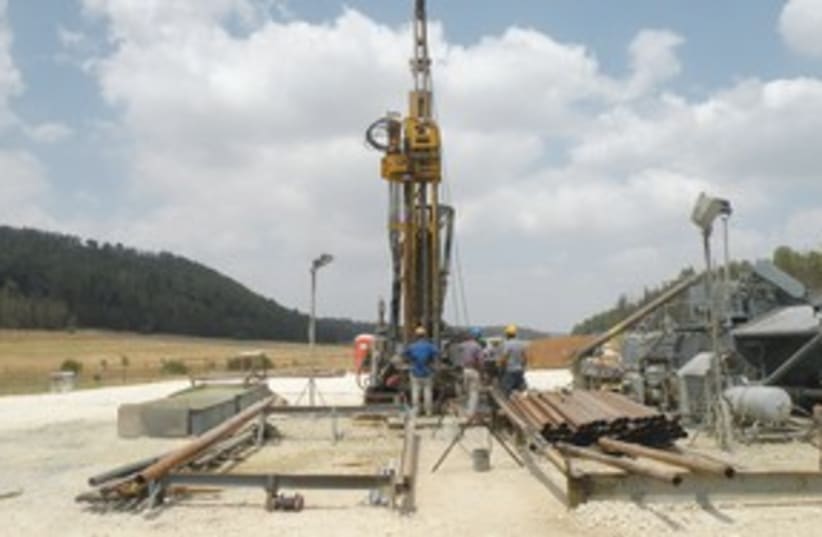
By SHARON UDASINZOHARIM drilling site 311(photo credit: Sharon Udasin)
After completing operations at its six oil shale experimental drilling sites, Israel Energy Initiatives has submitted a final assessment of its project’s environmental impacts to the Environmental Protection Ministry.IEI hopes to get the project’s official pilot phase under way in the coming months.RELATED:'Oil shale can bring energy security and independence' The report answers 72 questions that the ministry presented to the company after a previous environmental report in October, and will be made available to the general public next week on IEI’s website (www.iei-energy.com). Once the report is available online, the pilot phase will be brought for a hearing at the Jerusalem District Planning and Building Council, which the company hopes will occur within a couple of months.As the liquid oil supply curve continues to drop on an international level, oil prices will only rise dramatically, necessitating the development of unconventional oil productions, IEI CEO Relik Shafir told The Jerusalem Post at a meeting in Tel Aviv on Monday. Creating oil from shale – a dark sedimentary rock containing hydrocarbons – is one such unconventional method, and resources are particularly robust in Israel, Jordan, North America, Russia, Mongolia, China and Australia, according to Shafir.IEI was founded by its chief scientist, Dr. Harold Vinegar, who was formerly chief scientist at Shell Oil in the United States before coming to Israel with a dream of bringing the country closer to energy independence.“Our vision is to allow Israel energy independence,” Shafir said. “This is the vision that brought Harold Vinegar to Israel to make aliya, and the vision of the company.”In Israel’s case, the largest source of shale is in the Shfela basin region outside Jerusalem, where the hydrocarbons are located between 200 and 400 meters below the surface, beneath an impermeable layer of rock and enmeshed between 70-some-odd-million-year-old fossils.To produce oil, the company must drill a production pipeline surrounded by a ring of heating wells, which gradually heat the rock over the course of nine months to 300º C and thereby transform it into lightweight oil in situ. At the pre-pilot phase sites, the last of which – Zoharim – the Post visited in June, the company extracted the shale without using heaters, and sent the oily rock to laboratories at Ben-Gurion University and the US for analysis.During the pilot phase, which will consist of one drilling site and production facility in the northern part of the Shfela, IEI plans to extract 500 barrels of oil – 2 barrels per day – from this year through 2015.Once further drilling has been approved by the National Planning and Building Committee, a demonstration phase will produce about 2,000 barrels a day from 2016 through 2019, and by 2020, the commercial phase will yield 50,000 barrels a day for about 25 years, according to Shafir.Israel imports about $10 billion worth of oil per year. Oil shale production would bring the country $5b. per year through taxes and royalties, he said.However, the benefits of shale do not simply lie in finances and security, according to Shafir, who stressed that the drilling and production was environmentally sound.“Our technique of production is a little safer and puts out less carbon dioxide than crude oil production,” Shafir said.The pilot phase will be located in a secluded area in the northern part of the Shfela basin that is as environmentally insensitive as possible, he explained.However, commercial production will never occur in this area, and will be in an even more remote location, a promise that Shafir made to the Environmental Protection Ministry and included in the environmental report.The underground heaters will not affect surface plants and animals, he said.The drilling at the pilot site will take place – and heat – 200 meters below the surface, and the heat dissipates after nine meters.“Rock is a bad conductor,” Shafir said.There was no chance that the hydrocarbons would be flow into the aquifer that sits approximately 900 meters below the earth’s surface, he said. The layer in between the shale and the aquifer is impermeable and can not be fractured by drilling pressure, as the pressure of the production mechanism is only half the pressure of the natural surface 300 meters below the surface, according to Shafir. In addition, the deeper that one drills, the higher the pressure needs to be to fracture a rock, he added, using the analogy that a roof of a home might collapse while the base stood solid.Shafir acknowledged, however, that the company would have to “continuously show that we are not putting the aquifer at risk.”While certain NGOs, particularly Greenpeace, have launched ardent campaigns against the oil shale drilling and production, which they charge will damage the aquifer, Shafir said these complaints are invalid.“Greenpeace had picked on the fact that the water in the aquifer may be in danger by our technology,” he said. “That was a bad strategic move because they could not find a single geologist or hydrologist to corroborate their claims.”Rather than using data about in situ oil shale drilling, Greenpeace has used information regarding gas shale drilling, a explosive process that takes place far beneath where oil shale extraction does – at 3,000 meters down rather than 300 meters – that is entirely unrelated to oil shale production, according to Shafir.The Greenpeace information, he stressed, “is totally misleading the public and using totally erroneous data that has nothing to do with us.”Representatives of the Environmental Protection Ministry, the Health Ministry and the Water Authority have already been convinced that the aquifer would not be affected, he said.“Nonetheless, we need to prove this in the pilot itself by drilling down below and showing that there are no hydrocarbons that are sipping down,” he added.Shafir said there was no possibility of a fire underground, as there was no oxygen there. The landscape above the surface, he argued, would be easy to reclaim, as the drilling sites are small. At an experimental drilling site completed in November 2010, the area was already fully grassy by the following March.
While there will be methane gas emissions, these will be minimal, and currently cannot be trapped and reconverted back into usable fuel oil – as was done in Qatar – as such a mechanism costs $20b. to build, Shafir said.The pilot phase will require electric heating for about a year, in which the heat is gradually increased by one degree per day – equivalent to the energy consumption of a mid-size urban office building. In the commercial phase, the heating will rely on a much more environmentally friendly combination of molten salt and natural gas.Far outweighing any adverse ecological effects, Shafir argued, would be the positive impacts of oil shale production on Israel, which would no longer need to be “strangled” by its energy deficiency.“The whole idea is energy independence for Israel,” he said. “This is the beginning and this is the end.”
if(catID != 151){
var cont = `Take Israel home with the new Jerusalem Post Store