'Israel must have alternative to Egyptian natural gas'
Energy experts tell 'Post' as a result of the chaos in Cairo, the gov't should move immediately to secure backups to gas supply.
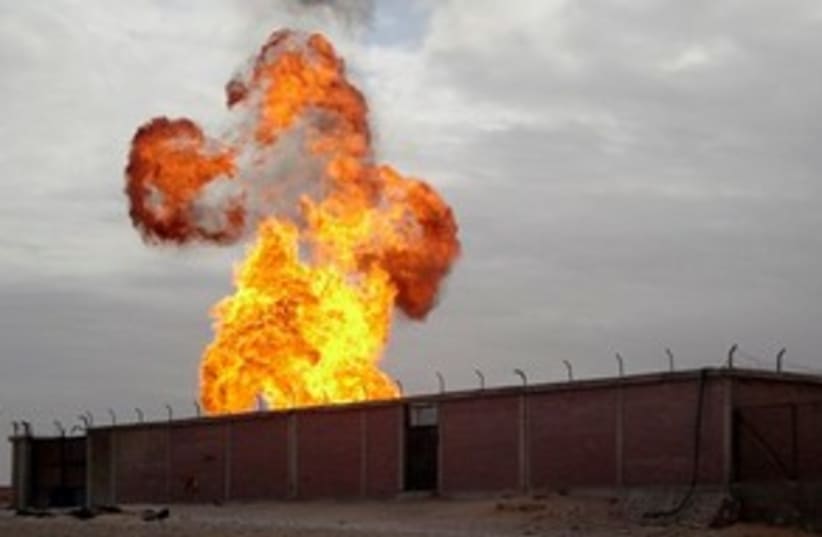
By EHUD ZION WALDOKSGas Pipeline Blast 311(photo credit: Associated Press)
The government should move immediately to secure alternatives or backups to Egyptian natural gas following the upheavals there, experts told The Jerusalem Post this week. While they were split over how the regime change in Egypt would affect the supply, they said it should be seen as a wakeup call for immediate action.Egyptian natural gas is pumped through a pipeline from El-Arish to Ashkelon. The gas is then used to turn turbines that produce 20 percent of Israel’s electricity. Another 20% of the country’s electric power is produced with natural gas from a domestic field off the coast.RELATED:Battling for Sunken Treasure Pipeline blast prompts calls to speed gas development Israel, PA may open natural gas fields off Gaza coast While one Israel-based analyst said the stoppage of Egyptian gas was merely a “technical glitch,” a Washington-based analyst opined that it could be “the beginning of the end.”Dr. Amit Mor, CEO of Ecoenergy, told the Post that the current delay was the result of missing equipment.“According to our understanding, the pipelines to Jordan and Israel should resume in a few weeks’ time. They are waiting for equipment that was ordered from abroad to arrive,” Mor said by phone from Eilat, where he is participating in the Eilat-Eilot Renewable Energy Conference.Supplies through the Egypt-Israel pipeline were suspended in early February after an explosion damaged a nearby pipeline that was not part of the system. Initial estimates that the supplies would resume by mid-February proved unfounded.Mor, who has consulted for governments and companies here and abroad, and worked for the World Bank for eight years, predicted that only a takeover by the Islamists would end the supply of natural gas from Egypt.“As long as the regime doesn’t become Islamist and anti-Israel, gas will be supplied. However, it will be subject to technical availability in Egypt,” he said.“The political risks that have existed until now will continue to exist in this project.”He added that the gas supply should resume in several weeks.However, Delphi Global Analysis Group Founder Dr. David Wurmser was far more pessimistic.“The current delays are very troubling and could be indicative of where supply is headed. I have my doubts that the gas supply will resume properly,” he told the Post by phone from Washington. Wurmser is a former senior adviser to vice president Richard Cheney and State Department official John Bolton, as well as a former intelligence officer.“The gas pipeline to Israel had already been attracting opposition from the opposition. It was attacked as a symbol of normalization. Moreover, the head of the East Mediterranean Gas Company [EMG, an Egyptian firm with Israeli stakeholders] was close to [President Hosni Mubarak’s son and heir-apparent] Gamal Mubarak. The army may even find it hard to continue supplying gas,” he assessed.“The pipeline will no doubt be revisited and reinvestigated if the delay isn’t the beginning of the end anyway, and so I think the government of Israel’s worry is entirely appropriate,” he declared.Wurmser will be addressing the National Energy Conference in Tel Aviv next week.The pipeline has had a rocky history over the past decade that included a price renegotiation following a lengthy Egyptian court battle over whether the country was selling the gas to Israel for too little.While Mor and Wurmser disagreed on the resumption of gas from Egypt, both were very clear that Israel would need to build a liquefied natural gas (LNG) terminal and floating storage regasification unit offshore.Natural gas can be supercooled until it becomes a liquid.In gaseous form it requires 600 times as much space, meaning LNG is much easier to store. However, in order to be used, it needs to be regasified.Mor said both LNG and a backup supply of fuel oil and diesel oil should be laid in.“It is important to have backup plans with an additional supply of LNG [from other countries aside from Egypt] that can be brought in tankers and regasified offshore, as well as strategic and operational reserves of fuel oil and diesel oil in times of gas shortage,” he said.Mor stressed the importance of such measures since “gas comprises 40% of electricity production today and will increase to 70% by decade’s end.”According to Wurmser, the Israeli government’s thinking was to have encouraged competition and diversified supply by pitting EMG against the developers of Tamar. The government will have to figure out a way to reintroduce competition to keep prices reasonable, he said.Currently, Israel has been receiving gas from Egypt and from the Mari-B field off Ashdod.Mari-B is set to be tapped out in 2013, but if the gas supply from Egypt does not resume, it will be tapped out much sooner, thus potentially causing a serious shortage.Therefore, Wurmser argued, development of Tamar needed to be expedited and some form of LNG secured.“The government needs to think through the vulnerabilities and immediately secure additional sources either through Noa [an undeveloped Israeli gas field] or expediting Tamar,” according to Wurmser.The government has already warned Tamar’s developers not to hold out for a better deal in light of the new uncertainty, he added.“One potential stopgap measure would be to rent a floating LNG ship, although the government would need to secure supply and very quickly sign an agreement, which is not a simple thing,” Wurmser said.Having all natural gas flow through Mari-B also posed questions of vulnerability, Wurmser said.“There could be serious electricity disruptions if there’s even a day of delays,” he said.Wurmser suggested that in the long term, the government encourage the oil and gas exploration sector and, especially, draw in foreign investment.“That might involve a strategic campaign in Washington to secure US assistance in challenging the Arab boycott,” he said. Oil and gas companies have generally chosen to work either with the Arabs or with Israel, but not both. So far, Noble Energy is the only foreign company to invest in Israeli gas exploration. Noble is a partner in the Mari-B, Tamar, and Leviathan fields.“The financing question is deeper and broader than just the Sheshinski Committee and Tamar,” Wurmser contended. “It will cost tens of billions of dollars to find and develop Israel’s potential fields, and all the fields are already 60% to 100% owned by Israeli companies. That presents a problem because Israeli companies are not universally up to raising that kind of money. The government needs more incentives to lure foreign companies to Israel.”
if(catID != 151){
var cont = `Take Israel home with the new Jerusalem Post Store