US envoy: Israel a true partner in renewable energy
American envoy tours Arava installations.
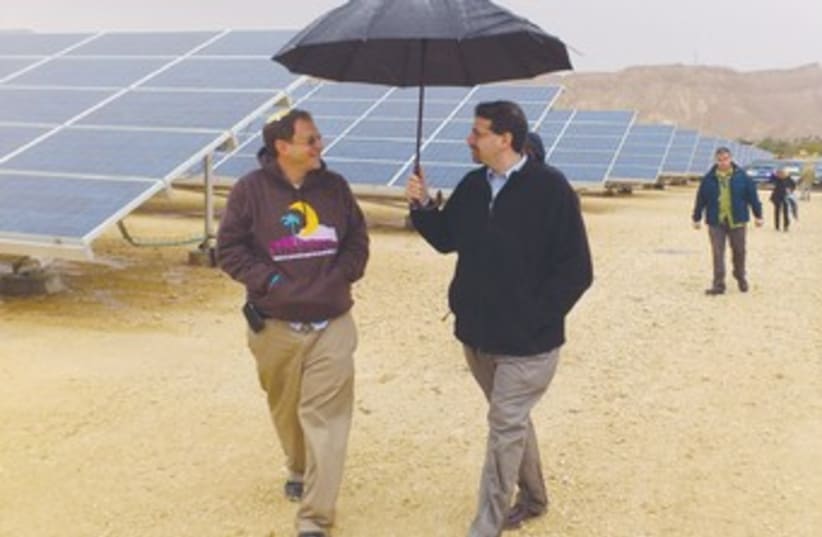
By SHARON UDASINShapiro at Arava solar field 370(photo credit: Sharon Udasin)
While forging ahead on the path to popularizing renewable energy, the United States continues to find a true partner in Israel, which is capable of exporting its innovation to countries small and large, American Ambassador Daniel Shapiro said on Thursday.“We in the US government are extremely interested in opportunities in renewable energy and environmental research, and we know that some of those exciting developments in Israel are happening here in the Arava,” he said at Kibbutz Ketura in the morning.“We are pleased that we have partners here.”Shapiro was on a visit of solar facilities in the southern Arava Desert – a day after touring agricultural achievements in the central area of the same desert, at the Yair Research Station’s Arava Agricultural Open Day.Just one week prior to Shapiro’s visit, US President Barack Obama dedicated a chunk of his inaugural speech to the environment and renewable energy. Stressing an obligation “to all posterity,” Obama committed to combating “the threat of climate change,” which he said had been visible in the devastating storms, fires and droughts that had crippled portions of the world lately.Admitting that the path to achieving sustainability would be difficult, he noted that America must lead that transition and “claim [the] promise” of developing new technologies.Although Shapiro’s visit to the Israeli renewable-energy hub had no direct correlation with the president’s speech, he emphasized the US’s ongoing commitment to developing clean technologies.“It’s definitely been a priority of President Obama’s for many years, to not lose sight of the danger of the changing climate.And that we take upon ourselves the responsibility to be responsible stewards of the environment and of the Earth,” the ambassador told The Jerusalem Post during the visit.“Both [Obama] and Secretary of State John Kerry have devoted a lot of time and attention to that issue, [Kerry] both as senator and now as secretary of state,” he added. “I think we’ll see an increasing focus on it.”Starting and ending his Thursday morning at Kibbutz Ketura, home of the country’s first medium-sized solar field, Shapiro learned about the transboundary renewable energy research taking place at the Arava Institute for Environmental Studies and met with Hevel Eilot Regional Council chairman Udi Gat.“If volunteering on Kibbutz Yahel pushed you to be a good ambassador in Israel, then we can give you the next push,” Gat told him, referring to the time the ambassador volunteered at the Arava kibbutz in 1987.While rain began to pour in the background – something that only occurs three days a year in the Arava – Gat emphasized the importance of the expansive land and usually constant sun rays that would make the region the ideal “Silicon Valley for renewable energy.”“If we will be the sun valley for renewable energy, people, especially young people, will come to live here on the kibbutzim,” he said.Guided by Avi Feldman, CEO of renewable energy financing firm Capital Nature, Shapiro then visited Yotvata, home of the emerging Israel National Center for Renewable Energy and the Shikun V’Binui solar thermal installation.“The vision here is to create a big research center, where new startup companies can work,” Feldman said.With a $30 million budget, the center will allow for cooperation with academic institutes and industry, as well as provide a home for new startups and a technology test site, he explained.Already, the center has three operating companies and one more with a pending approval, as well as four academic partners collaborating on research.By the end of 2013, Feldman said, he hopes to have eight more new ventures.Speaking about academic and industrial cooperation, he requested that Shapiro push for a change that might allow increased US-Israeli collaboration in these areas. Right now, while the Binational Industrial Research and Development (BIRD) Foundation’s energy initiative allows for academicto- academic and industrial-toindustrial cooperation between the US and Israel, no “crosscooperation” exists, he noted.“I think we could very easily elaborate the mandates of existing programs just to support that,” he said.Immediately agreeing, Shapiro said he was going to look into speaking with the BIRD Foundation leaders to see if more flexibility could exist within the program.The ambassador concluded his southern Arava visit that morning with a return to the 4.95-megawatt Ketura Sun solar field, under the guidance of Arava Power president and cofounder Yosef Abramowitz and CEO Jon Cohen.Taking shelter from the pouring rain under the solar panels, Shapiro listened as Cohen explained the detailed history of the field’s birth, as well as the upcoming large solar field across the street and the other projects in the company’s pipeline.“In the desert, there aren’t lots of drops of rain, there’s sun,” Shapiro said, laughing at the surprising weather event.He praised Arava Power Company and its leaders as being great pioneers of solar energy, bringing renewable technology to the market in an affordable way and becoming a catalyst of change.“We consider Arava Power Company an American-Israeli product,” he said. “I know that every day this field is working, generating real output.”Also during the Ketura tour, Abramowitz introduced Shapiro to Hajj Mousa Tarabin, a Beduin leader who intends to build the first Beduin community solar field. Tarabin received Public Utility Authority approval for the 8-MW field after repeated delays, but now faces another wait, as the finance minister has blocked a necessary new 300- MW quota for medium-sized fields. Arava Power will build the Tarabin field, with financial backing from the Overseas Private Investment Corporation (OPIC), a US government agency.At the lunch table in the kibbutz dining hall, Tarabin requested that Shapiro relay an invitation to Kerry to lay the foundation stone for his field.“Soon-to-be-secretary Kerry does have a strong connection to renewable energies and climate change,” Shapiro told the Post in response. “I don’t know when he’s coming to Israel, but we’ll see what’s possible when he does come.”The ambassador praised Israel as a leader in the development of new technologies, solar energy being just one example of this success.“I think that Israel stands to be a real partner in developing those technologies for its own use, but also for spreading it throughout the world, especially the developing world,” he said. “And there’s no doubt that this opens up a lot of opportunities for science and technology and business and people-to-people cooperation between our two countries.”The ambassador had particularly warm words for Abramowitz, who is now aiming to bring Israeli solar fields to developing countries.“I think David Ben-Gurion was the first captain of sunshine, and now you’ve got the second one,” Shapiro said.
Related TagsDan Shapiroarava
if(catID != 151){
var cont = `Take Israel home with the new Jerusalem Post Store