Agriculture Ministry to hold hearing with Tnuva vets
Four veterinarians will be summoned over allegations workers at the Beit She'an slaughterhouse were abusing cattle.
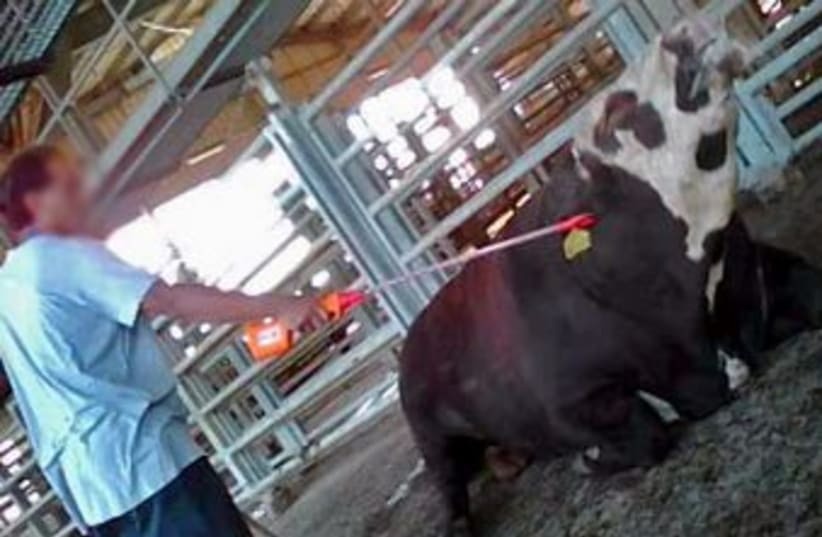
By SHARON UDASINCattle prod animal abuse cow pain scream 370(photo credit: Courtesy of 'Tnuva Cruelty')
Four veterinarians from the Tnuva Adom-Adom slaughterhouse in Beit She’an will be summoned to a hearing before the director of Veterinary Services at the Agriculture Ministry on Thursday, the ministry announced on Tuesday.Following allegations that Adom-Adom slaughterhouse workers were abusing their cattle, a criminal investigation opened on Friday by the Environmental Protection Ministry, the Agriculture Ministry and the Beit She’an Police.The allegations, first exposed by the Reshet program Kolbotek, showed and spoke of workers beating the animals, shocking them and dragging them by the legs with forklifts.As part of the ongoing investigation, Agriculture Ministry officials received a warrant from the Tiberias Magistrate’s Court to search the facility on Tuesday and confiscated items such as a shocker, sticks, ropes and straps, the ministry said.Thursday’s hearing will allow for a preliminary procedure before authorities decide whether to take action against the veterinarians, as the veterinary services director is able by law to restrict employment of veterinarians, the ministry said.In the wake of the ongoing investigation, the Agriculture Ministry said that it has also decided to increase the level of supervision and enforcement in slaughterhouses, by requiring them to install surveillance cameras. From now on, the shocker tool will only be used in extreme cases, with the approval of the supervising physician, the ministry said.The director of Veterinary Services also demanded that Adom-Adom’s head veterinarian conduct two on-site emergency briefings for the plant staff members as a condition to resumption of slaughter – which took place last Friday and Sunday.“Veterinary Services at the Agriculture Ministry is shocked by the details uncovered by the Kolbotek investigation,” said Dr. Nadav Galon, director of Veterinary Services. “Immediately after the program, the very next morning, the ministry launched a number of actions to eradicate the grave phenomenon exposed, such as plant emergency briefings and instructions not to use the electric shocker, except in extreme cases and only then with the supervision and instruction of the slaughterhouse head doctor.Veterinary Services at the Agriculture Ministry is working tirelessly to prevent the recurrence of such events in the future.”
if(catID != 151){
var cont = `Take Israel home with the new Jerusalem Post Store