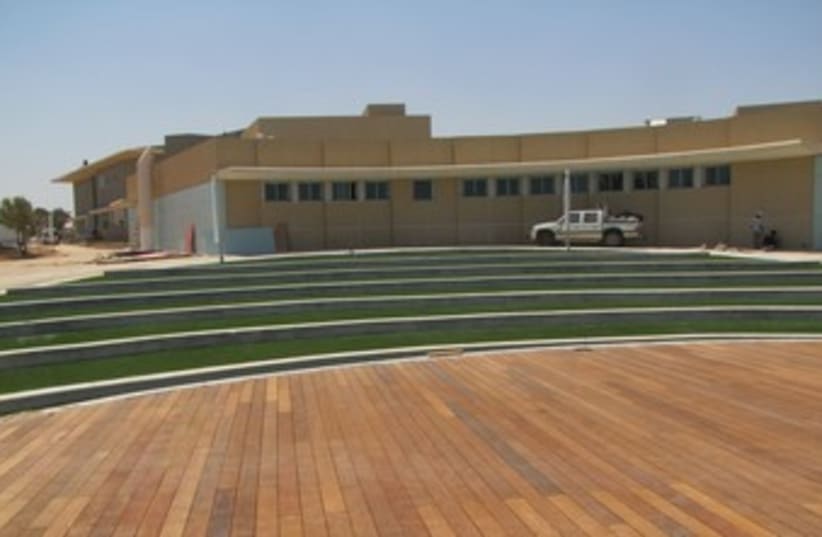
Grounds include synagogue, science center, archeological park, concert stage – and 28 shelters.
By SHARON UDASINSha’ar Hanegev high school 370(photo credit: Michal Shaban Kotzer)
High school students who have learned to deal regularly with rockets from Gaza landing nearby will open the school year this September with a brand new, fortified campus.The school, officially named Yitzhak Shavit Sha’ar Hanegev School, was dedicated on Tuesday night in the presence of Education Minister Gideon Sa’ar, school principal Aharale Rotstein and regional council head Alon Schuster.Dozens of rockets have exploded on the former, 50-year-old Sha’ar Hanegev School campus to this day.Planning began for a new, protected school – to serve the region’s 1,200 high school students – following both a High Court and government decision four years ago, according to the council. Construction of the sprawling, six-hectare campus began two years ago.“I think that building a new school in Sha’ar Hanegev is progress in a fundamentally important issue,” Schuster told The Jerusalem Post on Wednesday. “There is no need to explain why education and in our case the safety of the kids is so crucial for every human being.The school provides us with security and provides a opportunity to give a much better structure – physical and pedagogical – for education in our area.”The NIS 105 million project, of which about NIS 60 million was provided through the Education Ministry, included substantial funding outside Israel from World ORT, San Diego Jewish Federation, Legacy Fund of New York, Jewish Federations of North America and the Jewish National Fund – Australia.From inside Israel, additional financing came from the Israel National Lottery, Antiquities Authority, Regional Development Ministry, the Settlements Division and the Jewish Agency. The school’s namesake, Shavit, was the leader of both the Jewish Agency and Jewish Federations of North America, and a devotee to Negev development who died prematurely in early 2011.In the heart of the campus – which the regional council describes as “unique, technological, fortified educational institution, the first of its kind in the country” – is a synagogue/Jewish center financed by the Legacy fund, an art center provided by San Diego Federation and a science and technology center, as well as a mechanics workshop, funded by World ORT. The campus also includes an archeological park, concert stage, 28 shelters and classrooms, all of which compose a “green and nurtured environment,” according to the council.The planning and building process occurred under the joint auspices of Yuval Geni Architects, Ltd., Mansfeld-Kehat Architects and Israel Prize winner for architecture Dan Zur.The science and technology center of the school, funded by World ORT’s KadimaMada branch, aims to enable cutting-edge experience in advanced areas of science and technology, while the professional training center – called the “mechatronic” – will enable vocational training. The KadimaMada projects collectively amounted to an investment of over $1 million, with about another $1.5 million contributed to additional projects around the campus, according to World ORT.In order to encourage people to stay in the area, the institution “should be a school of excellence,” Robert Singer, director-general of World ORT, told the Post.“What keeps people in the area is if the parents have jobs and the kids have an education that they can’t receive in any other place,” he said.KadimaMada is active in 64 countries and serves over 300,000 students annually, with a goal of promoting science education by equipping students with advanced technology, as well as strengthening ties between Israel and the Diaspora, according to the organization. In the past few years, the group has invested approximately NIS 100 million in projects throughout Israel, the organization added.Parents may now think twice before leaving the area, because their children would lose an enormous educational opportunity, fostered by partnerships between the government, the local community and the Diaspora, Singer explained.As part of KadimaMada’s science and technology revamp, the organization is also providing upgraded science labs as well as equipping about 40 percent of the classrooms with smart-board systems, he said.Thinking about the students on the old campus, who just last week had their bagrut (matriculation) exams interrupted by rocket alarms, Singer said, “These kids are the heroes of Israel these days.”Two years of planning and seminars went into the design of the complex, before building even began, with a “first you think and then you do” tactic, according to Schuster.The school will not only be an educational institution, but also a “communal center,” and will include a synagogue and Jewish center to teach the young generation about Jewish history, he said.Meanwhile, the students will also have access to a greenhouse, agricultural fields and environmental projects relevant to the Shikma Valley, where the school is situated, he added.By securing the school, the region’s residents are able to show their neighbors in Gaza that “[they] are not going anywhere, [they] are here to stay,” and have influential partners around the world to support them, Schuster said. The mayor stressed that in the past 11 years, as rockets have rained down on the region, the population there has actually doubled.“We are going to stay and come back to a stage where you start to talk with us business, financial issues, stop shooting and start looking toward a joint future,” he added.“Our resilience is fundamentally important to our ability to stay and live here – and not just technically live here but live with joy and feeling we are doing the right thing.”
if(catID != 151){
var cont = `Take Israel home with the new Jerusalem Post Store