Population has thus far largely been excluded from partaking in the industry due to land disputes.
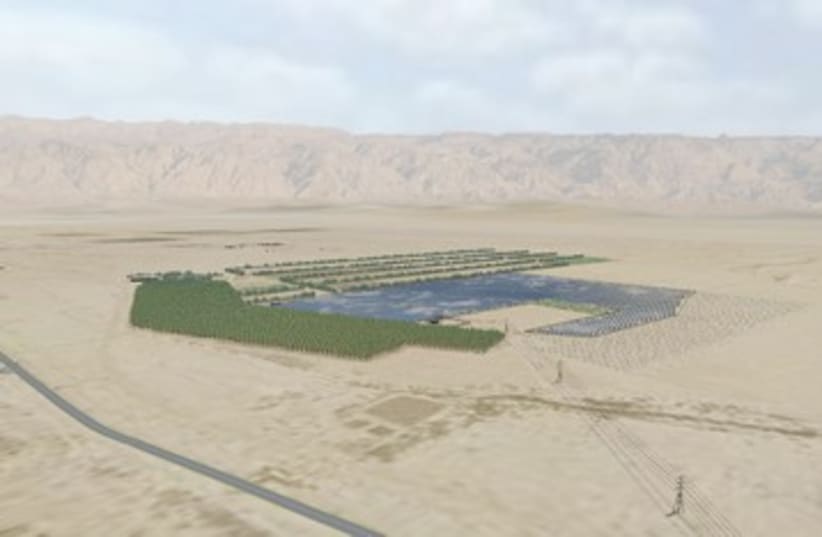
By SHARON UDASINSolar fields 390(photo credit: Arava Power Company)
A bill launched in the Knesset on Monday calls for the government to set aside special solar energy allocations for the Negev Beduin, who thus far have largely been excluded from partaking in the industry due to land disputes.The goals of the bill, sponsored by MKs Einat Wilf (Independence) and Ghaleb Majadele (Labor), include eliminating discrimination against the Beduin population in government policy, encouraging the Beduin to compromise with the government on their land ownership claims and promoting entrepreneurship and economic growth and development in the population.The bill also aims to reduce the unemployment rate in the Beduin sector as well as promote their inclusion in the “Negev solar revolution,” according to the bill’s text.“It’s a great bill because I believe that we really need to begin to think positively about how we can create modern working opportunities for the Beduin,” Wilf told The Jerusalem Post on Monday night. “This is just a classic fit.They live by and large in the Negev, this is where we need to build the future solar field and we are also tying it to incentives to settle various land disputes with the state.”In addition to Wilf and Majadele, official supporters of the bill include: Labor MKs Eitan Cabel, Amir Peretz, Binyamin Ben-Eliezer, Avishay Braverman, Daniel Ben-Simon and Isaac Herzog; Meretz MKs Zehava Gal-On, Ilan Gilon and Nitzan Horowitz; Kadima MKs Akram Hasson and Shloma Molla; United Arab List-Ta’al MKs Masud Gnaim, Ibrahim Sarsour, Ahmed Tibi and Taleb a-Sanaa; Hadash MKs Afo Agbaria and Muhammad Barakei; Balad MKs Said Nafa and Jamal Zahalka; and Independence MK Shakib Shanan.If passed, the bill would require the Public Utility Authority (PUA) to allocate a quota specifically designated for the construction of solar facilities on Beduin lands – lands that have been legally agreed upon in a compromise between the government and the Beduin landowner, according to the text of the bill. The quota should amount to no less than 10 percent – or 30 megawatts – of the current medium-sized field solar cap, the same amount designated to Judea and Samaria, the bill says. Meanwhile, the Energy and Water Minister would be responsible for overseeing the implementation of the bill.The Israeli government clearly aims to promote the production of renewable energy, as per a series of government decisions that have already occurred on the matter, the bill’s explanation section reads. However, due to preconditions that the PUA legitimately places – which call for applicants to prove their connection to the real estate on which they intend to build – the Beduin population has largely been unable to procure generation licenses, the text continues.The conflict over land status between the state and the Beduin is ongoing, yet all the while – as many Negev agricultural owners have jumped at the chance to take advantage of the new economic opportunities afforded by solar energy – the Beduin for the most part have not been able to, the bill says.Government Decision no. 3707, adopted on September 11, 2011, indicated that the government would implement a five-year plan to promote economic growth and development of the Negev Beduin between the years 2012 and 2016, to strengthen their living conditions and economic situation, the bill continues. The new bill, according to its text, would certainly be in line with these aims.While providing employment and entrepreneurship opportunities to the Negev Beduin, the solar industry would also provide a great incentive for those members of the population still hesitant or holding off on settling their land claims, Wilf told the Post.“I think it’s a really good combination with a cause that the state supports,” she said. “The state right now is very interested in high quality employment among the Arab and Beduin minority.”“It’s a really good idea to bring together several important objectives,” Wilf said.Before being able to use portions of the solar quota that the bill would allocate to them, the Beduin entrepreneurs would be obliged to settle their land disputes according to the rules already established on the subject.“It’s not just about handouts, it’s about rewarding a behavior that is constructive,” Wilf added.While she doubts that there will be too many objections to the bill, Wilf acknowledged that she has been “surprised before,” but she hopes that the bill’s supporters will get it completely settled before the Knesset recess so that it can be read during the next session.Two cabinet members from her party, Agriculture Minister Orit Noked and Industry, Trade and Labor Minister Shalom Simhon, also have expressed support for the bill and will help fight for its passage, according to Wilf.The first and only Beduin solar field project, an 8- megawatt plot in the Abu Basma region, was approved for a PUA license after much delay in February. The $30 million field, on land owned by Haj Musa Tarabin, will be developed by Arava Power Company, the firm responsible for opening the country’s first medium-sized solar field at Kibbutz Ketura last June.However, due to the unusual delays that the Tarabin field faced in receiving approval, its license arrived after the medium-sized field solar caps were already maxed out – so it can only be built at the moment with a separate quota, or if other approved projects drop out, according to Arava Power.“MKs Wilf and Majadele, along with their co-sponsors, deserve praise for correcting the injustice in solar policy that has kept the Beduin from participating in Israel’s solar revolution,” Arava Power president Yosef Abramowitz told the Post. “No Beduin applications for solar licenses within the existing limited caps can build solar fields.These are the Beduin who have made their peace and compromise with the state on land, yet they are still denied equal access to solar benefits.”Abramowitz continued: “All who want Israel to go green and who care about social justice should support this bill.”
if(catID != 151){
var cont = `Take Israel home with the new Jerusalem Post Store