Project aims to save Dead Sea from environmental degradation; Public can submit comments on plan through March 15.
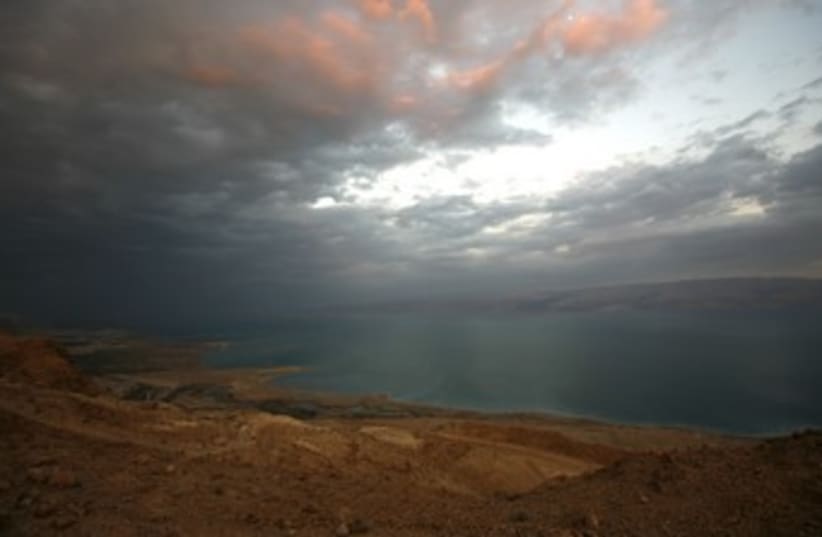
By SHARON UDASINThe Dead Sea 370(photo credit: Ronen Zvulun / Reuters)
A World Bank public hearing in Jerusalem about the Red Sea-Dead Sea conduit project was filled to capacity on Tuesday, with hundreds crowded into a conference room and sparring over the proposed 180-kilometer pipeline.The project’s objectives, as seen by the World Bank, are saving the Dead Sea from environmental degradation, increasing affordable desalination and hydro-power, and building peace among the three participating governments – Israel, the Palestinian Authority and Jordan.In mid-January, the World Bank released three detailed reports regarding this proposed conveyance of water – a feasibility study, an environmental and social assessment, and a study of strategic alternatives, drafted by different external authors.While Regional Cooperation Minister Silvan Shalom has repeatedly lauded the idea of the Red-Dead conduit, Israel’s green groups and the Environmental Protection Ministry have slammed the plan in its current form as destructive to the Dead Sea.In the Red-Dead conception and planning process, the World Bank serves as a neutral party and facilitator of funding, but it will not be providing any project financing itself, Alexander McPhail, head of the World Bank study program, explained on Tuesday.Addressing the public at Jerusalem’s Mishkenot Sha’ananim, McPhail presented an overview of the reports, beginning with the feasibility study, on the effect of an annual conveyance of 2 billion cubic meters per year of water from Aqaba to the Dead Sea. Along the all-Jordanian route would be a desalination plant, as well as two hydro-power stations.The project would be feasible from an engineering and economic perspective, but there would be a large net consumption of energy, McPhail explained.The feasibility study determined that the project would not hurt the Gulf of Aqaba’s coral reefs. As seawater and brine would mix into the Dead Sea, unsightly gypsum would only likely form when water entrance reached levels of 600 million-700 million cu.m. per year, McPhail said.Presenting the environmental and social assessment, McPhail pointed out certain environmental risks had been identified, but that most of these adverse effects could be mitigated “by readily available and proven methods and technologies.”Looking at the study of alternatives, McPhail presented its three most viable options – the first two being the Red-Dead project and a Mediterranean Sea to Dead Sea transfer of water, respectively. The third option is a combination of techniques, including desalination at Aqaba and at the Mediterranean shore, importation of water from Turkey, and water recycling and conservation.While this was a flexible approach that could respond to technological advances and might not require upfront investment or big sea-to-sea infrastructure, it would likely take 30 to 40 years to implement, McPhail explained.This alternative is favored by both Friends of the Earth Middle East and Adam Teva V’Din (Israel Union for Environmental Defense), environmental groups that have expressed severe criticism of the Red-Dead Sea conduit project.An official from the Water Authority said, however, that this combination option “is not a comprehensive alternative.”Only the Red and Mediterranean sea conveyance options were viable choices, explained Doron Markel, head of Lake Kinneret monitoring and management at the Water Authority, and a member of Israel’s Red-Dead steering committee.Dissecting the combination alternative, Markel said that only a minuscule amount of the desalinated Mediterranean water would end up in the Dead Sea, while the desalination in Aqaba would require the disposal of brine into the Red Sea. In addition, the supply of water from Turkey “would oblige us to rely on the goodwill of the third party,” he noted.While Markel favored implementing a small pilot program, environmental groups argued that this would serve little purpose, because if more than 400 million cu.m. of seawater were to flow into the Dead Sea, the environmental risks would change dramatically.“It’s basically all or nothing,” Friends of the Earth Israeli Director Gidon Bromberg said.The project would also be financially difficult, requiring an international gift of up to $4.5 billion as well as a $2.6b. loan for Jordan, Bromberg said.“The international community is not going to provide the money unless a treaty [in which Israel recognizes the PA as an equal when it comes to natural resources] is signed,” he said.“We need to bring this out into the open, because we want to be realistic. We want to stabilize the Dead Sea, we want to bring water, and we want peace.”While the authors of the environment and social assessment said the project could be implemented without great impact, Sarit Caspi, a water expert at Adam Teva V’Din, disagreed.“We are drastically changing the mineral composition of the Dead Sea,” Caspi said.“In effect, we would be killing the Dead Sea and there would be a different body of water composed of evaporated sea water where the Dead Sea once stood.”Agreeing with the Friends of the Earth experts, Adam Teva V’Din professionals deemed cost-benefit analyses generated thus far as inaccurate.For example, the money generated by tourism may not be what the planners expect, particularly after the Dead Sea’s mineral composition were changed, the organization said.For Jordan, however, going forward with some sort of reliable water project is critical, as the country lacks natural water supplies and is becoming increasingly thirsty, explained Saad Abu Hammour, secretary-general of the Jordan Valley Authority and chairman of Jordan’s Red-Dead steering committee.“We in Jordan are very much interested in having this project in place,” he said.In a move not directly related to this project, Jordan is planning a small desalination plant in Aqaba, Hammour said.As Jordan has a large budget deficit, Hammour suggested beginning with a smaller version of the Red-Dead conveyance project, until international financing could be secured. In any case, moving ahead in some way is vital to Jordan’s future, particularly since more than 1 million Syrians had moved to the eastern portion of Jordan, he said.“They are living in camps, but they are consuming a lot of water,” Hammour added.“They will put a lot of pressure on our water resources.”Whatever the region’s three governments decide regarding the Red-Dead plan, McPhail explained, there would still be two critical project elements whose outcomes were still unknown.“We’re not sure if we can raise the money. The economic condition of the world is a lot different from when we did the studies,” he said.“Also, we are not sure what will happen when you get above 400 million cu.m. of sea water or brine into the Dead Sea.”Regarding the path toward peace, however, McPhail said that thus far the World Bank had found that “at the technical level the cooperation between the three governments has become exceptionally good.”Members of the public can continue to submit their comments online, in English, Hebrew or Arabic, on the World Bank project website through March 15, McPhail said.“The three governments have not decided and we are not involved in the decision-making,” he continued. “The space for debate and discussion remains open.”
Related TagsRed Sea
if(catID != 151){
var cont = `Take Israel home with the new Jerusalem Post Store