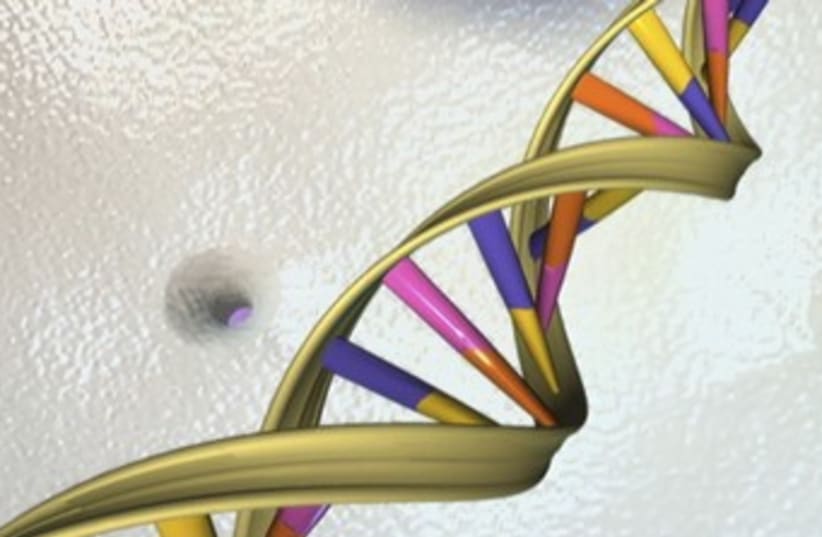
Prof. Ostrer publishes new book that explores the genetic, environmental basis of the Jewish people.
By JUDY SIEGEL-ITZKOVICHDNA(photo credit: REUTERS)
As Diaspora Jews increasingly assimilate and intermarry with gentiles, and their Israeli counterparts marry Jews whose forebears came from the four corners of the earth, a window of opportunity to study Jewish genetics is gradually closing.In another generation or two, it may be possible only to know whether one bears a “Jewish genome” rather than identify the different genetic threads that once bound them together.For more than 100 years, both Jews and non-Jews have been trying to find out whether Jews are a religious group, a people or even a race. Some were motivated to use this information as a basis for discrimination or even murder, others to boast about supposed superior intellectual abilities and a disproportionately large number of Nobel Prize laureates.Jews with a family history of chronic or genetic diseases wanted to know if they were likely to contract them or pass them on to their children and grandchildren. The higher prevalence of Tay-Sachs, Gaucher and Canavan’s disease among Jews is well known, but some experts claim certain psychiatric, metabolic and oncological diseases are also more common among them.Now, Prof. Harry Ostrer has produced a 264-page, English-language volume melding together science, history and biography to better understand the complex subject. Titled Legacy: A Genetic History of the Jewish People, the $25 hardcover book was published by Oxford University Press.A Jewish medical geneticist at Yeshiva University’s Albert Einstein College of Medicine, Ostrer is also director of genetic and genomic laboratories at Montefiore Medical Center in New York. Almost two years ago, he was named to the Forward 50 list of “people who have made an imprint in the past year on the ways in which American Jews view the world and relate to each other.”A physics graduate of the Massachusetts Institute of Technology who received his MD from Columbia University College of Physicians and Surgeons, Ostrer trained in pediatrics and medical genetics at Johns Hopkins University and molecular genetics at the US National Institutes of Health.Before joining Einstein, he spent 21 years as professor of pediatrics, pathology and medicine and director of the human genetics program at New York University’s School of Medicine.While he has spent much of his career investigating the genetic basis for a variety of rare diseases from color vision deficiencies and thalassemia to sex development disorders – even going to the Far East to test Cambodian and Thai citizens for mutations that disrupt their blood – Ostrer has put a special emphasis on population genetics among Diaspora Jews, collaborating and competing with research groups in Israeli centers and others abroad.He co-established with Israeli-born Einstein researcher Dr. Gil Atzmon the Jewish HapMap Project on genomes of contemporary Jewish Diaspora groups (Hap refers to haplotype – a group of genes inherited together by an organism from a single parent).The book is divided into six large chapters – “Looking Jewish,” “Founders,” “Three Genealogies,” “Tribes,” “Traits and Identity” – plus 277 references. In the first chapter, he describes the work a century ago of Dr. Maurice Fishberg, a young Russian-Jewish immigrant physician in New York City, who “grappled with the issues of Jewish origins, identity and traits” in a series of articles that he made into a book: The Jews: A Study of Race and Environment.A one-time coal miner, the physician became chief medical examiner of new immigrants for United Hebrew Charities and then a physical anthropologist who confronted American supporters of restricting immigration who claimed the Jews brought in communicable diseases, especially tuberculosis. But his maps proved that the prevalence of TB was significantly lower in the lower Manhattan districts where Jewish immigrants congregated than in all other districts, apparently due to their better hygiene and eating habits due to kashrut.But he also found that “mental retardation, mental diseases...called hysteria and neurasthenia,” diabetes and “amaurotic family idiocy,” now known as Tay-Sachs disease, were more common among Jews, leading him to wonder about their heredity. Fishberg decided to become a physical anthropologist to measure and compare physical shapes such as head shape (using calipers) and pigmentation to scientifically determine “racial characteristics.”Researchers after him postulated that humans originated in Africa, and that over the millennia, their migration out of the continent led to genetic differentiation in which those with lighter skin, hair and eyes were more likely to survive in cooler climates and passed on their genes to produce new races.“Viewed in the context of Jewish history,” Ostrer wrote, “the genetic makeup of contemporary Jewish populations has been influenced by the geographic origins of a relatively small number of founders... Following the destruction of the Jewish kingdoms more than 2,000 years ago, the Jews became a migratory people who established communities throughout the world. Some of these communities retained their continuity over long periods of time.“Within those communities, Jews were linked by religion, customs, marriage and language. The designation ‘Jewish’ was limited by Jewish law to those whose mothers were Jewish. Entry [into] the community was possible through religious conversion, but this was not common. Jewish identity was maintained within these communities up to the present day.”Ostrer noted that Jews today can be designated according to where their forebears lived for many centuries as “Middle Eastern” (Mizrahi); Sephardi (originating in Spain and Portugal until the end of the 15th century); Ashkenazim, who moved from Italy and crossed the Alps and settled in the Rhineland and then other places in Europe; and North African Jews, who lived along the coast for over two millennia after being exiled after the destruction of the two Temples, mixed with surrounding populations.All this shaped the face of world Jewry.DR. CHAIM SHEBA, the pioneering Israeli geneticist who was surgeon-general of the Israel Defense Forces and Health Ministry director-general (after whom Sheba Medical Center at Tel Hashomer was named) is lauded in the book for his work to determine whether Jews constituted a single homogeneous group or a series of genetically related groups.He found that eating ful (fava beans) and certain anti-malaria medications can cause terrible anemias in certain people due to G6PD deficiency caused by genes that are found in certain non-Ashkenazi Jews, Greeks and African Americans. This led to Sheba becoming “the original force behind the concept of ‘Jewish genetic disease.’” The work of the past four decades has provided a basis for Sheba’s observations that “Jews from different Diaspora groups had different disease susceptibilities.” Other researchers identified the higher rate of Neimann-Pick, Canavan’s and Gaucher’s diseases among Jews of specific origins.Ostrer explained that in recent years, a method known as “coalescence,” that estimates when a mutation occurred in populations based on the observation that DNA is inherited in “blocks.” If people who have the same mutation share a large block, the mutation arose from a recent founder, but if the block is short, the founder lived long time ago. Thus this technique is similar to carbon dating for archeology.The author discusses the two breast/ovarian cancer mutations, BRCA1 and BRCA2, which do not cause most cases but are likelier in Ashkenazi Jews. He mentions that Rosalind Franklin, a young Orthodox Jewish scientist, discovered the structure of DNA with Watson and Crick in 1953, but unlike them, did not live to receive the Nobel Prize they did because she died at 37 of ovarian cancer caused by the mutant gene.Also mentioned is the University of Washington’s superb geneticist Prof. Mary-Claire King, who studies the genetics and interaction of genetics and environmental influences on human conditions such and is known for three major achievements – identifying the BRCA1 mutation, showing that humans and chimpanzees are 99 percent genetically identical; and applying genomic sequencing to identify victims of human rights abuses. King is a frequent visitor to Israel and collaborates regularly with Israeli scientists, including Sha’are Zedek Medical Center’s chief of medical genetics, Prof. Ephrat Levy-Lahad (whose work is also mentioned in the volume).The genetic link between members of the Jewish priestly tribe (Kohanim) through their paternally inherited Y chromosome, proven by geneticists Michael Hammer, Luca Cavalli-Sforza, Rambam Medical Center and Technion Prof. Karl Skorecki and others is described in detail as well.Ostrer said that his Jewish HapMap Project in New York City has so far shown “in exquisite detail what had been conjectured for a century. Jewish populations from the major Jewish Diaspora groups – Ashkenazi, Sephardic and Mizrahi – form a distinctive population cluster that is closely related to Semitic and European populations. Within this larger Jewish cluster, each of the Jewish populations formed its own subcluster.”A high degree of mixing of Ashkenazi, Sephardi, Italian and Syrian Jews caused them to become more closely related to each other than they were to Middle Eastern, Iraqi and Iranian Jews. This genetic split seemed to have occurred about 2,500 years ago.The author uses his observations to refute theories that Ashkenazi Jews are descendants of converted Khazars, a semi-nomadic people living in medieval Eurasia who welcomed Jews to their midst. He also reports that in addition to southern Europeans, the closest genetic neighbors to most Jewish groups were the Palestinians, Israeli Beduin and Druse. “The genetic clusters formed by each of these non-Jewish Middle Eastern groups reflects their own histories of marrying within the group,” he said.The issue of “Jewish intelligence” that seems to come up every time members of the “Chosen People” are awarded Nobel Prizes continues to be debated. There are those who contend there is a genetic basis for IQ and those who claim it comes from studiousness, from Torah learning and from the fact that Jews were held back by discrimination from joining the top ranks of the arts and sciences but rushed in after emancipation.“Breeding, selection and education may all have contributed to Jewish intellectual accomplishment, but so, too, did being in the right place at the right time,” and showing that they were worthy of emancipation by excelling.The belief that Jews constitute a religious, rather than ethnic or racial group in the US and other Western countries is widespread.“Jewish” was never a category for race in the US Census, Ostrer notes, even though genetic studies “would seem to refute this...Jewishness at a genetic level can be characterized as a tapestry with the threads represented as shared segments of DNA and no single thread required for composition of the tapestry,” he writes.Genetic analysis of Jews have high stakes, since being Jewish not only decides who belongs to the family and can take part in Jewish life and earn Israeli citizenship but also “touches on the heart of Zionist claims for a Jewish homeland in Israel.”Ostrer concludes his fascinating book by saying that much about Jewish genetics remains unknown but will probably be discovered in the next few decades as more is learned about susceptibility to diseases, origins and genetics of positive traits.“With Jews and non-Jews alike wanting to know about their origins, ancestors and relatives, it will take its place in the formation of group identity alongside shared spirituality, shared social values and a shared cultural legacy.”
if(catID != 151){
var cont = `Take Israel home with the new Jerusalem Post Store