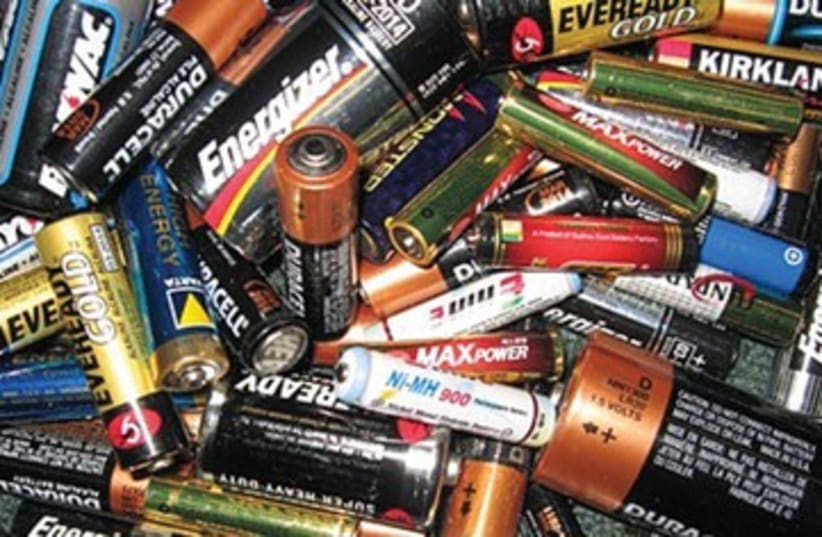
Legislation will require retailers to accept old electronics devices, recycle used batteries.
By SHARON UDASINbatteries 390(photo credit: Illustrative photo/Recycling Supply)
The cabinet on Sunday approved government support for a bill proposed by the Environmental Protection Ministry that would require producers of electronics and batteries to finance their eventual disposal and waste treatment.The “e-waste” bill was initiated by Adam Teva V’Din – Israel Union for Environmental Defense, and has been promoted by both the Environmental Protection Ministry and MK Nitzan Horowitz (Meretz).By placing responsibility for proper disposal of the electronic goods on their manufacturers, the government can reduce both health and environmental hazards, the Environment Ministry said.If approved by the Knesset, the bill would require that manufacturers and importers of electric goods recycle 50 percent of the total weight of electronic equipment they sell annually, and that manufacturers and importers of batteries recycle 25 to 35%, depending on the type of battery sold.Businesses that sell electronics would be required to accept old devices without additional payment when a consumer is buying a new device of the same kind, and stores that sell batteries would be required to have battery disposal bins.By 2020, sending electronic equipment that has not been recycled or reused to landfills would be illegal, according to the bill.“In modern times there is a huge increase in the replacement purchasing of electronic products,” Environmental Protection Minister Gilad Erdan said. “Televisions, refrigerators or computers are discarded, hurting our health and environment.The bill will regulate for the first time the treatment mechanisms for waste generated by electronics and will require manufacturers and importers of products to finance these treatment mechanisms.”The bill would also encourage the reuse of electronic equipment and is another step by the ministry’s to deal with solid waste, which of late have included implementing a Packaging Law and arranging separation of waste at source in private homes, according to the ministry. Every year, billions of electrical products are manufactured and only a small minority are recycled and refurbished, the ministry reported.In 2010, the ministry estimated that the annual electronic waste in Israel weighed about 85,000 tons.Adam Teva V’Din executive director Amit Bracha praised Erdan and Horowitz for getting the legislation off the ground.“This is the launch of a dramatic bill that is part of the recycling revolution promoted by Minister Erdan, which will transform the environmental nuisance of piles of electronic waste into an economic resource, strengthen the recycling industry and provide employment opportunities,” Bracha said.
if(catID != 151){
var cont = `Take Israel home with the new Jerusalem Post Store