Green energy entrepreneurs meet with Indian government delegation to form economic partnerships.
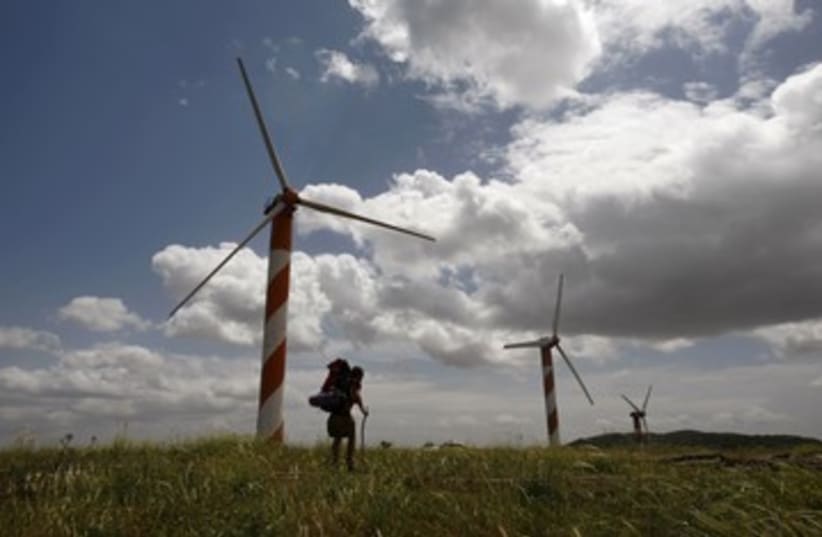
By SHARON UDASINHiker walks past wind turbines in the Golan Heights_390(photo credit: Ronen Zvulun/Reuters)
With its wide expanses of open space and ever-increasing energy needs, India would be an ideal place for Israeli renewable energy innovators to take their business, experts from both sides of the equation agreed on Tuesday.Representatives from both the Indian and Israeli governments, as well as leaders from around 50 Israeli renewable energy companies, gathered on Tuesday morning in Tel Aviv to discuss such opportunities – which seem to be plentiful. India is an enormous country where 400 million people still lack access to electricity, and despite already relying on renewable sources for 6 percent of its 200-gigawatt power supply, the country still depends on oil for the vast majority of its energy needs, according to Ashwani Kumar, a solar energy scientist at the New and Renewable Energy Ministry of India.“Israel is a start-up nation, and both the people and the country are known for innovation,” said Vani Rao, charge d’affaires at the Indian Embassy in Tel Aviv. “India has put energy security on the top of its agenda.”To this effect, Gireesh Pradhan, secretary of India’s New and Renewable Energy Ministry, was visiting Israel on Monday and Tuesday with a delegation from his office to examine cooperation opportunities between the two countries. A portion of that visit included meeting with a roundtable of Israeli industry leaders on Tuesday morning.“As we complete 20 years as an embassy, we are thinking of what we can do together [with the Israeli government] in the future,” Rao said. “One of the areas we have identified is renewable energy.”Pradhan, who is on his first visit to Israel, said he was very pleased to see the large turnout of Israeli renewable entrepreneurs and business leaders, and that the numbers nothing less than “overwhelmed” him.“I frankly did not expect the kind of interest that I see around this table,” he said.Forging partnerships with energy innovators such as those in Israel is crucial, as nearly 40% of the Indian population does not have access to electricity, Pradhan stressed.“India is a very vast country and like all vast countries has very vast problems,” he said.“Energy is one of the most crucial issues, which we feel could do wonders for us but could also act as the biggest holdback.”As the situation has become critical, the ministry – the only renewable energy ministry in the entire world – is eager “to provide energy access to our population at the earliest,” Pradhan added.To accomplish this in the short and medium term, renewable energy methods will be key, according to Pradhan.Of India’s already existing 25.857 gigawatts of installed renewable energy, 17.967 are from wind, 3.412 are from biomass, 3.434 of small hydroelectric and only 1.044 from solar sources, Kumar told the Israelis. While solar is relatively new in India, Kumar said that he believes it will become increasingly important as per the ministry’s future renewable energy plans. The ministry estimates a potential for 30 to 50 megawatts per square kilometer worth of solar energy in India, amounting to a projected total capacity of 10 gigawatts by 2017 and 20 gigawatts by 2022.Increasing the presence of solar facilities, as well as biomass, hydroelectric and wind structures, will help the ministry achieve its target of grid parity – when alternative energy sources can be purchased for similar prices to conventional ones – by 2022, according to Kumar. In order to accomplish this, the Indian government is issuing a number of subsidies, such as those for off-grid solar development in rural communities, and is also reducing custom fees, nixing excise duties and providing tax exemptions for imported machinery associated with initial solar power station setup, Kumar explained.Within the next five years, the ministry aims to install another 30 gigawatts worth of renewable energy total – primarily through private sources, Pradhan explained.“The important difference in India between conventional and renewable power is that for conventional power the lead is the government or the public sector, and for renewables it is the private sector,” Pradhan said. “In that context we look to partnering with countries such as Israel.”In India, there are bounds of land that could be put to no use other than building solar fields, as well as a vast array of other renewable energy opportunities, and Pradhan said he believes that Israeli technology and ideas should be employed in consonance with this advantage.“Israel has the ability to innovate under very trying circumstances,” Pradhan said. “The constraints that your country has faced and the ability to deal with these constraints and produce out-of-the-box solutions are well known.”Yifat Inbar, manager of the India-China desk and director of the Foreign Trade Administration at the Industry, Trade and Labor Ministry, assured the business people and entrepreneurs sitting around the table that her ministry was there to help them take up such opportunities.Her office, she explained, would be helping forge dialogues, ease access the Indian market, get in touch with local players and generally “facilitate that connection which we know is very difficult to make.”Placing a great value on Israel and India’s trade that continues to improve and flourish, Inbar attributed Israel’s ability to largely evade the world financial crisis in part to its success in trading with Asian countries such as India. Currently, the two governments are in the process of negotiating an agreement to reduce customs levels between the two nations in order to bring about free trade, she said.Innovators and business people from all sides of the renewable energy industry presented themselves to the Indian delegation, eager to create partnerships and bring their technologies to the subcontinent.Representatives attended from defense company Rafael, which is developing technology for fuel substitutes; energy storage startup EnStorage; photovoltaic field developer Arava Power Company; solar-thermal firms Ener-T Global and HelioFocus; solar panel enhancer Solar Edge; and from all corners of the solar, wind, biomass and capital investment industries.“India is a very important country for renewable energy market. We are actively pursuing opportunities there,” Dr. Daniel Farb, CEO and founder of Leviathan Energy – for wind and hydroelectric power – told The Jerusalem Post.Ultimately, both sides expressed enthusiasm about the partnerships they anticipated would result from the roundtable and the visit, the highest-level renewable delegation ever to come to Israel from India.“Energy is the flavor of the month,” said Anat Bernstein- Reich, vice president of the Israel-Asia Chamber of Commerce and president of the Israel-India Friendship Association. “Israel has the need and developed the solutions. India has the need and we don’t want you to develop your own solutions.”
Related Tagsarava
if(catID != 151){
var cont = `Take Israel home with the new Jerusalem Post Store