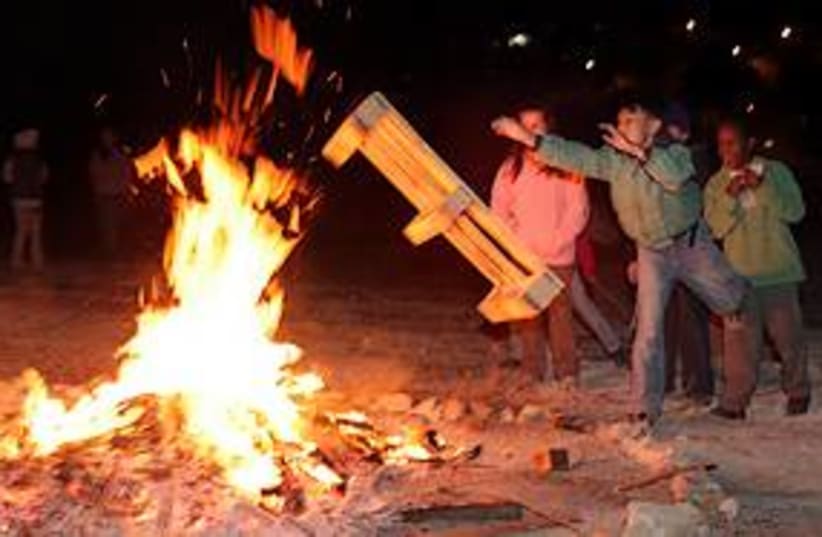
Israel Nature and Parks Authority warns against kindling large bonfires close to open spaces and beaches.
By SHARON UDASINlag baomer 311(photo credit: Ariel Jerozolimski)
The Israel Nature and Parks Authority (INPA) has requested that those participating in Lag Ba’omer festivities avoid kindling large bonfires close to open spaces and beaches, warning that the environmental damage caused by the thousands of holiday fires is not limited to air pollution alone.Masses of fires will overtake Israel on Wednesday night, and fire trucks as well as Magen David Adom crews will be on standby to handle out-of-control fires and human burns, according to the INPA.Meanwhile, park inspectors will also be on patrol, alerting those participating in fires to adhere to the law.Humans are not putting just themselves at risk by haphazardly planning their bonfires, the INPA warned.Future generations of sea turtles, an endangered species that comes to the beaches to lay eggs during this time period, can potentially be destroyed by beach fires, the INPA’s National Center for Sea Turtle Rescue said.“It is time that we start educating ourselves about ‘ecological’ fires – small and modest fires in place of the huge bonfires that characterize Lag Ba’omer,” said Yigal Ben-Ari, head of the INPA’s Central District.“The damage is not limited to smoke alone. After a winter blessed with rains, we have open spaces dense with vegetation – much of which is already dry – and one spark is sufficient to incite a giant fire.”Already on Sunday, prior to Lag Ba’omer, the INPA struggled to fight three fires in open areas around the country, which necessitated the rapid release of three firefighting planes.Keren Kayemeth LeIsrael- Jewish National Fund also warned that the holiday bonfires can cause tremendous damage to the environment, and reminded revelers to take safety precautions when igniting flames. Precautions include using only dry branches and not those with green leaves, cleaning up all fire waste, staying away from forests and making sure not to burn plastic products, which release carcinogens into the air.Air pollution during the holiday will be tremendous, the organization added. On a normal day, for example, Jerusalem air contains about 50 micrograms of particles per cubic meter of air, while on Lag Ba’omer this number jumps by 10.Einat Kramer, director of Jewish environmental organization Teva Ivri, encouraged the public to keep fires small and intimate, and share them with larger groups of people. She also warned against burning carcinogenic materials and reminded people to “leave no trace” of their fires, as any garbage left can pose a hazard to area wildlife. While celebrating Lag Ba’omer with bonfires is important to tradition and should continue, it is important that nature does not “pay the price” for human carelessness, said Kramer.“It is fine to connect one day of the year to the element of fire that is within us and to the wonders of sitting around a fire – especially when relating to a tradition that apparently dates back to the 1300s,” she said.“And especially when it is relatively easy to reduce the environmental damages and still celebrate with song and joy.”To this effect, the Ra’anana municipality will be taking specific measures to protect the environment by prohibiting individual classroom fires and instead, consolidating multiple classes for joint celebrations.“Bonfires are a very significant cause of air pollution and greenhouse gas emissions,” Ra’anana Mayor Nahum Hofri said. “Tradition can be consistent with maintaining values of nature by means of executing shared bonfires.”
if(catID != 151){
var cont = `Take Israel home with the new Jerusalem Post Store