Energy and Water Minister recommends a 30-megawatt increase in solar rooftops allocations to boost energy.
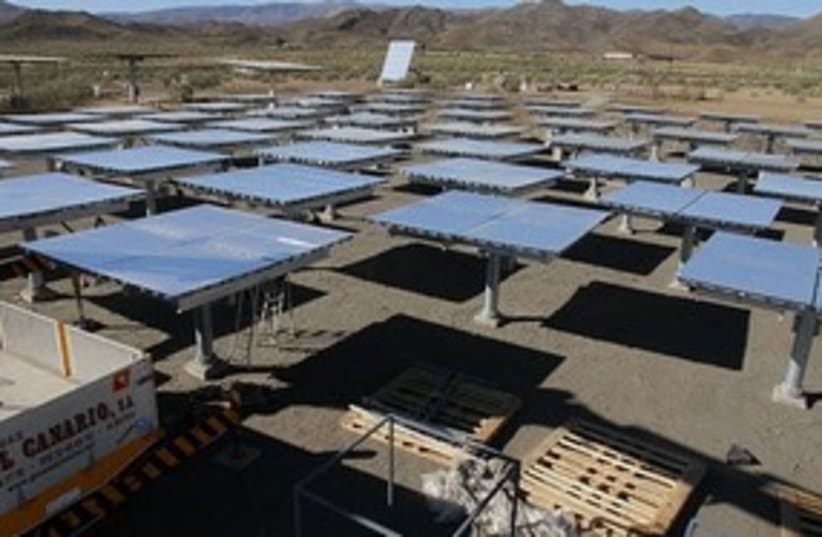
By SHARON UDASINSolar panels 311(photo credit: courtesy of AORA)
Energy and Water Minister Uzi Landau recommended a 30-megawatt increase in solar rooftop allocations, as part of a government proposal he submitted on Wednesday for coping with the expected electricity shortages this summer.After submitting the detailed proposal, Landau said he hoped the cabinet would discuss its measures at this Sunday’s meeting, so that the relevant government bodies would be able to take action as quickly as possible. The Energy and Water Ministry expects shortages between June and September, and will define shortage hours as those in which the difference between expected electricity production and peak demand does not exceed 600 MW.“The resolution is intended to provide additional tools to the Energy and Water Ministry, which is taking care of the anticipated electricity shortages this coming summer,” Landau said, in a statement his office released. “It comes to remove barriers and activate existing means in various ministries, so that it will be possible to take all the necessary steps in order to quickly increase the electricity production capacity in cases in which there will be a low reserve.”The ministry, he explained, is in the process of deploying a publicity campaign and a variety of incentives for reducing electricity consumption in the country’s households.One recommendation in Landau’s proposal stems from last summer’s government decision 3484, regarding renewable energy allocations.In response to pressure from the Environmental Protection Ministry and green groups, Landau proposed allowing for the installation of an additional 30 MW worth of photovoltaic rooftop panels – taking from a quota allocated for a future year.At an unrelated solar project launch event on Tuesday, Landau had toldjournalists that he preferred bringing forward the quota allocated for 2014 to this year.The day before, green groups had protested outside the Prime Minister’s Office during the weekly cabinet meeting demanding the solar allocations, in an effort led by Renewable Energy Association head Eitan Parness.Parness, however, was not satisfied with Landau’s proposal, particularly because its implementation would come with a July 1 time limit for construction.“This restriction is not justified, as it will reduce the chances of realizing the quota,” Parness said, noting that means for coping with the shortage would primarily be necessary in the month of August.“We demand to change the threshold date to the beginning of August,” he continued. “As for the size of the quota that has been approved, there is potential for about 70 MW, and it is unclear why the government is blocking the consumers who want to generate electricity for themselves and help the IEC in its efforts to cope with the expected summer shortage.”Aside from the solar recommendations, Landau’s proposal suggested that the government examine the possibility of regulating natural gas use so that quantities of gas in the hands of the Essential Service Supplier – the IEC or East Jerusalem Electric Company, according to the Public Utility Authority – could pass during shortage periods to partially or fully paralyzed private power plants.With the added gas, these plants would be able to help supply the economy’s needs, the minister wrote.Landau also recommended that if mishaps did occur, operators must report problems to municipal unions, the Interior Ministry and the Environmental Protection Ministry.Another suggestion in his submission was to examine ways to reduce power consumption among consumers, as well as make sure that the public was aware of the shortage.Meanwhile, regarding the IDF, Landau advised that military bases be added to the existing agreement, called the “mobile summit” framework, which stipulates that mobile generators cannot operate more than 100 hours per year.Regarding the use of generators in general, the minister emphasized the need to minimize the population’s exposure to environmental hazards stemming from diesel generator operation. He stressed that generators should not be within 500 meters of the population, and that they should run on diesel fuel used for transportation rather than for heating, as this type of fuel causes less air pollution.In addition, he recommended that the government require the interior minister to conduct the necessary hearings immediately at the National Council for Planning and Building, in order to provide for easy establishment of gas turbines exceeding 20 MW capacity. Along these lines, the minister also asked that the government instruct the environmental protection minister to allow for such turbines and to remove limitations on the use of generators.“We stand at the head of a joint effort of all bodies associated with the Israeli energy market and are enlisting government offices to mobilize the national effort,” Landau said.“Together, we will get through the summer in peace.”
if(catID != 151){
var cont = `Take Israel home with the new Jerusalem Post Store