Libya: 2,000 reported killed in Benghazi, 1,000 in Tripoli
"They carried out a real massacre," French doctor says; Fighter pilots crash planes rather than strike protesters.
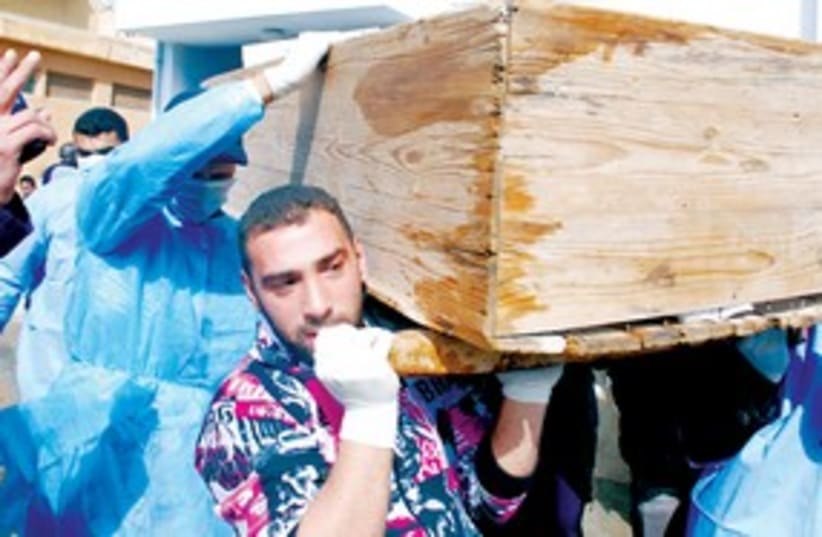
By ASSOCIATED PRESS, JPOST.COM STAFFMen carry coffin Libya 311(photo credit: ASSOCIATED PRESS)Militiamen loyal to Moammar Gaddafi clamped down in Tripoli, with the sound of gunfire ringing in the air, while protesters who control much of the eastern half of Libya claimed new gains in cities and towns closer to the heart of Gaddafi's regime in the capital.Protesters said they had taken over Misrata, which would be the largest city in the western half in the country to fall into their hands. Clashes broke out over the past two days in the town of Sabratha, west of the capital, where the army and militiamen were trying to put down protesters who overwhelmed security headquarters and government buildings, a news website close to the government reported.RELATED:WikiLeaks cables portray Gaddafi as a master manipulator 'Gaddafi orders explosion of Libya's oil pipelines'A French doctor working in Libya's eastern city of Benghazi told Le Point Magazine that over 2,000 people were killed in that city alone in the past days of fighting, AFP reported."From Tobruk to Darna, they carried out a real massacre... In total, I think there are more than 2,000 deaths," he said.The 60-year-old anesthetist who has been living in the Libyan city for over a year, said that one the first day of fighting in Benghazi, "out ambulances counted 75 bodies...200 on the second [day], then more than 500." On the third day, he added, "I ran out of morphine and medications," according to the report.Two air force pilots jumped from parachutes from their Russian-made Sukhoi fighter jet and let it crash, rather than carry out orders to bomb Libya's second largest city, Benghazi, which is now in opposition hands, the website Quryna reported, citing an unidentified officer in the air force control room.One of the pilots was from Gaddafi's tribe, the Gadhadhfa, said Farag al-Maghrabi, a local resident who saw the pilots and the wreckage of the jet, which crashed in a deserted area outside the key oil port of Breqa.International outrage mounted after Gaddafi on Tuesday went on state TV and in a fist-pounding speech called on his supporters to take to the streets to fight protesters. Gaddafi's retaliation has already been the harshest in the Arab world to the wave of anti-government protests sweeping the Middle East.Italy's Foreign Minister Franco Frattini said estimates of some 1,000 people killed in the violence in Libya were "credible," although he stressed information about casualties was incomplete. The New York-based Human Rights Watch has put the death toll at nearly 300, according to a partial count.Gaddafi's speech appeared to have brought out a heavy force of supporters and militiamen that largely prevented major protests in the capital Tuesday night or Wednesday. Through the night, gunfire was heard, said one woman who lives near downtown."Mercenaries are everywhere with weapons. You can't open a window or door. Snipers hunt people," she said. "We are under siege, at the mercy of a man who is not a Muslim."Click for full Jpost coverage ofturmoil in the Middle EastDuring the day Wednesday, more gunfire was heard near Gaddafi's residence, but in many parts of the city of 2 million residents were venturing out to stores, some residents said. The government sent out text messages urging people to go back to their jobs, aiming to show that life was returning to normal. The residents spoke on condition of anonymity for fear of retaliation.But Libya's upheaval, just over a week old, has shattered the hold of Gaddafi's regime across much of the country. Protesters claim to hold towns and cities along nearly the entire eastern half of the 1,000-mile Mediterranean coastline, from the Egyptian border. In parts, they have set up their own jury-rigged self-administrations.At the Egyptian border, guards had fled, and local tribal elders have formed local committees to take their place. "Welcome to the new Libya," a graffiti spray-painted at the crossing proclaimed. Fawzy Ignashy, a former soldier, now in civilian clothes at the border, said that early in the protests, some commanders ordered troops to fire on protesters, but then tribal leaders stepped in and ordered them to stop."They did because they were from here. So the officers fled," he said.Protesters have claimed control all the way to the city of Ajdabiya, about 480 miles (800 kilometers) east of Tripoli, encroaching on the key oil fields around the Gulf of Sidra.That has left Gaddafi's power centered around Tripoli, in the far west and parts of the country's center. But that appeared to be weakening in parts.Protesters in Misrata were claiming victory after several days of fighting with Gaddafi loyalists in the city, about 120 miles (200 kilometers) east of Tripoli.Residents were honking horns in celebration and raising the pre-Gaddafi flags of the Libyan monarchy, said Faraj al-Misrati, a local doctor. He said six people had been killed and 200 wounded in clashes that began Feb. 18 and eventually drove out pro-Gaddafi militiamen.An audio statement posted on the Internet was reportedly from armed forces officers in Misrata proclaiming "our total support" for the protesters.New videos posted by Libya's opposition on Facebook also showed scores of anti-government protesters raising the flag from the pre-Gaddafi monarchy on a building in Zawiya, 30 miles (50 kilometers) west of Tripoli. Another showed protesters lining up cement blocks and setting tires ablaze to fortify positions on a square inside the capital.The footage couldn't be independently confirmed.Further west, armed forces deployed in Sabratha, a town famed for nearby ancient Roman ruins, in a bid to regain control after protesters burned government buildings and police stations, the Quryna news website reported. It said clashes had erupted between soldiers and residents in the past nights and that residents were also reporting an influx of pro-Gaddafi militias that have led heaviest crackdown on protesters.The opposition also claimed control in Zwara, about 30 miles (50 kilometers) from the Tunisian border in the west, after local army units sided with the protesters and police fled."The situation here is very secure, the people here have organized security committees, and there are people who have joined us from the army," said a 25-year-old unemployed university graduate in Zwara. "This man (Gaddafi) has reached the point that he's saying he will bring armies from African (to fight protesters). That means he is isolated," he said.The division of the country — and defection of some army units to the protesters — raises the possibility the opposition could try an assault on the capital. On the Internet, there were calls by protesters for all policemen, armed forces and youth to march to Tripoli on Friday.In his speech Tuesday night, Gaddafi defiantly vowed to fight to his "last drop of blood" and roared at supporters to strike back against Libyan protesters to defend his embattled regime."You men and women who love Gaddafi... get out of your homes and fill the streets," Gaddafi said. "Leave your homes and attack them in their lairs."Gaddafi appears to have lost the support of several tribes and his own diplomats, including Libya's ambassador in Washington, Ali Adjali, and deputy UN Ambassador Ibrahim Dabbashi.International alarm has risen over the crisis, which sent oil prices soaring to the highest level in more than two years on Tuesday and sparked a scramble by European and other countries to get their citizens out of the North African nation. The UN Security Council held an emergency meeting that ended with a statement condemning the crackdown, expressing "grave concern" and calling for an "immediate end to the violence" and steps to address the legitimate demands of the Libyan people.French President Nicolas Sarkozy also pressed Wednesday for European Union sanctions against Libya's regime because of its violent crackdown on protesters, and raised the possibility of cutting all economic and business ties between the EU and the North African nation."The continuing brutal and bloody repression against the Libyan civilian population is revolting," Sarkozy said in a statement. "The international community cannot remain a spectator to these massive violations of human rights."Italian news reports have said witnesses and hospital sources in Libya are estimating there are 1,000 dead in Tripoli, the Libyan capital, alone."We have no complete information about the number of people who have died," Frattini said in a speech to a Catholic organization in Rome ahead of a briefing in Parliament on Libya. "We believe that the estimates of about 1,000 are credible."Libya is the biggest supplier of oil to Italy, which has extensive energy, construction and other business interests in the north African country and decades of strong ties.Frattini said the Italian government is asking that the "horrible bloodshed" cease immediately.
if(catID != 151){
var cont = `Take Israel home with the new Jerusalem Post Store