Party officials hoped to put to rest the controversy by holding a quick vote to add the language back in.
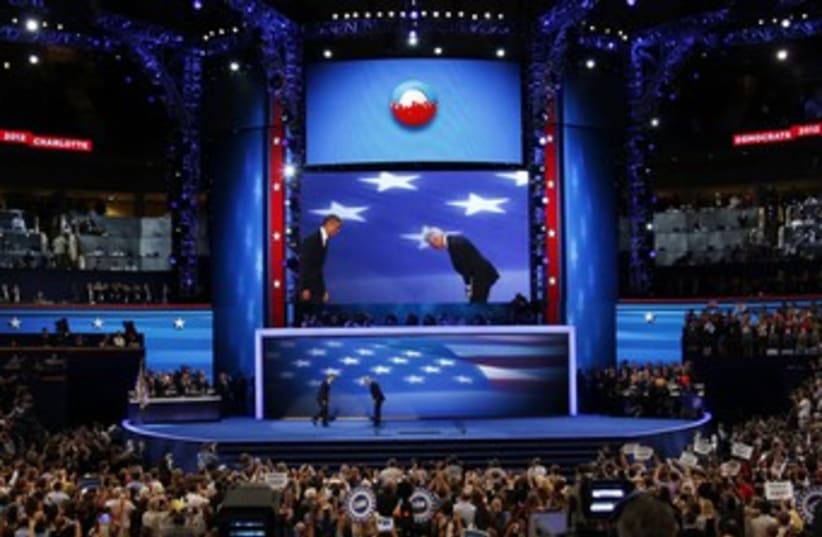
By HILARY LEILA KRIEGER, JPOST CORRESPONDENTPast, former US presidents Clinton and Obama at DNC 370 (R)(photo credit: Jason Reed / Reuters)
CHARLOTTE, North Carolina – Democrats faced criticism on Thursday over how they handled a last-minute amendment to the party platform that added in language recognizing Jerusalem as the capital of Israel.Party officials hoped to put to rest the controversy over a decision not to include the Jerusalem text from the 2008 platform by holding a quick vote Wednesday night to add it back in, as well as include a reference to God that had been excised, leaving the platform without reference to a higher power. Democrats hoped instead to focus on the convention’s main event, US President Barack Obama’s speech Thursday night.The move came after loud complaints from many Democratic members of Congress who objected to Jerusalem being cut from the platform.Several Democrats connected to the process said that Obama had personally intervened to have the language reinstated after the controversy, initiated by Republican pro-Israel activists, erupted. Several Jewish groups had also objected to the changes.But Democratic delegates in the convention hall on Wednesday, surprised by the amendment maneuver, did not give Los Angeles Mayor Antonio Villaraigosa, 2012 Democratic National Convention Committee chairman, the clear two-thirds backing needed in a voice vote to approve the change. Villaraigosa had to call for a vote three times before declaring that the sufficient amount of support had been mustered. In response, several in the arena broke into boos.Several people in the hall complained about the lack of proper process and said the negative reaction was due to complaints over the procedures used to secure support for the amendments, rather than the content. Others expressed opposition to the inclusion of a reference to God.But at least some in the hall were supporters of the Palestinian position and objected to adding in text declaring that “Jerusalem is and will remain the capital of Israel. The parties have agreed that Jerusalem is a matter for final-status negotiations. It should remain an undivided city accessible to people of all faiths.”“[The] amendment to reinsert the language on Jerusalem was a clear case of putting pandering above responsible politics,” the Arab-American Institute said in statement put out after the amendment was made, saying it “flies in the face of decades of policy and the positions of President Obama, international peacemakers, and the American public at large.”Click here for special JPost coverageMany Jewish groups, in contrast, were pleased by the change, with the American Israel Public Affair Committee, Anti-Defamation League and American Jewish Committee issuing statements welcoming the move.At least one Jewish group, however, had praised the original 2012 language as a more constructive platform for the party.Americans for Peace Now, in a statement put out before the amendment was made, said the DNC deserved credit rather than criticism for a platform that “offers a breath of fresh air by refraining from pandering on the issue with empty words that are disconnected from longstanding US policy on this sensitive issue.”Even some Democrats, however, were frustrated at the notion that the party platform had been revised to reflect current US policy, rather than the party’s hopes for how that policy would be set in the future.“It’s between legislation and aspiration. It’s always been a mix,” said someone familiar with the platform-drafting process.She added, however, that her understanding was that the platform was drafted to focus on what Obama had achieved in office on Israel – particularly support for defense assistance – as a way of indicating stong support for Israel.Asked about the change in the platform’s Israel language from 2008, DNC chairwoman Rep. Debbie Wasserman Schultz said Thursday on CNN that “essentially, with Jerusalem, it was a technical omission and nothing more than that.”“There was never any discussion or debate commentary over adding or subtracting it,” she said.But former congressman Robert Wexler, who was involved in drafting the foreign policy portion of the platform, told The Jerusalem Post that the 2012 language was drafted from scratch because rather than focusing on final-status issues such as Jerusalem – which were less relevant during a period when the peace process was frozen – because the aim was to focus on security, since that matters most to Israel as the threat of Iran looms.“The original platform was 100 percent pro-Israel. Now the platform is even stronger,” he said.Wexler said the decision to amend the platform was made because “there was confusion on the president’s support for Israel. We wanted to end it.”Colin Kahl, a former Pentagon official also involved in the platform’s drafting, agreed that the platform was unquestionably reflective of Obama’s strong backing for the Jewish state.“I don’t think there was any intention by the drafters of the platform to signal a fundamental change in US policy on Jerusalem or any other issue,” he said. “Clearly it was misinterpreted that way, so the president personally intervened to correct the record.”Though some Obama advisers pointed fingers in his direction for the changed language, he didn’t respond to the charge when asked about it during a Truman National Security Project program Thursday.“We should move on,” Kahl said. “The platform is changed.”
if(catID != 151){
var cont = `Take Israel home with the new Jerusalem Post Store