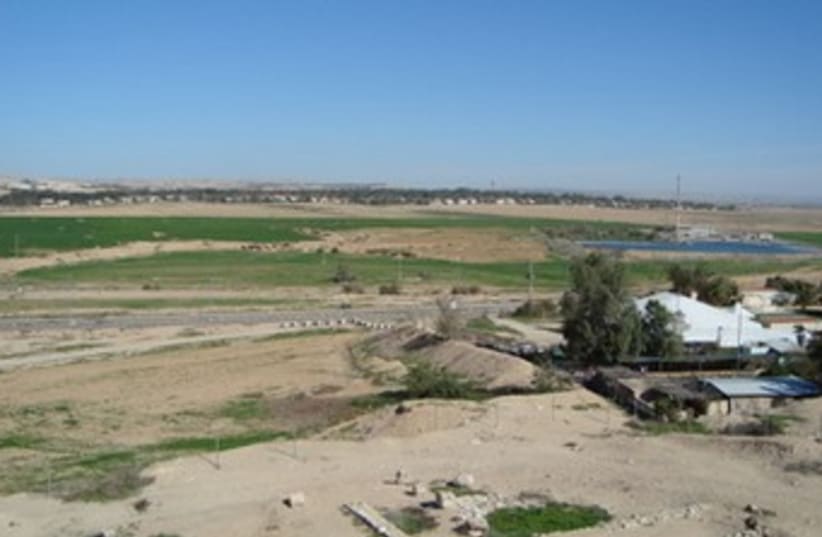
One of the most significant features of the site is an ancient well, known as Abraham's Well.
By GRAEME STONE, TRAVELUJAHBeersheva(photo credit: Travelujah)For further information on Christian tourism and Holy Land Tours to Israel contact Travelujah.Just outside the perimeter of the modern city of Beersheba, stands the ancient site of Tel Sheba, the remains of a biblical administration center/fortress dating back to the early Israelite period.It is strategically situated, overlooking the confluence of the Beersheba and Hebron Stream. The site was excavated in the 1970's, and it was designated a UNESCO World Heritage site in 2005. The site contains the remains of ancient walls, with parts of the gateway and an ancient well at the entrance. Inside the fortifications, one sees the foundations of the original residences, warehouses and a general layout of the former town. Extremely interesting, and impressive, is the ancient subterranean water system which was connected to the Hebron Stream and delivered water inside the fortress via tunnels and cisterns, erstwhile concealed on the outside to invading forces.Entrance gate into Tel Beer Sheba (courtesy Travelujah)Adjacent to the tamarisk trees, beside the entry into the site, stands the replica of an altar with the four horns, the original having been discovered on the site. The ancient Tel Sheba is a site rich with biblical references, especially associated with the wanderings of the Patriarchs - the digging of the well by Abraham and his servants, the sworn agreement with Avimelech, and confirmed by the planting of the tamarisk tree - Genesis 21:22-33; the covenant with Isaac, renewing the blessing God had made with Abraham, and sanctified by Isaac who built an altar there - Genesis 46: 1-3; and the covenant with Jacob, and the promise that God will accompany Jacob and his family down to Egypt and redeem them as a great nation Genesis 46:1-3.One of the most significant features of the site is an ancient well that lies just outside the city gates, known as Abraham's Well, which is where, according to tradition, Abraham made the oath with Abimeleh.Ancient well outside the gates of Tel Sheba (courtesy Travelujah)Today Beersheba, the gateway and the modern capital of the Negev, boasts a population of 250,000 citizens, of whom a large majority are students studying at the various faculties of the Ben Gurion University. The university has revived a city that belies an important historical event that took place almost a hundred years ago on October 31, 1917. Only in recent years has the story come to light, and yet it had the most profound effect of changing the direction and redefining the boundaries of the modern Middle East.Entrance to ancient water tunnel underneath Tel Sheba (courtesy Travelujah)The drama can be retold from the commanding location of Tel Sheba, and with a compass and maps in hand, it is possible to determine the various positions of the opposing forces. One can visualize the charge of the Australian Light-Horse Brigade, valiantly racing across the plains of Beersheba, as the late afternoon sun is wavering, and their desperate mission to capture the wells of Beersheba before dark, or otherwise face the grim prospect of retreat, returning through two days of blistering, waterless desert to their nearest supply source.The failing theater of war in Western Europe during World War I, and being trapped in a bloody carnage of trench warfare, encouraged the British Command to initiate an alternative Front, by attacking the German-Turkish Alliance through the Middle East. History books memorialize the tragic and unsuccessful Battle for Gallipoli (1915-16). Its disastrous consequences for the British, Australian and New Zealand forces led to a change of strategy, resulting in the re-deployment of forces in Egypt with the intention of advancing through Palestine. However, two disastrous battles fought by the British Palestine Expeditionary Force along the Gaza coastline, thwarted their attempt to breach the German-Turkish forces.Subsequently a change of command, with the promotion of General Allenby, created a different quality of leadership. He employed a ruse - using propaganda, whereby the enemy was misled to incorrectly anticipate and reinforce their troops - leaving Beersheba exposed and vulnerable. In the background to this smoldering situation, Lawrence of Arabia was creating a groundswell of rebellion among the Arab tribes on the eastern side of the Jordan River. There was a spy story, and a tragic love-triangle that assisted the Expeditionary Forces to find their way across the desert to Beersheba. While in London, the British Parliament was promulgating the Balfour Declaration, for the establishment of a Jewish homeland, and yet simultaneously, the same British Parliament was deceptively promising part of the same territory to Emir Hussein, offering an Arab Kingdom that extended across the Arabian Peninsula to the Mediterranean Sea. Against this scenario of conniving politics, calculated duplicity and empty promises, the British and the French had conspired between themselves to divide the Middle-East and formulate their own borders - in essence, the creation of the modern Middle-East.If we return to the events unfolding in the Battle of Beersheba, one recalls the capture of the strategic mound of Tel Sheba - by the New Zealand forces - which had militarily dominated the surrounding landscape and overlooked the plain below. This success was followed by the dramatic 6 kilometer charge of the Australian Light - Horse Brigade, across the plains towards the town of Beersheba, the last great horse-cavalry charge in history. The Australian force comprised of volunteer farmers from rural Australia - chosen because they were all good horsemen - and later, their virtues were immortalized in a poem by Banjo Paterson. The horsemen were desperate to succeed before darkness, and capture Beersheba or face forced retreat and defeat. With their bayonets waving - as they were not a regular cavalry they did not carry sabers - and with that will to decide the fate of the battle, they overran the German-Turkish positions and trenches, among volleys of enemy artillery and rifle-fire.They secured the wells of Beersheba and victory was theirs. As a result of this breakthrough, the way to Jerusalem was opened. Six weeks later, General Allenby entered Jerusalem and received the surrender of the city - which heralded the change into the modern Middle East.Tel Beersheva (courtesy Travelujah)Driving through the modern city of Beersheba today, we pass the Commonwealth Cemetery, where the graves of 1200 brave men recall that period of history, and whose heroism brought about the fall of the Ottoman-Turkish Empire (1530 - 1917), and led to the more favorable change of administration under the British Mandate Period (1917- 48). It seems providential that Beersheba, the site chosen by God to renew the covenant with the patriarchs of Israel, would be the place in modern history which was chosen again, and most influenced a causal chain of events resulting in the eventual creation of a State.Touring Tel ShebaThere are no regularly scheduled bus tours that currently include Beersheba and Tel Sheba so options for touring these sites are limited to doing them on your own by either public transportation or car rental, or by hiring the services of a private guide for a day. Beersheba is approximately a 70 minute car ride from Jerusalem and Tel Aviv and both cities offer regularly scheduled bus service to Beersheba, as follows:From Tel Aviv: Take line 380 from Arlozorov Terminal, or line 370 from Tel Aviv Central Bus Station. The trip takes about 1.5 hours.From Jerusalem: From central bus station - line 470; line 446, approximately 1 hour and 50 minutes.Train services runs hourly from Tel Aviv to Beersheba.Graeme Stone is a licensed Israeli tour guide and contributing expert on Travelujah. People can learn, plan and share their Holy Land tour and travel experiences on Travelujah. He can be reached at grums@bezeqint.net.il. Follow @JPost_Lifestyle
if(catID != 151){
var cont = `Take Israel home with the new Jerusalem Post Store