Samaritans to perform ancient rite of animal sacrifice, which is unique among the world's monotheistic faiths.
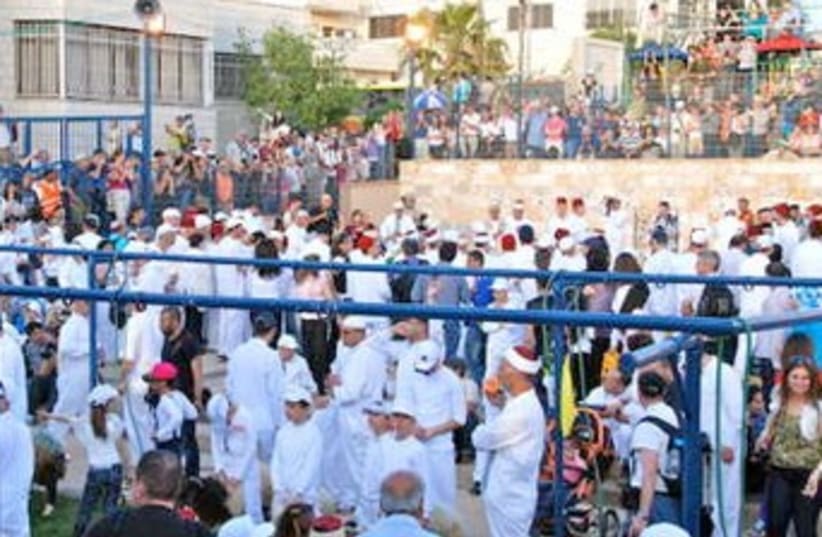
By GIL STERN STERN ZOHAR/TRAVELUJAHSamaritans gathering at Mt. Gerazim 370(photo credit: Courtesy Travelujah)For further information on Christian tourism and Holy Land Tours to Israel contact Travelujah.Unperturbed by the uncertainties of the Israeli-Palestinian conflict, the world's smallest ethnic community will gather Friday, May 4 on Mount Gerizim for the biblical observance of Passover.The 760 Samaritans in the world are the last remnant of the once flourishing biblical kingdom of Israel. They trace their descent back to the tribes of Ephraim and Manasseh.After the death of King Solomon in ca.920 BCE, his northern subjects gathered at Shechem (modern Nablus) to secede, rejecting his arrogant heir Rehoboam (I Kings 12:1-20). The breakaway kingdom bolstered its political independence from Judah by theologically challenging the beliefs of the older kingdom. The Samaritans maintained that God's chosen site for his sanctuary is Mount Gerizim, an 881-meter peak looming over Shechem from the south, rather than Mount Moriah in Jerusalem 63 km to the south. The Samaritan religion became fossilized in the centuries following the split between Israel and Judah. Very little innovation in thought, literature or social organization has arisen over the millennia, affording a telescopic glimpse of the pristine Judaism of pre-Rabbinic times.The Samaritans call themselves Shamerim, meaning guardians (of the truth). They hold as sacred the Five Books of Moses but have never accepted as canon the Prophets or Writings, or the Talmud (the compendium of Jewish Oral Law.)Their Torah, written on parchment in the ancient Hebrew alphabet, contains some 6,000 variants from the Masoretic Hebrew Bible. Most of these are discrepancies over spelling or pronunciation. Some, however, reflect the bitter historical and religious struggle waged in antiquity between the Samaritans and the Jews.For example, the Ten Commandments as they are known to Jew and Christian alike have been compressed into nine in the Samaritan version. A 10th commandment drawn up from passages in Deuteronomy 11 and 27 proclaims the sanctity of Mount Gerizim, the Mount of Blessing. The Samaritans observe only the biblical Holy Days - the New Year, Day of Atonement, Sukkot, Shavuot and Passover, the latter being their most important festival.This year the Passover sacrifice is again being led by the community's High Priest Elazar ben Tsedaka ben Yitzhaq. Born in 1927 when Nablus was a city in the British Mandate of Palestine, Elazar succeeded his cousin Saloum Cohen in 2004 to become the 131st holder of this post. He traces his genealogy back to biblical figure Uziel, son of Kohath, son of Levi. It was the Levites who assisted the Kohanim in their priestly duties in Solomon's Temple.High priest, Elazar, officiating at the Samaritan sacrifice (photo courtesy Travelujah)This year's festival follows one month after Jews celebrated Passover since this year is a leap year in the Samaritan tradition. In contrast to Rabbinic Judaism, which adds an extra month seven times in a 19-year cycle, the Samaritan elders determine leap months on an ad hoc basis.Until 1624 there had existed a chain of High Priests descended from Eleazar, the son of Aaron, and the nephew of Moses. Ben Abisha, who lives in Nablus, conducts his business from a cramped room that opens onto a back street."We are the true Israelites," Elazar says of the Samaritans. His long white beard, red turban, and full-length robe bestow upon him an air of authority that belies the chaos and poverty of his office. He ignores the scattered newspapers, the rusty piece of pipe, and decades of dust around him.In addition to his official duties as final arbiter in matters of religion and as leader of religious ceremonies, Elazar has encouraged the young to learn their historical and literary traditions from the community's sages, and has endeavored to find matches for the unwed. More than half of the Samaritans are under the age of 30.Traditionally the sacrifice of the paschal lamb takes place at dusk on the 15th of Nisan, the night of the full moon according to the Samaritans' 354-day lunar calendar. But this year the sacrifice will be advanced to noon so as not to desecrate Shabbat. The ritual itself has been faithfully preserved across the generations and is a literal observance of the Passover slaughter commanded in Exodus 12.As noon approaches, a crowd of chanting males carrying cleavers and wearing rubber boots will escort the High Priest in a procession to the sacrificial site, a plateau 80 meters from the summit. He is carrying the Abisha Scroll, which the Samaritans claim is the oldest Torah manuscript in the world. The followers are dressed in flowing white ceremonial robes or plain white shirts and pants, their heads covered either with the traditional red tarboosh or the warm Czech wool cap popular with local Arabs during the rainy winter season. The young men prefer baseball caps.Elazar, wrapped in a prayer shawl, leads a semi-circle of heads of families in the rhythmic chanting of Hebrew verses from the Samaritan Pentateuch describing the Exodus from Pharaoh's bondage. The archaic Samaritan pronunciation of Hebrew differs considerably from Israel's standard Sephardi usage, and speakers of modern Hebrew have difficulty in following the service.Other men and boys have readied the sheep for slaughter, binding them by the feat in an earthen altar, a shallow 2.15-meter long trench lined with stones. At a signal from the High Priest, the 28 sheep are slaughtered, one for each clan, evoking an ecstatic outburst of cheering, chanting and clapping by the entire assembly. Their white robes splattered with blood, the ritual butchers raise their bloodied knives into the air, embrace and kiss each other's forehead and on the cheeks of their children. Boiling water is poured over the sheep, the carcasses stripped of their fleece, gutted, salted and impaled on spits for baking. The two ovens, rectangular, concrete lined pits dug into the earth, are covered with shrubs and wet clay. The fleece and fat are set aside as a burnt offering. As the sacrifice slowly bakes in the fire-pits, more prayers are chanted. Then all the community retires indoors to remove their white clothing, emerging dressed in rough garments and heavy shoes, with staff in hand and bundles on their back, ready to re-enact the Exodus.Exactly at noon (instead of midnight), the earthen ovens are opened. Each extended family claims its lamb and everyone tears a piece of meat from the sacrifice, standing while eating it quickly together with matza and bitter herbs to symbolize the hasty departure of the Children of Israel from Egypt and the bitterness of slavery. In compliance with biblical law, not one bone of a paschal lamb may be broken. All the bones and any leftover meat are heaped on the embers to ensure that nothing remains by morning.After everyone has hastily eaten, the pilgrims circle the sacred precinct in a procession symbolizing the 40 years of wandering in the wilderness on the way to the Promised Land. They pass a fenced-off slab of rock said to be the site at which Abraham intended to sacrifice Isaac, and an altar of stones supposedly built by Joshua when he assembled the Tribes to hear the reading of the Torah. (Jewish tradition maintains the respective sites of these events are Mount Moriah - Gen. 22:2-14, and Mount Ebal, Mount Gerizim's cursed sister peak - Joshua 8:30-35.)The pilgrims then sit down to a full festive meal. Any leftovers are burned.The ceremony is open to the public and invitations are available from the Tourist Ministry. Transportation must be arranged privately. Every year a small group of students of comparative religion and just plain curiosity seekers make their way to Mount Gerizim to watch this ancient rite of animal sacrifice unique among the world's monotheistic faiths.Gil Zohar is a Canadian born Israeli tour guide and journalist and writes regularly for Travelujah, the leading Christian social network focused on travel to the Holy Land. People can learn, plan and share their Holy Land tour and travel experiences on Travelujah.Follow @JPost_Lifestyle
if(catID != 151){
var cont = `Take Israel home with the new Jerusalem Post Store