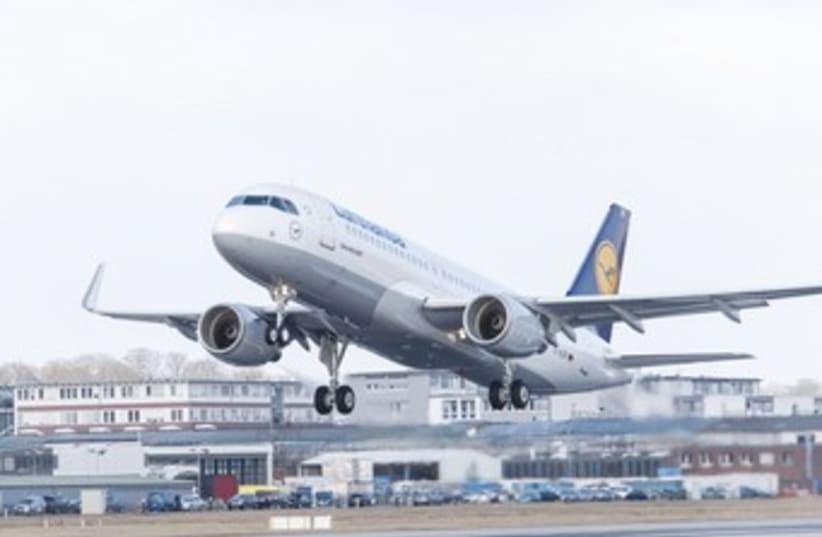
Airbus and Lufthansa have introduced 'sharklets,' specially formulated wings – in effort to reduce carbon footprint.
By NOA AMOUYALlufthansa370(photo credit: Courtesy)
HAMBURG – In the film Up In The Air, George Clooney plays Ryan Bingham, a cutthroat “downsizing expert” who travels from city to city with one singular mission: to fire employees, sparing management from doing so in person.As such, Bingham is a world travel connoisseur, more comfortable in an airport terminal than his own home. Evidence of his ease with flying is shown in a montage where - in a seemingly fluid motion – he meticulously and deftly navigates through the various security barriers with little effort.The rest of us aren’t likely to maneuver through the various travel stages quite so gracefully or rack up the frequent flyer miles as quickly. However, in recent decades, the number of airplane passengers has grown exponentially. According to a 2012 report published by the Air Transport Action Group (ATAG), the aviation industry carried 2.7 billion passengers in 2010, marking a 1.5 billion increase from the 1.2 billion passengers carried in 1990. Moreover, these skyrocketing figures are not expected to dwindle any time soon. In 2030, ATAG predicts the aviation industry can expect approximately 5.9 billion people worldwide.While these figures are promising economically, a booming aviation industry that services more passengers, more aircrafts and more fuel is troubling from an environmental perspective.Airbus, the giant European aviation manufacturer, is well aware of the potential harm its industry can have on the environment and it has taken several notable measures to reduce its carbon footprint.In 2007, Airbus’s parent company devised EADS Vision 2020, a program intended to pinpoint the industry’s environmental shortcomings and identify potential solutions to dramatically reduce its carbon footprint by 2020. Ultimately, Airbus hopes that 2050’s carbon emissions levels will be half as much as 2005’s emissions.Their introduction of its A-320 jet with ‘sharklets’ is the company’s most recent example of working toward reaching its eco-friendly goals.These sharklets are specially formulated 2.4-meter wings that reduce the airplane’s drag, which will enable planes to fly an additional 100 nautical miles, make for easier takeoff and ultimately reduce fuel burn by 1 to 4%.Earlier this month, after providing a tour of its assembly facility in Hamburg, Airbus teamed up with Lufthansa Airlines to inaugurate this new more aerodynamic model was flown in Europe.“Even if it’s just steel and iron, you still have a deep relationship with the aircraft,” pilot Bernhard Zinser said before embarking on the aircraft’s maiden flight from Hamburg to Frankfurt.Zinser explained that a pilot, like a doting parent, feels a sense of pride whenever the industry unveils a new innovation that will make his aircraft faster, greener and more technologically impressive.While these kind of improvements will help protect the environment, they may also very well save the commercial aviation industry. The skyrocketing cost of fuel, ever-expanding airport infrastructure and increasing personnel salaries are just some factors currently plaguing the airline industry. European and American carriers are tasked with the additional challenge of squaring off with their competitors in the Middle East who have significantly less government regulation and restraints.These eco-friendly measures then, are not done altruistically. As far as commercial airlines are concerned, going green is a crucial cost saving measure that must be implemented whenever an opportunity arises.In a promotional video screened for journalists in Hamburg, Airbus explained how technologically advanced, interactive and comfortable the future of aviation can be.It prophesizes “social areas” in the middle of an aircraft where passengers can engage in recreational activities, seats that adjust specifically to the contours of a passenger’s back and cabins made entirely out of plant fibers.Such a vision is most likely a pipe dream or something implemented for first class passengers at best. But what is real in the meantime, are the efforts by companies like Airbus and Lufthansa to eliminate unnecessary emissions and demonstrate environmentally sustainable measures.It’s certainly a flight in the right direction.The writer was a guest of Lufthansa.
if(catID != 151){
var cont = `Take Israel home with the new Jerusalem Post Store