Cambodian tourism - now about 3 million a year - is growing by leaps and bounds.
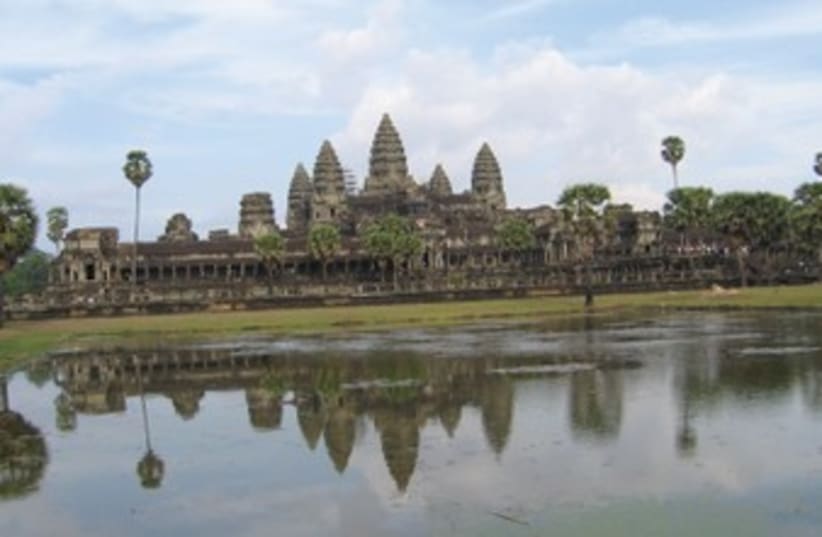
By BEN G. FRANKAngkor Wat 370(photo credit: BEN G. Frank)
PHNOM PEN – Twenty-nine-year-old Chabad Rabbi Bentzion Butman often stands in front of the two-story, balcony-laden Jewish Center located at No. 32, Street 28, in Phnom Penh, the capital of the ancient country of Cambodia, thousands of miles away from his hometown of Lod, Israel. At the front gate is a sign that says, “The Jewish Center” followed by the words, “No Jew will be left behind.”Once called the “Pearl of Asia” and noted for its French colonial architecture, Phnom Penh may be a metropolis with only about 100 Jews out of a total population of about 1.5 million. Yet, the Jewish community was large enough to be cited by The Economist last summer as an example of Chabad’s reach to residents and travelers.The rabbi says he and his wife Mashie settled here to help the Jewish community, even if there are only 100 Jews left.“That’s what we mean when we say, ‘No Jew will be left behind,’” said Butman, who added that the Jewish community is composed of NGOs, embassy people and ex-pats. “I wouldn’t say it’s tough, it’s a challenge,” he said of his adjustment to this ancient land to which he came at the end of 2009.Cambodia’s capital does not stand as the only Jewish presence in this country of 15 million. About 60 Jews reside in at least 20 towns throughout the country now booming with tourism, including Siem Reap, about 350 km. from Phnom Penh.Siem Reap, a tourist boomtown, remains home to about 20 Jews, some of whom work in local hospitals. The town is bursting at the seams because Siem Reap is the gateway to Angkor Wat, the “mother of all temples,” and the heart and soul of Cambodia as well as the largest religious structure in the world. This 12thcentury Khmer temple stands adorned with elaborate bas-reliefs and its edifice contains the longest continuous relief ever carved. No wonder it’s considered the eighth wonder of the world.Just walk down the long causeway and view these magnificent ruins and you will be reminded of that “ah” moment, the same inner joy and excitement a traveler feels when viewing for the first time the Taj Mahal, Machu Picchu, the Great Wall of China and Petra, and certainly the Kotel.An Israeli I once met described these Cambodian ruins as “mahshehu” (something). I agreed.Angkor Wat is so famous that its picture is front and center on the Cambodian flag. But like many sites, it is advisable to visit in the early morning, especially in the early part of the year, to see the vast complex.WE DIDN’T listen and got there at noon; the crowds were sparse and it was very hot, almost like Masada, mid-day in August. So we returned and came back before sunset, easily sauntering through the ruins and pausing on the paths where we observed monkeys scattering up and down stone terraces. These playful animals tease and pose for pictures though we were warned not to get too close as they are wild.Even the children trying to sell souvenirs didn’t bother us. They were wonderful and practiced their English on us.Angkor Wat is surrounded by a moat which forms a giant rectangle measuring 1.5 x 1.3 km. The site remains in a remarkable state of preservation, so archeology buffs may want to spend a full day or two exploring the walls. Be ready to almost crawl up worn, century- old stone steps.This mother of all temples was dedicated to the Hindu god Vishnu. It holds the temple mausoleum of King Suryavarman II (1113-50) its builder. From the 9th century through much of the 15th century, Cambodia was home to one of the world’s most impressive civilizations. By the 15th century, Khmer civilization collapsed; its people dispersed. The city itself lay forgotten until the 19th century when it was rediscovered.Angkor Thom is the name of the walled city constructed at Angkor.Angkor Thom was the capital of King Jayavarman VII (1181-1219) where the architectural design and decoration symbolize the Hindu view of heaven. The city is about 2,250 acres. A million people lived here between the 10th and 15th centuries, more than lived at that time in London, England.At Angkor Thom, a UNESCO World Heritage site, we stared at ancient, serene faces etched into the stone walls dating back to the Khmer era.Unbelievable are the thick air roots of Banyan trees that inhabit the area and literally grow out of ancient stones. A good photo-op is the South Gate. And make sure to stand on the Elephant terrace (the façade is covered with stone-elephants).Many of these temples, we were told, bear silent witness to the encroaching power of the jungle with its huge tree roots overhanging and grasping the walls as would an octopus. This phenomenon can be seen at Ta Prohm, a ten-minute drive from Angkor Thom.CAMBODIA IS undergoing a rebirth. Gone are the Khmer Rouge; the Vietnamese invaders who occupied the country; the United Nations democracy-restored period and the era of warring prime ministers.And the people are pulling this land out of its miserable past. Very few senior citizens walk the streets of Cambodian towns and cities. Not out of fear, it’s just that few elders inhabit this kingdom. A whole generation was wiped out by the Khmer Rouge in the 1970s.Even our guide tells us confidentially that he was tortured during the brutal years of Khmer Rouge rule. As they did with thousands of others, they tied him up and attacked him with hot irons. Nobody knows why he was freed. “I have a second life,” he told me. He is pleasant man with a wife and young son whom he worships.He jokes that when he was young, “they taught me how to harvest rice. Now they teach students how to harvest US dollars.”He and personnel at the luxurious Sofitel Hotel Resort and Golf Club tell me tourists are coming to bike, trek and to take part in adventure tourism and experience this ancient Angkorian civilization.More than one-and-a-half million Cambodians died in this, the “most radical revolution the world had ever seen.” The Khmer Rouge literally announced “Year Zero,” when they took over the country on April 17, 1975, two weeks before the fall of Saigon. They initiated “killing fields,” set up by the tyrant Pol Pot. Massive piles of bones throughout the country attest to this grisly activity. Others simply starved to death. During the Khmer Rouge terror, all civilians in cities were evacuated to form rural cooperatives. Phnom Penh became a ghost town.Abolished were private property, religion and traditional customs. Hard labor in the fields, starvation rations and brutal purges killed off a fifth of Cambodia’s population. In 1979 Vietnamese troops toppled the Pol Pot government. In April 1998, the death of Pol Pot was announced. Meanwhile, much of the country’s infrastructure had been destroyed.On my trip, I found today’s Cambodians resilient. Truly, they are the brave people of Cambodia who had been brutalized, in this case not by a foreign evil, but by their own flesh and blood. You see suffering on the roads around the temples, where small groups of musicians perform Asian selections. They are maimed individuals working for donations. The tragedy hits home.But it is not just the ruins of Angkor Wat and Angkor Thom that tourists flock to. Like all travelers we took part in elephant rides, drove around in motorbike taxis, and visited the famous night market of Siem Reap where shopping easily meets the tight-budget expectations of visitors: T-shirts, jewelry, crafts and silks. After walking and standing in the market, we re-energize our feet in relaxation pools.Although Cambodia was taken over and made a protectorate by the French in 1863, a nationalist movement did not arise until the 1930s. It strengthened in 1940-41 when the French submitted to Japanese demands for bases in Cambodia. In 1953, Cambodia became independent. And then came decades of civil war, brutality, bombings and invasions by nearly everyone, including the US, the Vietnamese and Thais.Throughout my trip, I felt sure that tourism will increase. As Cambodia opens up more to business and commerce, it is likely that as have Thailand, Vietnam and China, Cambodia will welcome businesspeople eager to participate in a burgeoning economy.Cambodian tourism– now about 3 million a year – is growing by “leaps and bounds,” says Michael Kong, director of Lotus Tours, New York. The company has three kosher tours planned for the next few years, to be catered by Butman and led by Rabbi Marvin Tokayer, author and scholar.Ben G. Frank, journalist and travel writer, is the author of the just-published The Scattered Tribe: Traveling the Diaspora from Cuba to India to Tahiti & Beyond (Globe Pequot Press).
if(catID != 151){
var cont = `Take Israel home with the new Jerusalem Post Store