Analysts: Iran to be high Obama priority, Syria arms aid looms.
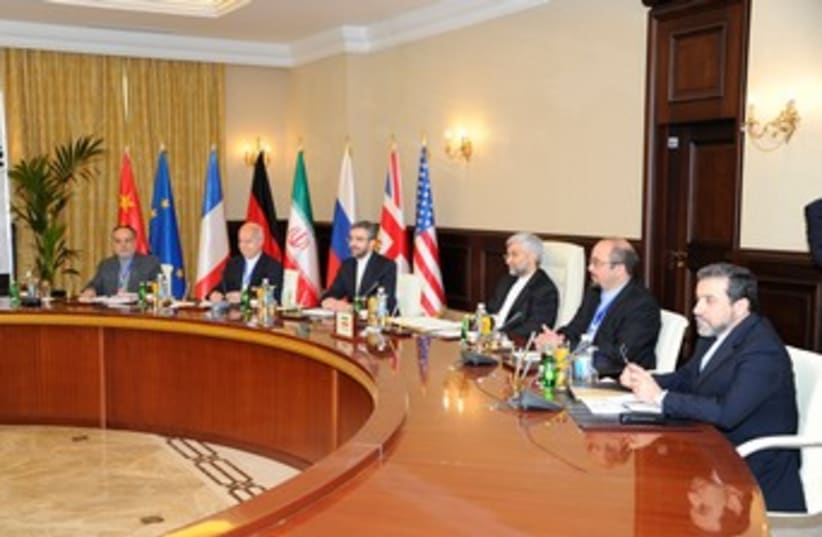
By REUTERSIran- P5+1 negotiations 370(photo credit: REUTERS/Government Spokesman Office/Handout)
WASHINGTON - Having defeated Republican Mitt Romney at home, Barack Obama has no shortage of adversaries to grapple with abroad, including the governments of Iran, Syria and possibly China.The Democratic president's re-election ensures continuity in US foreign policy but leaves open questions such as whether diplomacy can constrain Iran's nuclear program or whether Israel or the United States might resort to air strikes.Nor is it obvious whether Obama will be able to sustain his refusal so far to try to tip the scales in Syria's civil war by allowing US arms to flow to the rebels seeking to oust Syrian President Bashar Assad.If events permit, US foreign policy analysts said Obama will continue his "pivot" to Asia, seeking to reorient US policy to take advantage of the projected growth in such nations as China and India and gradually withdraw from the Middle East.However, both Iran, which the United States and its allies suspect of developing nuclear weapons, and Syria, where a car bomb killed and wounded dozens in the capital, Damascus, on Tuesday, will demand attention.Click here for special JPost coverage2013: Decisive on Iran?Martin Indyk, vice president of foreign policy studies at the Brookings Institution think tank, said 2013 could be a decisive year on Iran and suggested Obama's wider commitment to nonproliferation could produce a "focused and assertive" policy."It's going to be very high on the agenda," Indyk said. "Preventing Iran from getting nuclear weapons is a critical imperative for bolstering the nonproliferation regime." Iran denies US accusations that it seeks to develop nuclear weapons under cover of its civilian atomic program, saying its program is for peaceful uses such as generating electricity and producing medical isotopes.Talks between the major powers and Iran on a diplomatic solution are expected to resume - possibly as early as this month - but it is by no means clear whether one can be fashioned under which Iran might rein in its program.In an effort to drive Iran to compromise, the United States and the European Union have gone for the jugular - Iran's oil exports - over the last year.The United States has targeted foreign banks that deal with Iran's central bank, the clearing house for its oil sales, and the European Union has ceased importing Iranian crude entirely.The United States and Israel, which regards a nuclear-armed Iran as a threat to its existence, have also hinted at the possibility of military strikes against Iran.In a speech to the United Nations General Assembly in September, Israeli Prime Minister Benjamin Netanyahu suggested that a decision on force could come by next spring.Tehran's UN mission responded by saying Iran has the means and right to retaliate with full force against any attack.Israel, presumed to be the region's only nuclear power, has twice destroyed sites it feared could be used to develop atomic weapons - in 1981 in Iraq and in 2007 in Syria.Obama has said the United States will "do what we must" to prevent Iran from acquiring nuclear weapons and has repeatedly said that all options are on the table - code for the possibility of using force.James Dobbins, director of the RAND International Security and Defense Policy Center, said he thought Obama might be forced by events to intervene to some degree in Syria, possibly by supplying arms, but was unlikely to strike Iran."I don't think it's viable to stand aside if Syria gets worse and unless the Iranians are stupid enough to give us a better rationale for an unprovoked attack, I don't think the administration would do it," Dobbins said.Analysts said that the overarching challenge for Obama will be to try to shape the international environment to the United States' advantage at a time when the country is deeply in debt, other powers are rising and it faces transnational threats such as terrorism, cyber attacks and global warming."My read of Obama is that he, essentially, wants to turn away from the Middle East and focus on Asia," said Indyk, saying Obama was unlikely to make a fresh run at Israeli-Palestinian peace, nor to make great efforts to shape the outcome in Syria or to deeply engage Islamist governments in Egypt and Tunisia."I just don't see those things as high on his agenda versus building a relationship with China, promoting India's rise in Asia and seeking the opportunities that lie in that region of the world," he said.Despite having referred to China as "both an adversary but also a potential partner," in his final debate with Romney, Obama's prime focus is likely to be to try to find ways to cooperate with, rather than confront, China."We will increasingly think of ourselves as a Pacific nation rather than an Atlantic nation," said Jon Alterman, who holds the Zbigniew Brzezinski Chair in Global Security and Geostrategy at the Center for Strategic and International Studies.
if(catID != 151){
var cont = `Take Israel home with the new Jerusalem Post Store