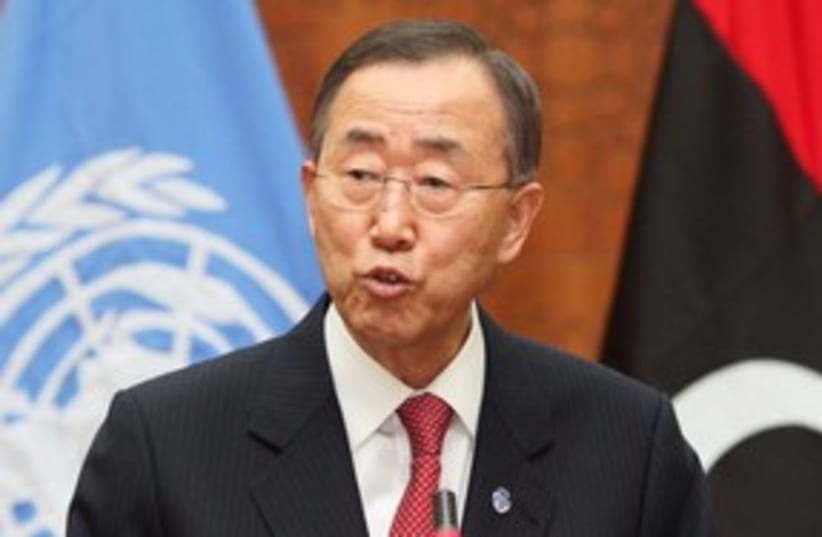
Ban Ki-Moon to focus on UN peacekeepers, Hariri tribunal, calls on Hezbollah to disarm.
By REUTERSUN Secretary-General Ban Ki-moon 311(photo credit: REUTERS/Ismail Zitouny)
BEIRUT - United Nations chief Ban Ki-moon arrived in Lebanon on Friday to discuss attacks on UN peacekeepers in the south, a UN-backed tribunal that has indicted Hezbollah men over Rafik al-Hariri's killing, and the fallout of a revolt in neighboring Syria.The secretary-general's trip made waves even before he arrived, with one Hezbollah leader saying he was not welcome, a stance criticized by Lebanese politicians opposed to the armed Shi'ite Islamist movement and its Syrian and Iranian patrons.RELATED:Thailand says Lebanese suspect arrested in security scareHezbollah threat prompts security for Ashkenazi Hezbollah accepted an expansion of the UN Interim Force in Lebanon (UNIFIL) in the south after its devastating 2006 war with Israel, but rejects a UN Security Council resolution that demands that it lay down its weapons, as all other Lebanese armed groups did after the 1975-90 civil war.In an interview that Beirut's an-Nahar daily published on Friday, Ban reaffirmed that Hezbollah, which says it needs arms to defend itself and Lebanon against Israel, should disarm."No state can work successfully without a monopoly over the legitimate use of force," Ban declared.UNIFIL troops came under three attacks last year in which Italian and French soldiers were wounded. A rocket was launched into Israel in November and another rocket launching was attempted last month. No group claimed responsibility."There are no explicit fears that there is a new climate of hostility to the United Nations," a diplomatic source said. "But there is concern, which the secretary-general will emphasize, over the attacks (on UNIFIL) in May, July and December."Indictment by Special Tribunal for Lebanon angers Hezbollah Hezbollah, the most powerful faction in Lebanon, is angry at the indictment by the Special Tribunal for Lebanon (STL) of four of its members over the assassination of Hariri, a former Lebanese prime minister, on Beirut's seafront in 2005.It denies any part in the bombing that killed Hariri and 22 others and vows not to hand over the indicted men. Hezbollah also wants Lebanon's unity government, of which it is a part, to cut off funding for the tribunal and end cooperation with it.Lebanon paid $32 million, its 49 percent share of the costs, in November, using a maneuver by which Lebanese banks gave the money to a special fund whose use did not need cabinet approval.Ban said he was sure Beirut would continue to respect its obligations. "I am very glad the Lebanese government decided to transfer the 49 percent of funds to the STL," he told an-Nahar.The UN chief said he would decide soon, in consultation with the Security Council and the Lebanese government, whether to extend the STL's mandate, which expires in March.Ban, due to speak on Sunday at a conference on democratic transitions, said he had repeatedly urged Syria to halt the killings that have turned a 10-month revolt against Syrian President Bashar Assad into one of the bloodiest of Arab uprisings."The Syrian authorities must respond to the legitimate democratic aspirations of the Syrian people," he told an-Nahar, adding that the Security Council, so far divided over Syria, should find a way to speak with one voice on the issue.The United Nations says more than 5,000 people have been killed in the unrest, which Syria blames on armed "terrorists" it says have killed 2,000 members of the security forces.Russia and China have blocked any firm Security Council action against Syria. The Arab League has sent monitors to find out if Damascus is complying with an Arab peace plan. If their report next week is negative, it may refer Syria to the council.
if(catID != 151){
var cont = `Take Israel home with the new Jerusalem Post Store