Astronomy
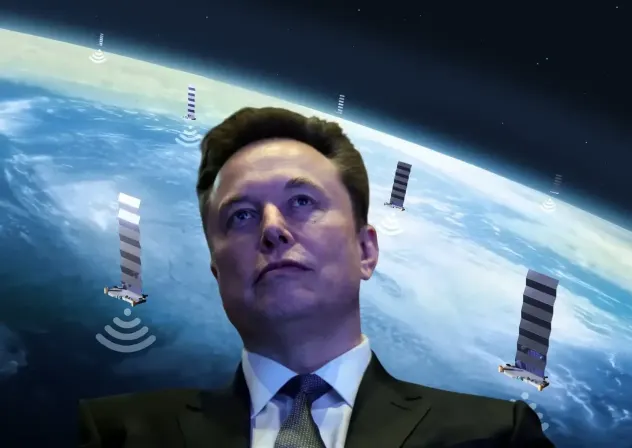
What environmental impacts would a million SpaceX satellites have on Earth, space? - explainer
SpaceX's Starlink pioneered the era of large satellite networks, known as megaconstellations, with rivals including Amazon and Chinese operators developing similar systems.

Israeli astrologer predicts Iran conflict will flare up within days, could last until 2028

China's Shenzhou-24 space flight takes off with Pakistani national as first foreign astronaut

On Columbus Day, remember Abraham Zacuto, the Jewish astronomer history forgot - opinion
Rare 'blue supermoon' to rise this week, won't return until 2037
The coming full moon will be the brightest and the largest of 2023.

Sun-observing spacecraft sheds light on the solar wind's origin
New observations by the Solar Orbiter spacecraft may provide an answer as to how the sun generates solar wind.

Scientists unveil secrets of star violently torn apart near black hole
Astronomers have recently encountered numerous instances of "tidal disruption events."

Spanish astronomer discovers a galaxy within a galaxy
A Spanish astronomer has discovered an active galactic nucleus at the center of the Sombrero Galaxy.

How did the Milky Way galaxy get its shape?
Our home galaxy, the Milky Way, did not always have its iconic spiral shape. Rather, it acquired its shape through a process called “galactic speciation.”

What sounds do twinkling stars make? - study
To get the "pure sound" of the twinkles the researchers applied a number of filters to the noise hoping to isolate the sounds from environmental interference.

NASA's Hubble Telescope records evaporating planet hiccupping during orbits
This variable loss was described as "puffs", meaning that when observed the atmosphere was lost in large bursts followed by almost no loss.

Do we need to change the definition of 'life' to find it among the stars?
As long as astronomists continue to search for life outside the borders of our world, biologists are forced to continue to reconsider the meaning of the word "life."

Hubble telescope captures galaxy clusters merging
Gravitational lensing has the practical effect of a magnifying glass, microscope, or binoculars, and enables scientists to observe celestial bodies that would otherwise be too distant to discern.

Introducing Janus, the exotic 'two-faced' white dwarf star
Scienets have observed a white dwarf star, named for the two-faced ancient Roman god, that appears to have two sides with completely different compositions.
