Earth
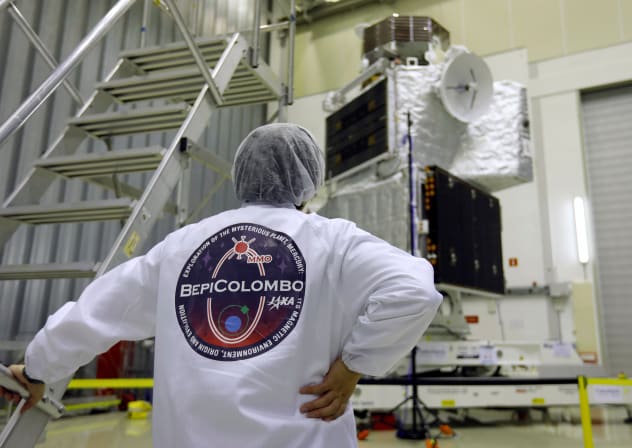
European-Japanese spacecraft reaches Mercury after eight-year journey, suffers glitch
Mercury, only slightly larger than Earth's Moon, is the least explored of the four planets in the inner solar system, with BepiColombo only the third spacecraft to visit the planet.

Shavuot 2026: The festival's Jewish mission to elevate the world

Israeli company wins space agency contract for next-generation satellite imaging

NASA tracks colossal asteroid on a close approach to Earth
Submerged tectonic plates? Scientists find anomalies deep within Earth's mantle
Using high-resolution models and the Piz Daint supercomputer, researchers identified anomalies beneath oceans and continental interiors.

No Cosmic Grinch: Asteroid 2024 XN1 to pass safely by Earth on Christmas Eve
NASA is set to track a sizable near-Earth object, asteroid 2024 XN1, which is expected to pass relatively close to Earth on December 24.

Flat Earth YouTuber admits mistake after trip to Antarctica
Campanella participated in "The Final Experiment," an expedition conceived by Will Duffy, a pastor from Colorado, aiming to end the long-standing disputes about the shape of the planet.

Are dark comets Earth's 'life delivery' couriers? We now know about 14 of them in the solar system
Dark comets resemble asteroids but speed up unexpectedly, suggesting they may fire jets of gas like comets.

Special delivery: New study suggests water came to early Earth via comets
A new study renews focus on the role of Jupiter-family comets in Earth's water history.

Human activity shifted Earth's axis by 80 centimeters, study finds
Water extraction caused an average annual drift of Earth's rotational pole by 4.63 cm, totaling 80 cm in less than two decades.

So soon? Bidding goodbye to our recently arrived mini moon
The smallish asteroid is expected to come back next year, and then take its leave for 30 more years.

Bigger than the dinosaur-killer, asteroid S2 smashed life on Earth into a higher gear
Researchers discovered a 3.26-billion-year-old asteroid impact acted as 'giant fertilizer bomb,' aiding early microbial life.

Researchers find strong evidence for “Snowball Earth” theory
Study “presents the first physical evidence that Snowball Earth reached the heart of continents at the equator” says lead author Liam Courtney-Davies.

Rendezvous with a comet: 10 years to the historic Philae comet landing
On 12 November 2014, after a 10-year journey, the European Space Agency's Rosetta mission's lander Philae made space exploration history.
