Archaeological study
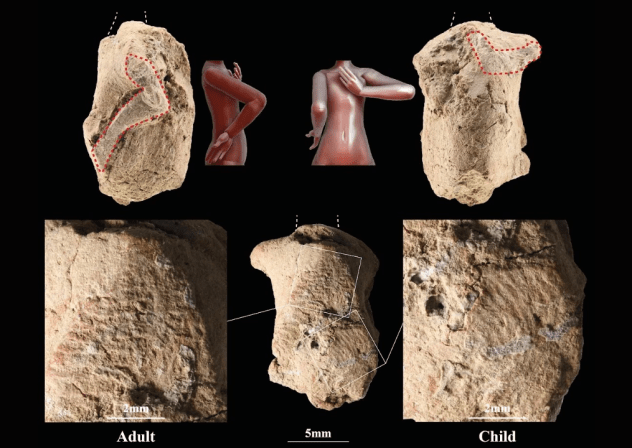
Israeli researchers uncover 15,000-year-old clay figurines, the earliest in Southwest Asia
The Natufians lived in the Levant from roughly 15,000 to 11,650 years ago and were the first people in Southwest Asia to establish permanent or semi-permanent settlements.
Collecting keepsakes may have helped autobiographical memory evolve in early humans, study suggests
Ancient Scythian burial site from Siberia reveals earliest known use of cannabis as an intoxicant

New LED technology helps archaeologists uncover details invisible to the naked eye
King Arthur's Hall in Cornwall found to be 4,000 years older than previously thought
The monument was first documented in 1583 by the English cartographer John Norden, who wrote, "It is called Arthur's Hall".

Newly discovered DNA changes previous speculation of Pompeii victims' final moments of life
A recent study has undermined prior assumptions about several victims of the Pompeii tragedy.

Ancient net fishing scenes discovered on 15,800-year-old stones in Germany
A plaquette previously showing a fish was found to include net-like lines. Seven others showed similar net-and-fish scenes.

Skeleton made from bones of five people across 2,500 years found in Belgium
The tomb, known as "Tomb 26," was unearthed in the 1970s during excavations of a cemetery in Pommerœul, near the French border.

Colombian rancher finds largest known fossil of three-meters tall “Terror Bird” in Tatacoa Desert
Fossil bears tooth marks from giant crocodile, hinting at how the predator met its end.

Archaeological mission discovers first Middle Kingdom tomb in South Asasif Necropolis
The excavation revealed a wealth of unique jewelry in the female burials, including necklaces, bracelets, chains, rings, and belts made from red agate, blue and green glazed ceramics, and faience.

Hidden 4,000-year-old fortified town discovered in the Khaybar Oasis of Saudi Arabia
Al-Natah, occupied from 2400 to 1500 BCE, had about 500 residents and is the first of its kind for studying an ancient settlement in northwest Arabia.
