Reporter's Notebook: Hollande was viewed as normal candidate for presidential election, or “the honest man.”
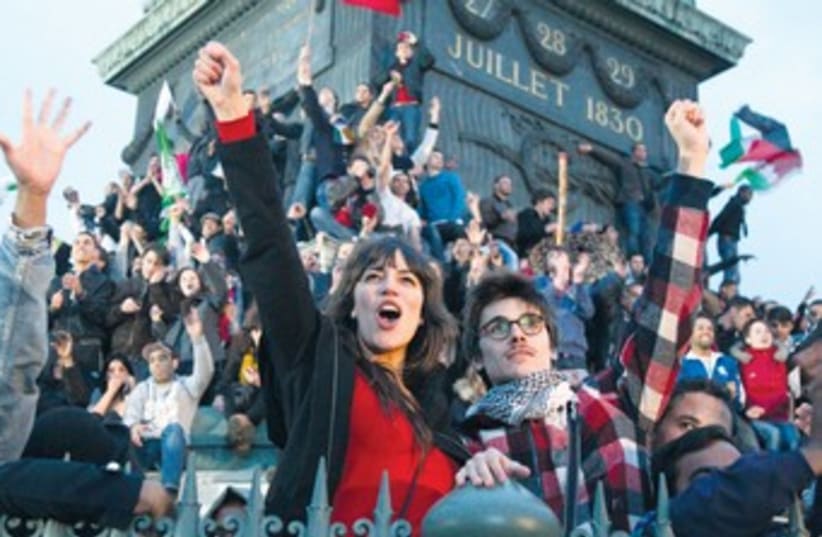
By JOSEPH STRICH JERUSALEM POST CORRESPONDENTSupporters of Hollande(photo credit: Reuters)
PARIS – This spring, “the people of the Left” emerged from the dark clouds and are now in Seventh Heaven following the victory of their candidate François Hollande on Sunday night.On Monday the title “The Norm,” on the front page of the daily paper Liberation, was a dual reference: An admiring yet critical description of the man from Corrèze – a region in central France. He is considered to be “a simple rural man” as opposed to the Impetuous Nicolas Sarkozy, as the title of the latest biography written by Catherine Nay describes him.Hollande was viewed as the normal candidate for the presidential election, or “the honest man,” an expression used on TV on Sunday night.The implication lasted throughout the whole campaign and in the end helped Sarkozy’s opposing candidates.Dominique Strauss-Khan, who possesses stamina and political savvy, may have beaten Hollande in the primary if not for his criminal allegations in New York.Out of nowhere, the “apparatchik” from the Socialist Party appears – the one described as “spineless,” a wet rag, before the first round of the elections. He then defeated Super-Sarko, the unpopular outgoing president.“The incredible revenge of the “normal” candidate; a push from destiny” wrote the daily paper Le Parisien.Hollande’s left-wing political philosophy may surprise those acquainted with his biography, as his father affiliates with the far-right.Some speculate that Hollande won not due to merit but as the lesser of two evils.The Socialist Party has won the presidential elections twice since 1954: François Mitterrand in 1981 and his reelection in 1988. The Left held a majority in the assembly until 2002.The Socialists now hope to achieve a parliamentary majority during legislative elections scheduled for June 10th and 17th. A victory in the upcoming poll would provide a strong mandate for the party.But many French consider the presidential election as “the mother” of all voting since it is the structure around which everything hangs.According to political pundit Roland Cayrol, “when a party loses the main election, their voters stop fighting and do not go to the next polls.”Laurent Fabius, former Socialist prime minister and a frontrunner for the Foreign Ministry portfolio, compared the present situation to 1981.“There are lots of analogies,” Fabius said. “We will remember May 6, 2012 as long as we have remembered May 10, 1981. It is such a long time, far too long. We expected this victory.”Jack Lang, another former Socialist minister waxed poetic.“The first time is like love, it is the first time. At the same time, the first time does not make sense if there isn’t a second time. It’s going to be a night of delight,” Lang said.Many left-leaning politicians and activists anticipated the victory and used the day as an excuse to celebrate in the streets.As a correspondent, I’m used to vast Parisian rallies – demonstrations with overflowing crowds between the Republique Metro station and La Nation Metro station. I saw many rallies during the campaign at la Concorde, at Trocadero, at Vincennes.In Tulle, Hollande’s hometown, revelers played “la Vie en Rose” by Edith Piaf and quoted the lyrics, as ‘the night of a rosy glow of satisfaction.”The crowd shouted to him, demanding “a kiss, a kiss,” as he stood alongside his companion Valerie Trierweiler.Also last night, hundreds of thousands crowded into Place de la Bastille to celebrate and initiate a new chapter for French politics.The French people are suffering, affected by the economic crisis. Expectations sounded grandiose, almost unrealistic.Later at La Bastille, Hollande said, “I am the president of the youth of France. You are more than a nation who has chosen a change; you are also a trend of opinion rising in Europe and maybe in the world.”For most, the party occurred at home, with family or friends for a dinner of “soirée electorale.” I attended two, one for a Sunday afternoon “goûter,” the other, a proper “soirée,” with gourmet food, champagne and expensive red wine.At the “goûter” I visited, guests spoke freely, in an animated manner. One friend shouted, “we will get rid of Sarko!” Another colleague folded herself in a red flag before leaving to vote. “Hollande is the least bad,” she said.Two others walked to la Bastille well before the rally and bombarded me with text messages to express their optimism – they even bumped into aspiring politician Eva Joly.I left as well, to go to my friend Claire Vieille’s “soirée.” She voted for Hollande but is not fond of his persona.Her friend, Emmanuel, is the lone Sarkozyite among the crowd. He is sickened by the gossipers in Parisian cafes.“Sarkozy may have diverted money from some online poker game with the singer Patrick Bruel,” one rumor stated. “He may have had Gaddafi killed because he may have given 50 million for his campaign in 2007! He may be a dictator, becoming a little Napoleon.”Emmanuel tells me all this before saying that he is a descendant of Masséna, a Field Marshall of Napoléon Bonaparte.I furiously scribble notes before returning to the party. The TV blared the results, unfolding a portrait of Hollande on the screen. “Hurray!” shout the guests as they raise their toasts, the champagne flowing freely.One onlooker says, “let the Red Flag fly over Neuilly,” referring to Sarkozy’s electoral stronghold and hometown.Another finds Sarkozy’s “chasing after the voters of the National Front unworthy of the republic and democracy.”Claire’s 12 year-old-son, a composed and calm kid, sums up the sentiment.“Change is good, but now Hollande has to prove himself up to it,” he says.“We changed president, it is a strange feeling,” says a friend of mine.I am reminded of a quote by Asterix the Gaul, that “the French are all mad.”
if(catID != 151){
var cont = `Take Israel home with the new Jerusalem Post Store