'Birthright contributed NIS 2b. to Israeli economy'
02/26/2012 22:45
‘Eretz Nehederet’ sketches spoofing Diaspora Jews "show importance of program in daily lives of Israelis," says Gidi Mark.
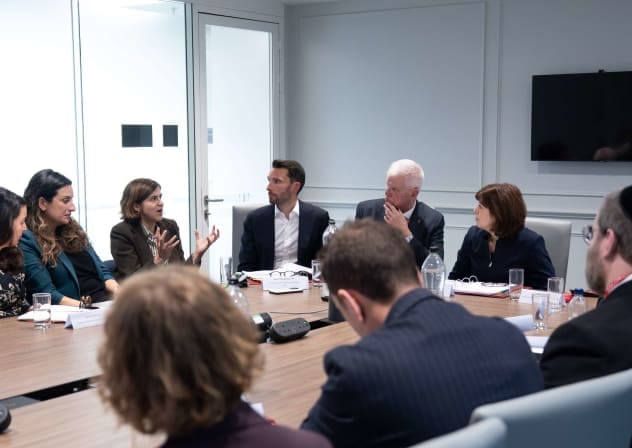
Gidi Mark at TASE with Birthright Excel participan Photo: Courtesy: Taglit-Birthright Israel
Taglit-Birthright Israel has contributed more than NIS 2 billion to the Israeli
economy since its inception in 2000, the organization said Sunday in an
announcement timed to coincide with the peak of its winter
season.
Birthright, Taglit’s flagship program, brings Jewish adults
between the ages of 18 to 26 from the Diaspora to Israel on a free, 10-day
educational trip.
Some 280,650 people have come to Israel since the
program was established, filling around 2.225 million hotel beds. The
organization estimates its programs have pumped more than NIS 178 million into
the restaurant industry, NIS 93 million into transportation, and NIS 82 million
into various tourist attractions.
Only direct expenditure was taken into
account, as it would have been impossible to calculate the value of repeat
visits by Taglit alumni, CEO Gidi Mark told The Jerusalem Post.
He
estimated that around 40 percent of Taglit participants have returned to Israel
at some stage, and that 7-10% have made aliya.
Despite its gradual
growth, Mark said Taglit’s most important contribution to the economy was made
in its early years, when it brought increasing numbers of young people to Israel
while other programs collapsed in the face of the second intifada.
“We
were almost the only source of tourism to Israel at that time. It was a
flourishing time for Taglit, [but one that] I hope will never return,” Mark
said.
He added that participation continued to increase around the time
of the Second Lebanon War in 2006, because the organization succeeded in
marketing Israel as “an attractive, safe destination for young Jews wanting to
discover their roots.”
Taglit’s best year so far was in 2008, when it
brought 44,000 Diaspora Jews to Israel following a $37-million contribution from
the Adelson Family Foundation. Participation halved the following year but has
gradually increased since, and Mark expects to attract a record 50,000 visitors
in 2013.
Mark said Taglit’s work was aided by the Netanyahu government’s
decision to contribute $100 million over the three years from 2011-2013, and by
the commitment made by the Jewish Agency, North American Jewish federations and
private philanthropists to match that with $240 million of their own
funds.
“All this will allow us to increase our contribution to the
Israeli economy,” Mark said.
He added that Birthright would add more
niche programs, following from the success of “Excel,” which has brought
students identified as future business leaders to Israel in each of the last
three summers. Such programs ensure participants will contribute to Israel and
its economy in years to come, Mark added.
Birthright has become known for
other reasons this past month, as high-rating television program Eretz Nehederet
poking fun at the program in a number of sketches. The ongoing series follows
four Birthright participants (three Americans and one Brazilian) as they travel
everywhere from Yad Vashem to Azrieli shopping mall in search of the complete
Israel experience. It mocks the Americans for their excitable nature and for the
ease with which they empty their wallets at every Israeli request for a
donation.
But Mark said he viewed the series in a positive light,
commenting that its very existence shows just how significant Birthright has
become.
“You cannot ignore the tens of thousands of young Jews who have
connected to us so quickly and become the best ambassadors for us around the
world,” he said.
“As a good Jew, I would hope I have a good sense of
humor, so I think the fact they have decided to run these episodes shows the
importance of Birthright in the daily lives of Israelis.”