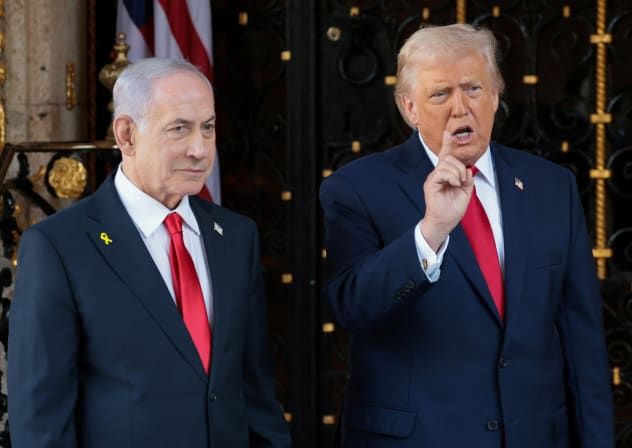
US Secretary of Defense Robert Gates is reported to have charged Prime Minister Binyamin Netanyahu with being an ingrate for failing to accept President Barack Obama’s terms for a settlement with the Palestinians. In this, Gates is echoing earlier presidential “spokesmen” such as former ambassador Martin Indyk and New York Times correspondent Thomas Friedman.
Apparently, it is expected that a country benefiting from American largesse will agree to surrender territory, rights and history in return.
In order to understand what the president was asking of Israel, and therefore why Netanyahu had to refuse, it is necessary to analyze just what his pronouncement calling for talks to start on the basis of the June 1967 lines entails.
For one thing, no previous American president had premised the Israeli-Palestinian talks on such a basis. American pronouncements repeatedly emphasized that the negotiations, and indeed any forthcoming agreement, was a matter for the parties to agree upon. No outside party was entitled to intervene and dictate the terms of the discussions.
The closest that any administration came to making such suggestions was
the ill-fated Rogers Plan of 1969 which, while calling for Jerusalem to
remain united, also endorsed a settlement with only minor territorial
changes. Israel vigorously rejected the Rogers Plan, with prime minister
Golda Meir declaring that a government accepting that plan as a
starting point would be guilty of undermining Israeli security. The
Nixon administration beat a hasty retreat, and with the substitution of
Henry Kissinger as secretary of state in place of William P. Rogers,
nothing more was heard of the plan.
That episode also highlights another unusual feature of the Obama pronouncements.
Presidents generally float new ideas by means of a subordinate, a state
department official or even a secretary of state. Such a procedure
ensures that the president’s prestige is not directly involved. It
allows the president to backtrack, if need be, or qualify the
subordinate’s statement without loss of face and without the
embarrassment of a major confrontation and crisis with an injured party.
In relation to the Middle East, however, Obama is acting very much as
his own secretary of state, issuing orders or statements directly from
the White House. This leaves very little room for revision of policy. It
becomes this or nothing.
On the subject of Jerusalem, such an approach is fraught with danger.
WHEN JORDAN unleashed its barrage on Jerusalem, against Israeli suburbs,
during the Six Day War, the Israeli response was immediate and
overwhelming.
Within two days Israel had expelled the Jordanians and united Jerusalem under Israeli control.
The international legal implications of this development were spelled
out by Stephen Schwebel, subsequently America’s judge on the
International Court of Justice, in an article entitled, “What Weight to
Conquest,” that appeared in the American Journal of International Law in
1970. He wrote: “Having regard to the consideration that ... Israel ...
[acted] defensively in 1948 and 1967 ... and her Arab neighbors ...
[acted] aggressively in 1948 and 1967 ... Israel has better title in the
territory of what was Palestine, including the whole of Jerusalem, than
do Jordan or Egypt.”
It should be remembered that neither President Johnson’s Five Points nor
Security Council Resolution 242 mentioned Palestinians. When the legal
status of Jerusalem was determined in 1967 in the wake of the Six Day
War the Palestinians were not a legal factor. Israel contends that
nothing has occurred in the interval to disturb Israel’s sovereign right
in all of Jerusalem. This status was confirmed in 1980 by the Knesset
when it adopted a law declaring: “Jerusalem, complete and united, is the
capital of Israel.”
Nor did the 1993 Oslo Accords modify matters, even with Jerusalem being
designated as the first item listed for the final status talks. Prime
minister Yitzhak Rabin declared in 1995: “Undivided Jerusalem is the
heart of the Jewish people and the capital of the state of Israel.
Undivided Jerusalem is ours.” Foreign Minister Shimon Peres, in a 1994
interview, said: “We have told the Palestinians this – we are very
adamant about our position. Jerusalem will not be redivided.
It will not be a Berlin... One cannot have two capitals in one city
because that would mean a division of Jerusalem. It is the historical
capital of Israel and Israel’s capital today.
... In summation, I would say that in the political sense, the issue of
Jerusalem is closed and it will remain the united capital of Israel.”
For these two men, discussion of Jerusalem in the final status talks
would relate only to matters of religious and social interests, not to
the political status of the city. Thus, in legal terms, Israel’s
position, as outlined by Prime Minister Netanyahu in his recent
Washington appearances, accurately reflected the longstanding bipartisan
position of the Israeli consensus.
IT IS this status of Jerusalem that President Obama apparently seeks to
modify. He cannot challenge Israel’s title directly. By confirming the
’67 line he seeks to posit that Israel lacks title in east Jerusalem.
However, both the facts and the law regarding Israel’s claim are clear
and decisive. Prime Minister Netanyahu was therefore fully justified,
and even compelled, to adhere to the pattern of his predecessors in
declaring categorically that the ’67 lines are not the starting point
for any negotiations. Those lines were armistice lines, and no more.
Netanyahu was unable to allow the United States to conceive, even for a
moment, that Israel could accept a dictat about the status of Jerusalem.
It is Israel’s contention that anything proposing the redivision of
Jerusalem is destructive of the search for peace.
Acceptance of Obama’s reference to the June ’67 lines means acceptance
of a scheme to divest Israel of its title to Jerusalem “complete and
united.”
This, in Israel’s view, is not compatible with the search for peace.
Anyone suggesting that Israel accept Obama’s proposals for negotiations
should first ponder the implications of those proposals for Israel’s
capital, Jerusalem.
The writer is a professor at the Hebrew University of Jerusalem and the author of Jerusalem in America’s Foreign Policy.