Hebron: A matter of opinion
By ANAV SILVERMAN
04/03/2012 22:11
Gabriel, leader of Germany’s Social Democratic Party. not 1st European politician to associate Israel with apartheid.
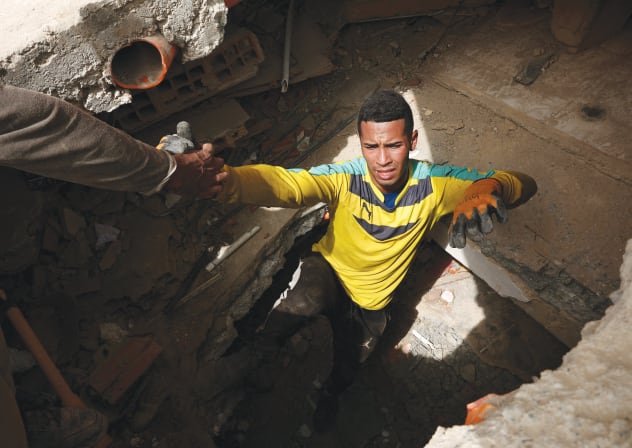
Palestinians, Jews Together Photo: REUTERS
When Sigmar Gabriel wrote that Hebron was “an apartheid regime for which there
is no justification” on his Facebook page (March 14), the chairman of Germany’s
main opposition party sparked an outcry that reverberated beyond his virtual
wall.
Gabriel, the leader of Germany’s Social Democratic Party and a
likely challenger to Chancellor Angela Merkel in 2013, was not the first
European politician to associate Israel with apartheid – nor will he be the
last.
While the comment may have been particularly surprising coming from
a high ranking German politician, the truth is that Gabriel simply echoed an oft
repeated statement made in international discourse about Israel – one that has
rarely been questioned in the past. In 2008, the former president of the UN
General Assembly Miguel d’Escoto Brockmann likened Israel’s policies to “an
apartheid of an earlier era.” In 2002, South African Archbishop Desmond Tutu
accused Israel of apartheid policies towards Palestinians.
Other notable
officials who have joined in the Israel apartheid chorus include former UN
special rapporteur John Dugard, former US President Jimmy Carter, Turkish
President Abdullah Gul, Palestinian Authority President Mahmoud Abbas,
University of Chicago political science professor John Mearshimer, prominent
Israeli media commentators and South African activists including antiapartheid
veteran Reverend Allan Boesak who in November 2011 stated that Israeli apartheid
is “more terrifying” than South Africa’s.
The above mentioned figures’
conclusions are inevitable considering their reliance on sources and
organizations that present Hebron in an extremely skewed light.
One of
the most active is the Temporary International Presence in Hebron (TIPH), the
group that guided Gabriel during his visit to Hebron recently. Established in
1994, TIPH representatives, who hail from Norway, Switzerland, Sweden, Italy,
Turkey and Denmark, patrol Hebron and provide situation analysis with the aim of
ensuring that residents are upholding human rights law while providing “a
feeling of security to the Palestinians of Hebron.”
TIPH, whose members
enjoy diplomatic immunity and wear special “observer” badges during their Hebron
patrols, has given numerous tours to ambassadors, government officials,
ministers and diplomats from across Europe. Israeli Foreign Ministry officials
in the past accused TIPH personnel of compiling false reports against IDF
soldiers and Jewish settlers, while ignoring violent acts by Palestinians,
thereby “vilifying Israel.”
What is most unfortunate about these tours is
that they do not provide an all-encompassing perspective of Hebron, rather one
that distorts its history and promotes a propaganda campaign that leads to the
demonization of Israel.
The tours do not highlight the fact that the
Jewish presence in Hebron dates to biblical times, from King David’s monarchy,
and continued for centuries after, throughout the Babylonian, Roman, Byzantine,
Arab, Mameluke and Ottoman periods.
Following the Hebron Massacre in
1929, where 67 Jews were murdered, their synagogues and homes ransacked by
Arabs, the survivors (who were saved by 19 local Arab families) fled. For the
next 38 years, Hebron had no Jewish community until after the 1967 Six Day War,
when the Jewish community was reestablished.
Nor is it made clear that
Hebron today is divided into two areas – H1 and H2 – following the Hebron
Accords in 1997, which were signed by Israel, the US and the PA.
The
accords offered international recognition of the existence of the city’s Jewish
community and its entitlement to security and development.
The accords
ceded some 80 percent of the area to the PA and left Israel responsible for
20%.
The majority of Hebron’s Arabs, approximately 120,000 people, live
in H1, which is the larger, thriving area of the city, full of factories,
businesses and continued construction. Palestinian police forces exercise full
control while the IDF is not allowed to enter unless they are escorted. H1 is
under PA rule and remains completely off limits to Jews.
The only area in
Hebron that Jews are permitted to live in is H2, the smaller and poorer area of
the city, which makes up 20% of the municipal territory. Jewish residents,
however, have access to only 3% of the city which entails one street along which
several Jewish neighborhoods are located. The 600 Jewish people who live among
30,000 Arabs are not permitted to travel into H1.
Furthermore, although
Israel’s security measures in Hebron have been questioned, they are crucial for
the protection of Jewish residents living in the city and for residents across
the country. Stabbing attacks against Jewish worshippers in the vicinity of the
Cave of the Patriarchs have been attempted numerous times since 2010. And one of
the most dangerous Hamas terrorist groups during the second intifada was the
Jihad Soccer Club, considered the best soccer team in Hebron, whose players and
coach carried out a wave of suicide attacks against Israelis, the most recent of
which in 2008 killed a woman and wounded 11 others in Dimona.
In reality,
the best way to gain an objective view of Hebron is to tour the city
independently, just as Stefanie Galla, a German lawyer from Cologne did in
December 2011. Galla travelled to Hebron and visited the city without a tour
guide. She recently wrote about her experience in the German liberal daily
newspaper, Der Tagesspiegel, where she called Gabriel’s view of Hebron
“one-sided.”
“The Hebron I have experienced is another,” wrote Galla, who
described the Jewish quarter in Hebron as “seeming to be a very small area,
sheltered by high walls and barbed wire.” According to Galla’s perspective,
Hebron to her was a “ghetto,” with “Jews included.”
Unfortunately,
Gabriel’s sensational comment, which received more than 1,000 likes on Facebook,
continues to perpetuate a misconstrued reality that is accepted as true by many
– except for the few like Galla who dare to think without being told
how.
The writer is an educator at Hebrew University High School. She
writes for Tazpit News Agency and a number of other news sources. She made aliya
from Maine in 2004.