Mass gratitute: Parshat Tzav – Shabbat Hagadol
By SHMUEL RABINOWITZ
03/21/2013 21:45
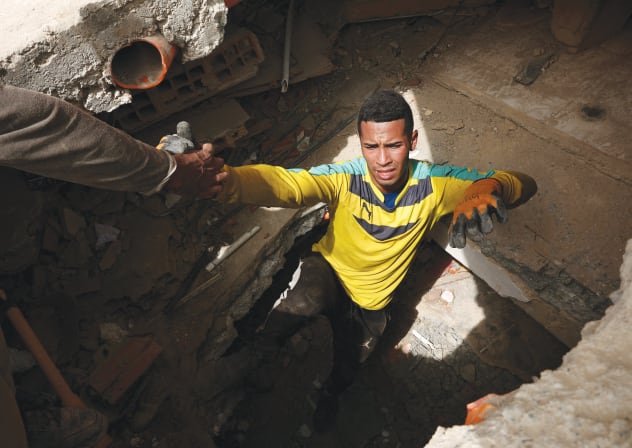
A person who was saved out of the grasp of danger feels a deep need to share his feelings of gratitude with those around him.
MAN HOLDS lamb at reenactment of Passover sacrifice Photo: Association of Temple Organizations
Among the many details regarding the laws of sacrifices that Parshat Tzav deals
with is one sacrifice that is still significant for us today, as members of the
Jewish nation who have lived for many years without a Temple or
sacrifices.
A person who was in a dangerous situation and was saved from
it, such as someone who was dangerously ill and recovered, or an innocent person
who was imprisoned and released, must – as is taught in our parasha – bring a
sacrifice of thanksgiving to the Temple.
This sacrifice is unique in that
it includes a tremendous amount of bread – 40 large loaves – to be eaten by the
person who experienced the miracle. He must eat all these loaves within a short
period of time: by midnight of the night after bringing the sacrifice.
If
we assume that the person brought the thanksgiving sacrifice in the morning of
that day, then he would have only about 16 hours to eat this huge amount of
bread.
Of course, a person cannot eat such an amount in such a short
time, and therefore he is allowed to invite anyone he wants to eat the bread
with him, as long as all the loaves are eaten by midnight.
What is the
purpose of this massive feast? And why is it connected to the thanksgiving
sacrifice and not with any other kind of sacrifice? Rabbi Naftali Tzvi Yehuda
Berlin (the Netziv), who was among the greatest of Torah scholars in the
previous century and the Rosh Yeshiva of Volozhin in Russia, provides us with an
explanation that teaches us the value of thanksgiving.
When a person
experiences a miracle – he was saved from death or from some other immediate
danger – he is full of gratitude to God. It could be that he had already
despaired from his situation and saw in his mind his impending death. Now that
he has been rescued from the danger, recovered or released, he expresses his
gratitude by bringing the thanksgiving sacrifice to the Temple.
But this
is not enough. A person who was saved out of the grasp of danger feels a deep
need to share his feelings of gratitude with those around him. We are all
familiar with this phenomenon.
When a person is saved from a great
danger, such as a terrorist attack or a grave illness, he is not satisfied with
quietly expressing the thanks and wonder that fill his heart; he feels the need
to share them with his acquaintances and sometimes even with those with whom he
is not acquainted.
Sometimes in these cases, a person even makes a great
effort to reach the media and share with the world the miracle that he
experienced. This is a natural, familiar and even healthy phenomenon, which
benefits the person himself and those around him who share in the miracle that
he experienced.
The Torah recognizes this healthy need and provides a
manner of expression through the large amount of bread that comes with the
thanksgiving sacrifice.
This person, who has just left the Temple holding
40 large loaves of bread which need to be eaten within the next several hours,
turns to his acquaintances – and if he has none in Jerusalem, he even turns to
strangers – and asks them to join him in eating the bread. Of course, these
people will ask him why he is celebrating, what happened that caused him to host
this feast. And he will answer them by telling the story of this wonderful
miracle that happened to him and the danger from which he was
saved.
Through these loaves of bread, the Torah brings the person’s
feelings of gratitude to a peak. By sharing his private miracle with great
publicity, the person is giving the utmost expression to his feelings and the
transcendent sense that he was saved from danger. Thus, many other people will
learn of the goodness of God, who supervises man and helps him in his time of
need, and will also learn to turn to God in times of distress and ask for
salvation.
Today, when the Temple does not exist, a person who was in
danger and was rescued recites before a quorum (usually in the synagogue during
the Torah reading) the blessing of, “Blessed are Thou... Who bestows good to
sinners, even as He has bestowed to me every good.” It is also customary to hold
a “thanksgiving feast” and share with family and friends the story of the
miracle, just as was done by the person who brought the thanksgiving sacrifice
with the many loaves of bread.
This Shabbat, adjacent to the holiday of
Passover, is called Shabbat Hagadol – the Great Shabbat. This name was given to
the Shabbat before Passover because of the great miracle that occurred during
that Shabbat when our forefathers were in Egypt, just days before their final
liberation and exodus to freedom.
On the night before the exodus from
Egypt, the Israelites celebrated the first Passover by eating the Passover
sacrifice. This sacrifice was a roasted lamb brought ceremoniously to the family
table on the evening of the holiday. But while we may think today that eating
the Passover Seder is a festive event and even one that whets the appetite,
about 3,300 years ago this eating came with no small amount of fear. The nation
of Israel was not yet liberated from the chains of Egyptian slavery. They were
living in a land that was full of pagan worshipers – whose main symbol was a
lamb.
The children of Israel had received a directive from Moses to take
a lamb for every family a few days before the holiday and slaughter it and eat
it on the evening of the holiday. They feared that their Egyptian neighbors
would not look kindly upon the slaughtering and festive eating of a lamb, and
the fear of the Egyptians’ wrath deterred them from fulfilling the
commandment.
But the Jewish nation courageously withstood this trial,
overcame their fear and ate the Pascal lamb. And, to everyone’s surprise, their
pagangod worshiping neighbors saw the Jews slaughtering, roasting and eating the
lambs and did not react with anger and violence after all.
This miracle
was the opening act of a wondrous chain of miracles that occurred during the
exodus from Egypt. In its memory, the Shabbat adjacent to Passover is called
Shabbat Hagadol.
The writer is rabbi of the Western Wall and holy sites.