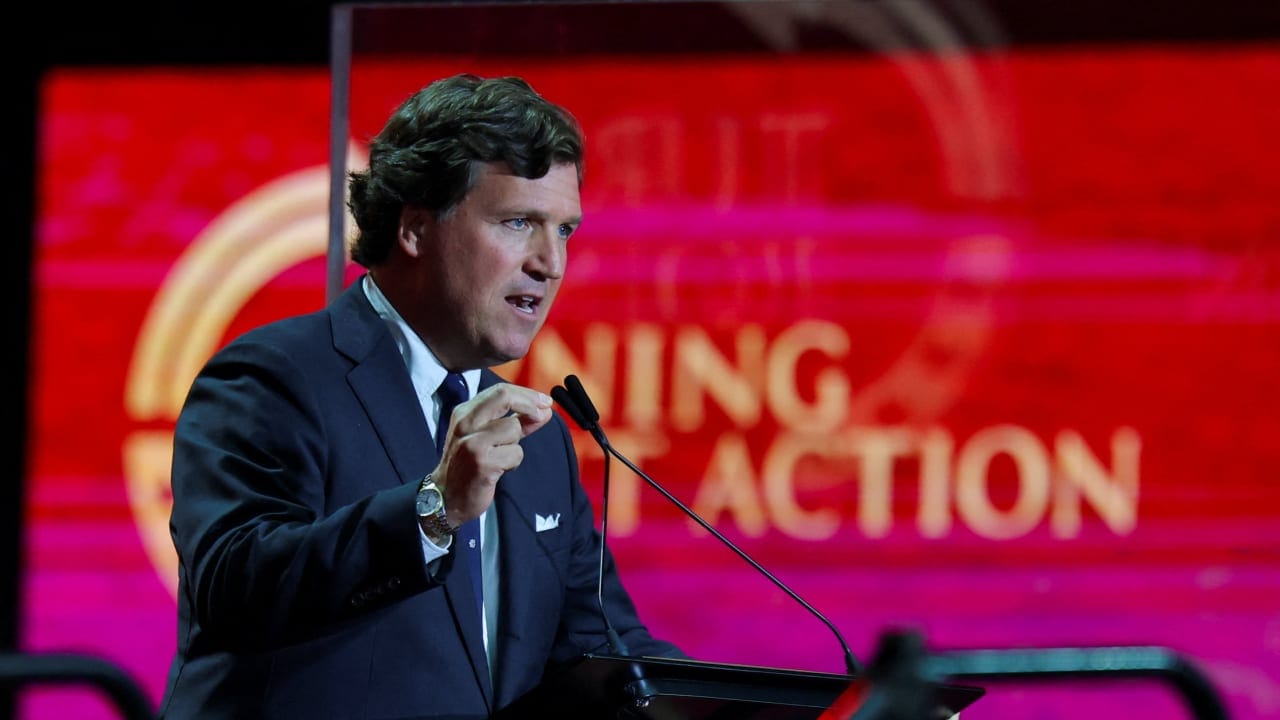
Tucker Carlson says that if JD Vance were president, the United States would not be at war with Iran.
He missed the most critical point: We might instead be facing a nuclear Iran.
Carlson speaks as though the only choice was war or peace. It was not. The choice was whether America would confront Iran’s nuclear program before it became unstoppable – or leave Israel, the United States, and the entire Middle East to live under the shadow of a nuclear-armed Iranian regime.
Saying that if Vance were president would have kept us out of the war sounds attractive. Nobody wants war. But what would he have done about Iran’s nuclear program? What would have replaced military action? Another agreement? Another inspection process? Another deadline? Another warning that Iran would ignore?
Carlson does not say.

“We would not be at war” is a slogan. It is not an answer.
But there is an even more disturbing part of Carlson’s statement, and I cannot understand why more Americans are not talking about it.
President Donald Trump has publicly said that he left instructions for an overwhelming American attack if Iran assassinates him. He said 1,000 missiles were “locked and loaded,” with more prepared to follow.
The legal reality is that a successor president would ultimately make the decision, but Trump’s purpose was unmistakable: Iran must believe that murdering an American president would bring destruction – not a political reward.
That warning did not come out of nowhere.
Iran and Iran-aligned forces have repeatedly threatened Trump, and Iranian propaganda has openly discussed killing him, displayed threatening imagery and circulated material focusing on his movements and possible security vulnerabilities.
There has also been reporting of a multi-million-dollar bounty attributed to an Iran-backed Iraqi group for his assassination, although the exact sponsorship and amount must be treated carefully until confirmed by authoritative sources.
This is the environment in which Carlson chose to announce that if JD Vance were president, America would not be at war with Iran.
Carlson is not an unknown commentator sitting on the sidelines. He is widely viewed as close to Vance and as an important voice within the political movement surrounding him. When Carlson declares that Vance would have taken an entirely different path, Iran is not hearing only a debate about past decisions.
Iran may also hear a message about what would happen next.
Trump is telling Tehran: If you assassinate me, the United States will strike Iran with overwhelming force.
Carlson is effectively telling the same regime: The man who would replace Trump does not support this war and would not have taken these actions.
What conclusion does he expect Iran to draw from that?
Is Carlson suggesting that Trump’s standing warning would not be carried by Vance if he were president? Is he telling Tehran that Vance would seek to de-escalate rather than follow Trump’s order? Is he publicly denouncing the very threat that was designed to keep Trump alive?
Most dangerously, is this an indirect encouragement for Iran to believe that assassinating Trump could change American policy in Iran’s favor?
Carlson sends dangerous message
I am not saying that Carlson wants Trump harmed. I am saying that his words create a dangerous message, and he should be held responsible for explaining it.
Intent is not the only thing that matters in national security. The message received by the enemy matters just as much.
Iran does not need Carlson’s permission to hate Trump. It already does. It does not need encouragement to threaten him. It already has. What Iran’s leaders are searching for is doubt that America would retaliate, doubt that Trump’s successor would carry out his warning, and doubt that killing one president would bring the full weight of the United States down upon them.
Why would Carlson give them that doubt?
The constitutional issue makes this even more serious. Trump may leave instructions, but if he were assassinated, JD Vance would become president and commander in chief. The final decision would belong to him. That means Carlson’s public portrayal of Vance’s position is not theoretical. It directly affects how Iran may calculate the consequences of attacking the president.
Vice President Vance should now make his position unmistakably clear.
He should tell Iran publicly that regardless of any differences over how the war began, any Iranian assassination or attempted assassination of Trump would bring the overwhelming response the president promised.
There can be no daylight on that question.
Carlson’s argument fails twice.
First, he says a Vance presidency would have avoided the war without admitting that the likely price could have been a nuclear Iran.
Second, he says it at the very moment Iran is threatening Trump’s life, and Trump is trying to convince Tehran that assassinating him would be suicidal.
Carlson may think he is attacking the war.
But he may also be undermining the warning intended to protect the president of the United States.
That is not a minor mistake. It endangers Trump, weakens America, and potentially tells Iran that the unthinkable could work.
The writer is the founder and CEO of the Orthodox Jewish Chamber of Commerce.