
A network of Iran-linked Shi’ite militias is operating in Iraq. Taken together, they are an extremely powerful military force.
When the Islamic Revolutionary Guard Corps launched ballistic missiles at US forces in Jordan on July 28, the US, in association with Saudi Arabia, did not aim its response at the IRGC directly.
They struck a number of the Iraq-based militias instead, accusing them of past attacks on US forces and of carrying out drone strikes on Saudi oil facilities – acting under the direction of the IRGC.
In short, the US and its allies have recognized that the militias are, in effect, an integral part of the Iranian military, a functioning wing of the IRGC.
This network of Shi’ite militias, spread across Iraq, was put together by Qasem Soleimani, the one-time commander of the IRGC’s Quds Force.
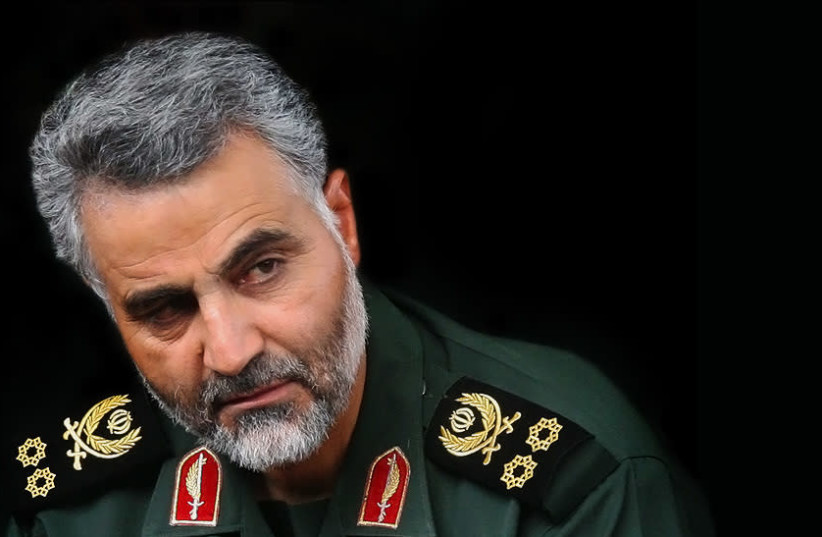
Responsible for Iran’s external operations and covert activities, it took him roughly 17 years – from the 2003 US-led invasion of Iraq until his death in 2020 by a US drone on the orders of US President Donald Trump – to build the network up.
It has since become an invaluable adjunct to Iran’s military potential. The militias, with Iranian financial and military support, have accrued arsenals that include long-range missiles and anti-aircraft weapons. They are, to put it briefly, a formidable proxy army capable of engaging the US and Arab countries in a long, costly conflict.
That was precisely Soleimani’s intention. The militias were built to fight Iran’s enemies beyond its borders, dragging conflict away from the Islamic Republic itself. With the US and Saudi Arabia striking Iraq instead of Iran, Soleimani’s plan appears to be working.
The UK’s Daily Telegraph reported a Tehran-based analyst’s opinion of the militias. “They have the potential to expand the war to Iraq and add more actors into it. Their main job is to move the war from Iran to Iraq.”
“If America wants to destroy them, it is a matter of one week,” the analyst continued. “But that would officially bring the war to Iraq, and this is what Iran wants. More actors and fronts will make it expensive and hard for Trump to carry on.”
Most of these Iran-aligned factions are nominally part of the Iraqi state’s Popular Mobilization Forces (PMF). The PMF as a whole is an umbrella organization comprised of dozens of militias that were mobilized in 2014 to fight ISIS.
In 2016, Iraq formally incorporated the PMF, which numbers well over 200,000 personnel, into the state’s security structure. It remains separate from the army and operates through its own command framework under the Iraqi government.
In practice, however, the framework is loose, and the main factions retain their own chains of command, intelligence networks, missile and drone arsenals, and political organizations, giving them substantial autonomy from the Iraqi state.
The principal Iran-aligned militia organizations operating within Iraq include Kataib Hezbollah, Asa’ib Ahl al-Haq, Harakat Hezbollah al-Nujaba, the Badr Organization, and Kataib Sayyid al-Shuhada. They are estimated to field around 50,000 frontline fighters.
Despite recent US and allied strikes, which have damaged their facilities and killed commanders, they remain militarily formidable. They possess rockets, ballistic missiles, armed drones, anti-tank weapons and sophisticated intelligence capabilities.
Several have extensive combat experience from Iraq, Syria and, more recently, operations linked to the wider Iran-Israel-US confrontation.
Militia organizations' embedding into Iraqi society
Moreover, rather like the position that Hezbollah in its heyday achieved within Lebanon, the militia organizations have embedded themselves deeply in Iraq’s political, economic, and social fabric.
Many militia leaders also head political parties represented in parliament, and hold ministerial portfolios or influence appointments throughout the security bureaucracy.
Further, they command substantial financial resources through various economic enterprises, border crossings, and reconstruction contracts.
Not all the money acquired is illicit. Many PMF units are officially part of Iraq’s security apparatus and receive government funding. Salaries, equipment, and operational budgets come from the Iraqi state budget and are legal.
But Iraq’s borders with Iran, Syria, and other neighbors handle billions of dollars in trade annually.
Notably, reports from Iraqi officials, researchers, and international organizations have described militia influence at certain border crossings, where groups allegedly extract unofficial “fees” from importers and truckers, facilitate smuggling operations, manipulate customs procedures, and gain control over transportation and logistics services.
After the war against ISIS, Iraq set aside large amounts of funding for rebuilding damaged cities and infrastructure. Militia-linked businesspeople and companies have been accused of winning government contracts through political influence.
They demand kickbacks from contractors seeking permits or security access, and control local economic activity in areas where the militia is dominant.
Consequently, the Iran-linked militias function not merely as armed groups, but as an entrenched political-economic network embedded within the Iraqi state.
This is a situation that Iraq’s recently elected Prime Minister Ali al-Zaidi – very much like Lebanon’s President Joseph Aoun – finds intolerable.
Both have declared their intention to bring all non-state military groups within their respective nation’s control. Al-Zaidi has gone so far as to set September 2026 as a target for significant progress. His pledge enjoys support from Washington and from many Iraqis who wish to strengthen national sovereignty.
He faces formidable obstacles. The strongest militias reject complete disarmament. With powerful parliamentary allies and independent sources of finance, they are in a position to frustrate any attempt by al-Zaidi to bring them under government authority. In any case, many of those within the groups do not see themselves as part of Iraq’s security forces, but as integral to Iran’s wider Axis of Resistance.
A complete dismantling of these organizations therefore appears unlikely in the short term. Al-Zaidi may succeed in reducing their autonomy, but not in eliminating their independent military and political influence.
An Iranian official is reported in the Daily Telegraph as describing the militias as “indispensable.”
“They are the backbone of the resistance forces in the region,” he said, “and their nature of multiple groups and closeness to Iran are their biggest strengths.”
He added that “some of them were in Iran during the war to help our armed forces control the streets” – that is, to subdue anti-government protesters – an indication of how deeply the militias are woven into Iran’s war machine.
For the foreseeable future, Iran can continue to rely on this substantial external military power to bolster its own military capacity.
The writer, a former senior civil servant, is the Middle East correspondent for Eurasia Review. Follow him at: www.a-mid-east-journal.blogspot.com