
Over the past year, I have walked onto American university campuses expecting hostility.
I usually found it.
I have been screamed at, protested, and confronted by people who had never met me, as though being Israeli told them everything they needed to know about my character. During my time as Miss Israel, the reaction became even more intense. I was no longer simply another Israeli arguing her perspective. To some people, I had become a walking symbol of everything they believed Israel represented.
But something else happened on those campuses that surprised me.
Some of the people most willing to speak with me were students from the Middle East.
Not necessarily to agree with me. Not to suddenly abandon everything they believed. Just to speak. To ask questions. To tell me where their families came from, and to hear where I came from. To disagree with me without first deciding I was evil.
The more it happened, the harder it became to dismiss as an anomaly.
This didn't begin when I became Miss Israel, or even after October 7. I am an Israeli who has spent much of my life in the Diaspora. For as long as I can remember, that has meant explaining Israel to people who often had remarkably strong opinions about it.
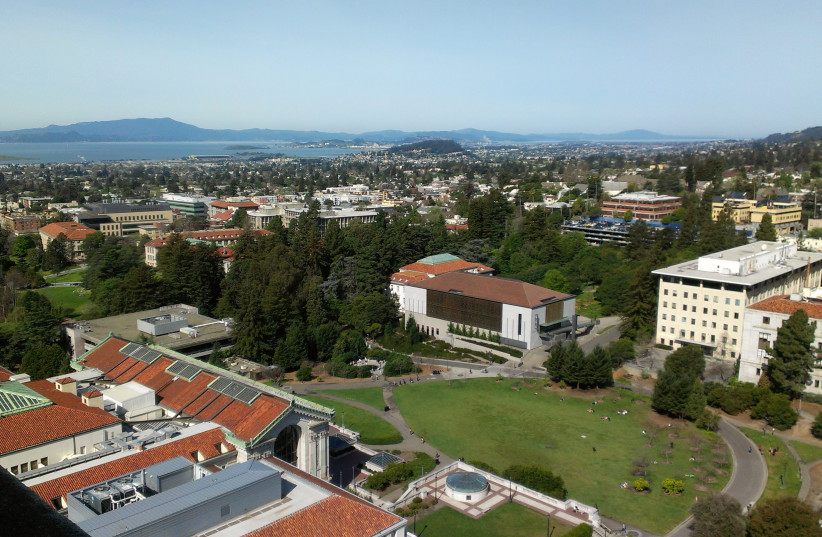
And in 2016, I became a student at UC Berkeley.
Israel was everywhere there: in classrooms, protests, student politics, conversations between friends. I spent four years talking to people across the political spectrum, often one-on-one, about the place I come from.
After Berkeley, I became a data scientist. Years later, my advocacy became much more public. Over the past year, during my time as Miss Israel and continuing today, I have toured universities across the United States speaking about Israel to thousands of students. I have spoken to welcoming audiences and hostile ones. I have debated protesters, stayed behind after events, and spent countless hours talking one-on-one with students who wanted to challenge me.
Taken together, I have now had nearly a decade of these conversations. It isn't a scientific study, and I didn't record every interaction in a spreadsheet. But after ten years and thousands of encounters, patterns become hard to ignore.
One in particular kept surprising me.
The people with the greatest personal connection to the Middle East were often not the hardest for me to reach. Oftentimes, they were the easiest.
Easy connections in the Middle East
I have had Arab and Muslim students approach me with deeply held disagreements and still want to know what I actually thought. They asked questions. They told me about their families. They challenged me, and then they stayed for my answer.
Meanwhile, some of the most absolute hostility I encountered came from Americans thousands of miles removed from the region, speaking about Israelis and Palestinians with a certainty that those of us who actually come from the Middle East rarely possess.
I began wondering whether we are paying attention to the wrong people.
We spend enormous amounts of time watching the loudest protesters, the ugliest social media comments, the most extreme political voices. Algorithms reward outrage, so outrage becomes our window into one another. Eventually, Israelis begin to believe the entire Arab world hates us. Jews begin to believe we are completely alone. Arabs are handed their own distorted image of Israelis.
Then, occasionally, two people who are supposedly enemies end up in the same room, and the narrative becomes much harder to maintain.
I saw that again when I represented Israel at Miss Universe.
Suddenly the experiment was global. I was surrounded by women and fans from countries with radically different histories, cultures, and relationships with Israel. Some came from places where Israel was primarily something they knew through politics, headlines, or social media.
And yet, face to face, the abstractions often fell away.
People approached me with questions about Israel, sometimes cautiously, sometimes with visible uncertainty. They wanted to know what life was actually like there. They asked about my family, my experiences, what I believed. Their questions were not always easy. Some reflected assumptions I strongly disagreed with. But many were asked in good faith, and good-faith curiosity can open a door that certainty keeps locked.
I found that same humanity among fellow contestants. We did not all agree about the conflict, and we didn't need to pretend our countries shared the same histories or interests. But backstage, away from official positions and geopolitical abstractions, we were young women sharing meals, stories, nerves, and laughter.
There is something powerful about meeting the person you had previously known only as a nationality. It is much easier to hate a category than a human being sitting beside you.
Then, recently, the same pattern followed me into a much less glamorous setting: an Uber.
My driver was Lebanese. When the conversation turned toward where we were from, I hesitated for a moment before telling him I was Israeli. There is always a small calculation now before saying it.
Then I told him. Nothing terrible happened. Quite the opposite.
We talked. We laughed. Somewhere along the way, he asked me about October 7, about what I had experienced, about Israel, about everything that had happened since. We found ourselves speaking openly about a conflict that, on paper, should have placed us on opposite sides of an enormous divide.
But the conversation didn't feel like a debate. It was heartwarming.
Here was a Lebanese man asking an Israeli woman about one of the most painful days in her country's history, not to challenge her grief or score a political point, but because he genuinely wanted to understand her experience.
I wanted to understand his.
For a moment, all the political machinery surrounding our identities seemed almost absurd. We were two people from neighboring countries that technically remain enemies, sitting in a car in America, talking about our region with more humanity than I had encountered in many conversations on American university campuses.
I left the car thinking about that interaction long after the ride had ended, because I found myself recognizing the same thing I had been seeing for years.
A conversation with one Arab student could be an anecdote. An unexpected friendship at Miss Universe could be an exception. A heartwarming exchange with a Lebanese Uber driver could simply be a nice story.
But after nearly a decade of conversations, as an Israeli living in the Diaspora, a student at Berkeley, speaking to thousands of students across America, representing Israel on an international stage, and now continuing that work, the same signal keeps appearing in very different places.
Again and again, the people I had been taught to see as being on the other side were often the most curious about me, and I about them. Through that curiosity, something else became clear: we had far more in common than the world had led us to believe.
The loudest voices tell Jews that we are alone. They tell Israelis that everyone around us will always hate us. They tell Arabs that Israelis are monsters with whom coexistence is betrayal.
But increasingly, reality is complicating that story.
The Abraham Accords were perhaps the most dramatic evidence of it. Countries that had spent decades without formal relations with Israel chose normalization instead. What followed was not just diplomacy between governments, but flights, tourism, trade, business relationships, cultural exchanges, and encounters between ordinary people who previously had few opportunities to meet one another.
And remarkably, even after October 7 and years of war placed extraordinary pressure on those relationships, they endured.
Perhaps that is because the change underway in the Middle East is bigger than a treaty.
What I have witnessed over nearly a decade is, of course, happening on a much smaller scale. But from Berkeley to campuses across America, from backstage at Miss Universe to the front seat of a Lebanese man's Uber, I keep encountering the same signal.
At some point, when a signal appears across different places, different people, different circumstances, you start to wonder whether you're looking at something larger than a collection of anecdotes.
Maybe the tide really is changing.
Not everywhere. Not all at once. And certainly not without forces fighting hard in the opposite direction.
But it is changing.
Behind the governments, the wars, the algorithms, something quieter is happening between people.
Curiosity.
It may not sound revolutionary. But in the Middle East, I think it might be.