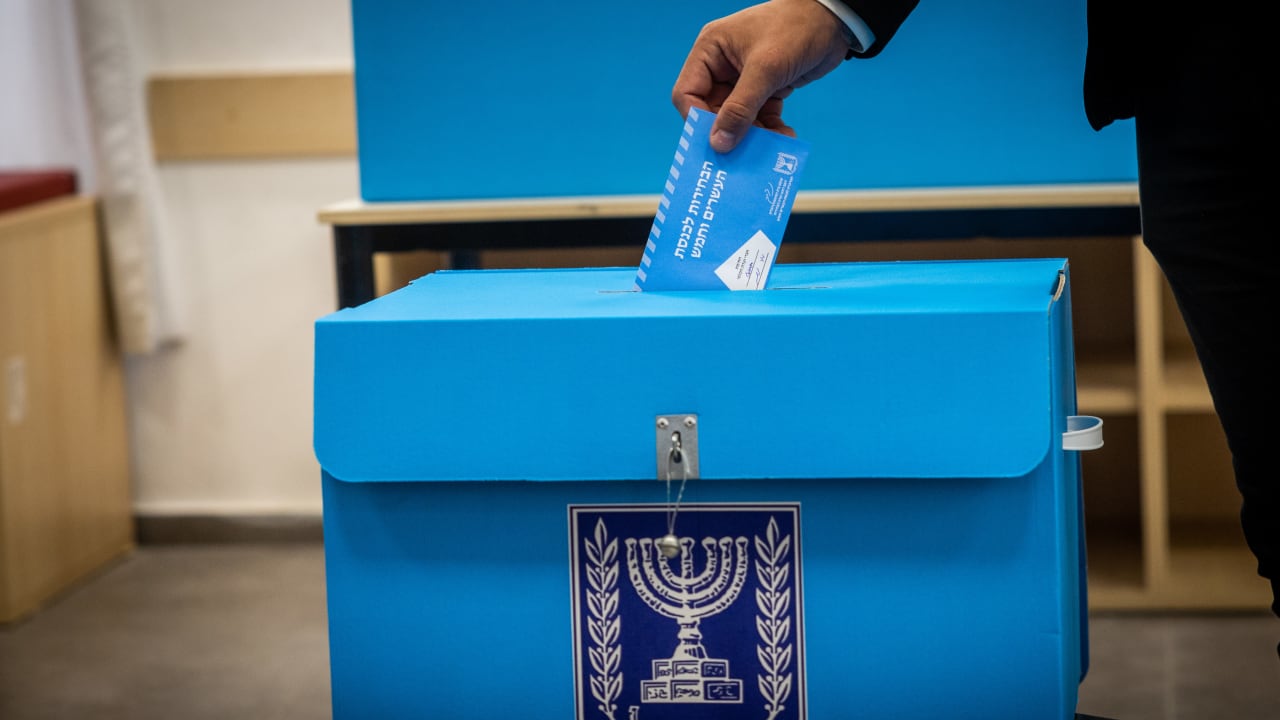
Israel should take another look at its electoral threshold.
The logic behind raising it to 3.25% in 2014 was hardly absurd. Israel once had a threshold of just 1%, meaning tiny factions could enter the Knesset and exercise influence wildly disproportionate to their support.
In a 120-seat parliament where 61 seats make a government, a faction representing a sliver of the electorate could become indispensable to a coalition and extract an extraordinary price for its support. In 2014, the Knesset raised the threshold from 2% to 3.25%, with proponents arguing that consolidation would reduce fragmentation and improve governability.
Politics also played a role. Critics argued that the change was aimed partly at making it harder for small Arab parties to enter the Knesset.
The result was almost comically counterproductive: the Arab parties united and performed better than ever, with four parties joining forces in response to the higher threshold and creating the Joint List, which won 13 seats in 2015 and became the Knesset’s third-largest faction.

The threshold had produced precisely the consolidation its supporters advertised, although perhaps among the last parties some of those supporters wished to strengthen.
Then came 2022, and the other side of the experiment became impossible to ignore.
Former prime minister Yair Lapid pleaded with Labor leader Merav Michaeli to run together with Meretz. Both parties were perilously close to the threshold, and Lapid understood the arithmetic. Michaeli refused.
She believed the two parties would perform better separately, while Meretz leader Zehava Galon favored an agreement. Michaeli rejected incentives offered by Lapid to facilitate a joint run, and the decision became one of the great electoral miscalculations in recent Israeli history.
Meretz received 150,696 votes, or 3.16%, and fell just 4,124 votes short of entering the Knesset. Balad, running separately from the other Arab parties, received another 138,093 votes, about 2.9%.
Together, the two parties collected 288,789 votes, more than 6% of all valid ballots and the raw-vote equivalent of more than seven Knesset seats.
The consequences were enormous. Netanyahu’s four-party bloc emerged with 64 seats against 56 for everyone else, an apparently decisive victory.
Yet the underlying vote was remarkably close. The Likud-Religious Zionist Party-Shas-United Torah Judaism bloc (plus another party that failed by a wide margin to cross the threshold) received 2,360,757 votes, while the eight parties against him received 2,330,464, including the votes for Meretz and Balad that yielded no representation.
The precise counterfactual depends on which parties had combined and how surplus-vote agreements played out, but the central fact is extraordinary: an electorate divided almost evenly – indeed with a tiny majority opposing Netanyahu’s coalition – produced a 64-56 Knesset in his favor.
Exactly what would have happened under a different threshold is impossible to know, because changing it affects more than Meretz. One post-election analysis found that if Meretz alone had crossed 3.25%, Netanyahu’s bloc probably would still have won 61 or 62 seats.
Pollster Dudi Chassid calculated that a Labor-Meretz merger combined with a reunited Joint List including Balad could instead have reduced it to 60, while Israel Democracy Institute modeling found another plausible combination that produced only 59 for Netanyahu, meaning Lapid would have stayed in power.
Instead, Netanyahu took office with an eight-seat majority. Within days, Justice Minister Yariv Levin unveiled the judicial overhaul, beginning an effort to shift power dramatically toward the elected government.
Israel plunged into months of demonstrations and an extraordinary constitutional confrontation over the power of a parliamentary majority and the institutional restraints upon it. To critics like me, Netanyahu was trying to “Putinize” Israel.
A few thousand votes therefore helped separate radically different political outcomes. That degree of distortion deserves scrutiny in any democracy, and especially in Israel, where elections routinely produce closely divided blocs and the consequences of a handful of seats can be profound.
The irony is that the threshold has delivered only a limited version of its promised benefit. Individual legislators can still destabilize governments when they are sufficiently determined to defy their parties.
The 2020 election illustrated the problem. Benny Gantz had a potential route to a 62-member majority involving his own bloc, with outside support from the Arab Joint List.
That route collapsed when individual lawmakers, including Orly Levy-Abekasis (who ran with the Labor Party and Meretz) and Blue and White members Yoaz Hendel and Zvi Hauser, refused to support a government dependent on the Joint List.
The larger parties produced by Israel’s electoral system therefore failed to prevent a tiny number of legislators from exercising exactly the kind of leverage that the threshold was supposed to diminish.
The Bennett-Lapid government demonstrated the point even more dramatically. In April 2022, coalition whip Idit Silman left the coalition, immediately reducing Bennett’s 61-member coalition to 60 seats and depriving it of its majority. Amichai Chikli, another Yamina MK – currently Diaspora affairs and combatting antisemitism minister – had already rebelled against the coalition shortly after it was established.
Then came Meretz MK Ghaida Rinawie Zoabi. In May, she announced that she was leaving the coalition, temporarily reducing the government to just 59 seats.
Three days later, after intense political pressure, she reversed herself and returned. One legislator had briefly placed the government on the brink of collapse.
This is precisely the phenomenon the threshold was supposed to ameliorate. Basically, it cannot be fully eliminated: in the United States, one senator’s vote can scuttle appointments and legislation and – in extraordinary circumstances – remove a president.
There is still a case for some threshold. It discourages vanity parties, encourages alliances and makes it harder for every ambitious politician with a personal following to establish a one-person parliamentary faction.
Yet the benefit has proved much smaller than advertised, while the potential cost is enormous. Hundreds of thousands of citizens can cast perfectly valid votes in a national election and receive zero parliamentary representation.
Meanwhile, individual MKs retain ample ability to threaten governments, defect from coalitions and transform the parliamentary arithmetic.
Israel therefore has reason to reconsider the entire design rather than treating 3.25% as some scientifically determined democratic sweet spot.
Raising threshold for entering Knesset
One option would be to lower the threshold dramatically, accepting greater fragmentation in exchange for greater proportionality and ensuring that almost every significant body of voters receives representation.
Another would be to move decisively in the opposite direction, perhaps toward 5%, creating such a formidable barrier that political camps would have overwhelming incentives to consolidate before Election Day rather than gamble with their voters’ representation.
This would presumably have prevented Michaeli’s catastrophic miscalculation.
Under such circumstances, fewer voters would risk small parties, reducing their support further. The cost there would be a smaller diversity of views on the party level.
Either approach has drawbacks. At least each follows a coherent principle.
The current threshold occupies an uncomfortable middle ground, and it is not working.
The writer is a former Cairo-based Middle East editor and London-based Europe/Africa editor of the Associated Press. He served as chairman of the Foreign Press Association in Jerusalem and authored two books about Israel.