Antisemitism and anti-Israel sentiments continue to rise in the Netherlands.
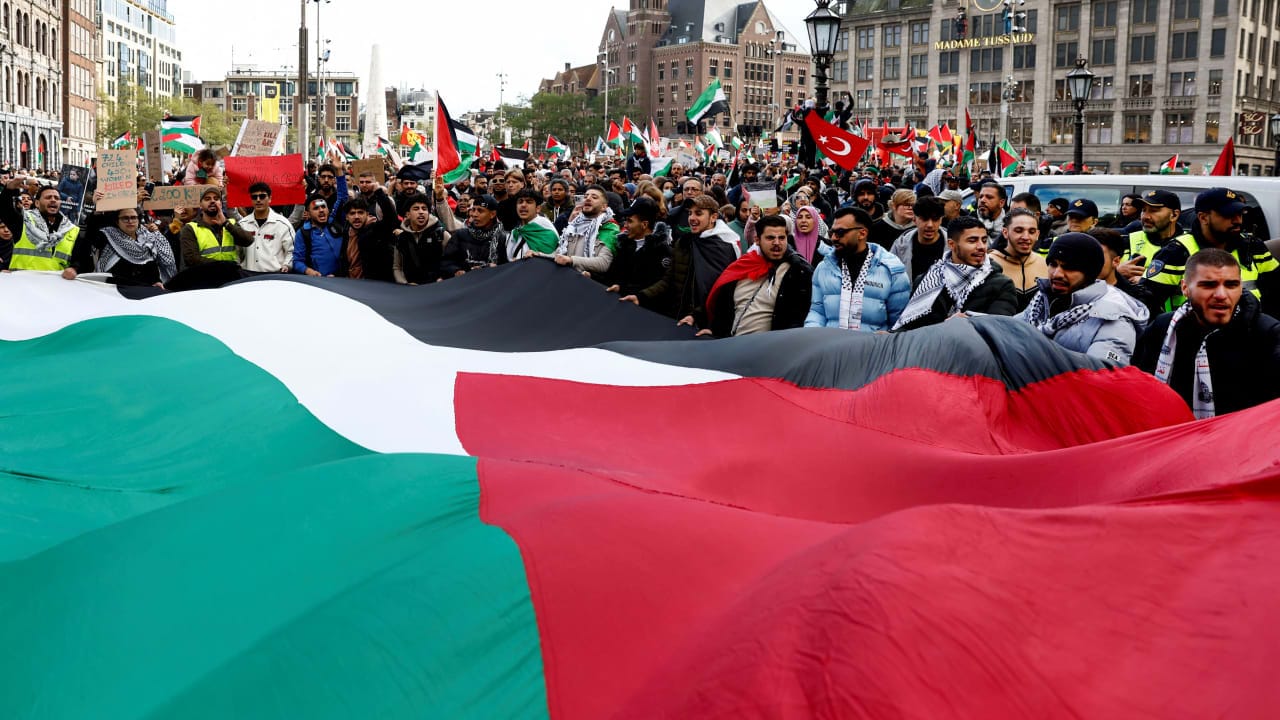
At the beginning of November, a group of strongly anti-Israel NGOs and a collection of far-left and Islamic organizations led a march of over 200,000 people in Amsterdam to pressure the Dutch government to take harsher measures against Israel.
Among them was Amin Abou Rashed, a leading figure in the Palestinian movement in the Netherlands, who was designated by the U.S. in 2025 as a senior Hamas operative in Europe.
Just this week, the Amsterdam City Council voted 34-8 to allow cultural boycotts of Israeli artists. What is alarming is that no one in power seems to care that this targets and effectively excludes the Jewish community.
In March 2026, Amsterdam wanted to hold a referendum on whether the city should boycott Israel. But a city-appointed committee pointed out that Amsterdam should not interfere in the Netherlands’ foreign policy even though national politicians regularly weigh in on Amsterdam.
On a national level, right-wing parties have proposed cutting off subsidies to organizations that boycott Israel.
Due to the threats from national right-wing parties, an extreme-left party called “Bij1” proposed the motion, which has now been adopted, to allow cultural institutions the right to boycott Israeli artists.
Even before this motion passed, a boycott of everything Jewish and Israeli in Amsterdam already effectively existed. Venues worry about renting to Jewish organizations because of vandalism and protest concerns.
Jewish institutions like synagogues and schools require heavy security due to threats. And now there is this official cultural boycott of Israel as hundreds of institutions have indicated (voluntarily or not) that they will boycott Israel and will no longer cooperate with Israeli institutions, unless they are not complicit in the alleged “genocide.”
A boycott is, by definition, a restriction on freedom, a tool that must be used with restraint because it is, after all, a drastic measure and a last resort. In practice, it affects a large portion of the Jewish community and severely infringes upon the fundamental rights of others.
The Amsterdam city government claims that this boycott is part of artistic freedom, which is ironic because you cannot expand artistic freedom by boycotting artists.
This boycott doesn’t just affect Israelis though. It hits the Dutch Jewish community hard because although in theory it targets institutions, in practice it targets every Israeli and Jew, regardless of their politics or beliefs, just based on their nationality.
Amsterdam has made a terrible decision to support these boycotting organizations, which will ultimately bolster antisemitism in the Netherlands.
This is the behaviour of activists, not city councils. But part of the city council consists of activists who know little about democratic values and the rule of law.
Their ignorance and bias have created even more direct consequences for the Jewish community in the Netherlands, which is scary and sad considering Amsterdam’s history. But maybe we should not be that surprised by this boycott decision, considering a senior Hamas official parades around the streets of Amsterdam, dragging behind him hundreds of thousands of people, essentially unchecked.
Freek Vergeer is a researcher and writer for the Center for Information and Documentation Israel (CIDI), a Dutch pro-Israel advocacy and information organization.