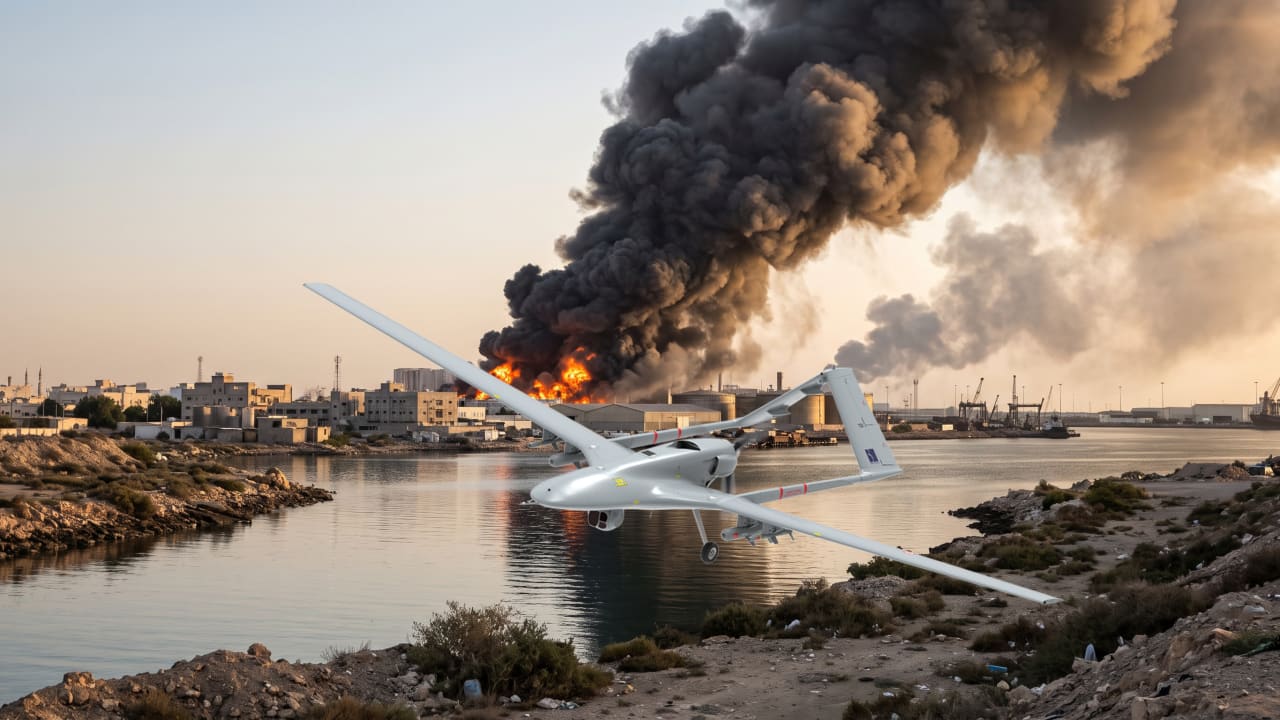
Turkish drones and foreign military support deepen Sudan's tragedy amid accusations that regional bases are being used in combat operations
International concern is growing over the widening scope of foreign military intervention in Sudan's war, as new evidence emerges of Turkish-made drones deployed at Egyptian military facilities near the Sudanese border, coinciding with UN warnings that the flow of foreign weapons and combat technology has contributed to escalating the conflict and exposing civilians to repeated attacks.
International press investigations indicate that the war raging since April 2023 between the Sudanese army and the Rapid Support Forces has gone beyond the bounds of an internal confrontation, as foreign weapons systems and cross-border supply networks have become an influential factor in the balance of power, amid a growing overlap between the security and political interests of regional and international states.
An investigation published by Reuters on 2 February 2026 revealed the deployment of Turkish-made "Bayraktar Akinci" combat drones at Egypt's East Oweinat airport, located near the Sudanese border, based on satellite imagery, flight-tracking data and interviews with officials and security experts. The images showed aircraft of this type at the airport in September and December 2025 and January 2026. The agency noted that The New York Times had earlier published images of similar aircraft at the same facility and reported their use in carrying out strikes inside Sudan.
Flight-tracking data also showed Turkish military transport flights arriving at East Oweinat during the period in which the drones were deployed, including flights departing from areas housing facilities linked to the testing of advanced Turkish aircraft. Reuters was unable to determine the nature of the cargo transported or independently verify all accounts of military operations launched from Egyptian territory. These findings highlight the growing role of drones in Sudan's war, having become a primary means of reconnaissance, targeting and long-range strikes, a shift that has increased the warring parties' ability to hit sites beyond traditional front lines.
An investigation published by The Washington Post in March 2025, based on documents and correspondence, revealed that the Turkish company Baykar had supplied the Sudanese army with drones and missiles, alongside technical support linked to the execution of the deal, raising questions about the nature of military and technical cooperation between Turkish entities and Sudan's military establishment. These developments are particularly sensitive given that the UN Independent International Fact-Finding Mission for Sudan has documented the use of foreign-made drone systems in attacks that struck civilian areas, including markets, health facilities and populated areas.
In a report released in September 2026, the mission said analysis of images of wreckage and video footage from areas in Darfur and Kordofan showed characteristics consistent with Bayraktar Akinci systems. It also concluded that there were reasonable grounds to believe the Sudanese army had used foreign-made drones and loitering munitions in operations that hit civilian targets.
According to Reuters, citing the findings of UN investigations, more than 1,000 people were killed in drone attacks during the first five months of 2026, an indication of the growing risks of using this technology in densely populated areas. The mission documented attacks attributed to the Sudanese army in the city of Ed Daein in East Darfur that killed at least 70 people and destroyed a major hospital.
In Egypt, the deployment of Turkish drones near the Sudanese border raises questions about the extent of Cairo's military involvement in the war, particularly given its close security and political ties with the Sudanese army. Reuters quoted regional experts as saying that the deployment of the aircraft at East Oweinat reflects a possible expansion of Egypt's role in the conflict. However, according to the investigation, Egyptian authorities have not provided detailed clarification on the nature of operations linked to the facility.
Foreign support linked to Sudan's war is not limited to Turkey and Egypt. Russia maintains military relations with Sudan, while questions are growing about Russian shipping networks using Algerian air bases for transport operations to Africa.
The UN fact-finding mission also revealed the involvement of foreign military contractors and cross-border transport networks in supporting combat operations, an indication that Sudan's war has turned into a conflict in which international arms, financing and recruitment networks intersect.
The UN warns that the continuation of this support strengthens the warring parties' ability to sustain military operations and weakens the incentives needed to engage in a political settlement, while the humanitarian situation worsens and the displacement of populations and destruction of civilian facilities continue.
In this context, the fact-finding mission called on states to halt transfers of weapons and military equipment where there is a substantial risk of their use in serious violations, and urged the Security Council to expand the arms embargo imposed on Darfur to cover the whole of Sudan.
These calls raise questions about the legal and moral responsibility of arms-exporting states and of entities providing transport, training and technical support services, particularly when there are credible indications that military equipment is being used in unlawful attacks against civilians.
As foreign combat systems continue to appear on Sudan's battlefields, there is a growing need for more effective international mechanisms to trace the sources and final destinations of weapons, and to investigate the role of supply networks that allow military operations to continue despite the mounting humanitarian cost.
As Egyptian security calculations, Turkish defence interests, Russian military relations and regional political alignments overlap, Sudanese civilians remain the party most affected by the continuing war, with diplomatic initiatives failing to reach a lasting ceasefire.