
Lebanese Christians may finally receive approximately $460,000 raised for them in Israel in 2022 by Maronite Archbishop Moussa el-Hajj, after Lebanon's military judiciary ruled on Friday that the funds should be returned to their rightful owners, according to Lebanese media reports.
El-Hajj was detained by Lebanese authorities in 2022 while transporting the funds and medical supplies from Israel into Lebanon. Justice Fadi Akiki, who was overseeing the case at the time, told Lebanese newspaper Annahar that the confiscated funds came from people residing in Israel, "the majority of whom work in the interest of the enemy."
Hezbollah-affiliated newspaper Al-Akhbar claimed that a list of Lebanese recipients of the funds Hajj was carrying included people who had been convicted of collaborating with Israel. The newspaper additionally claimed that financial support from Lebanese people in Israel to their relatives in Lebanon had become "beyond reason."
Government Commissioner to the Military Court Judge Claude Ghanem announced the reopening of the previously closed case two months ago, saying that the confiscated funds would be distributed directly to their intended beneficiaries.
The distribution will be based on a list of more than 100 beneficiaries provided by the archbishop to Lebanese authorities during his questioning. However, Al Modon reported that the Druze religious leadership denied receiving $260,000 of the confiscated funds.
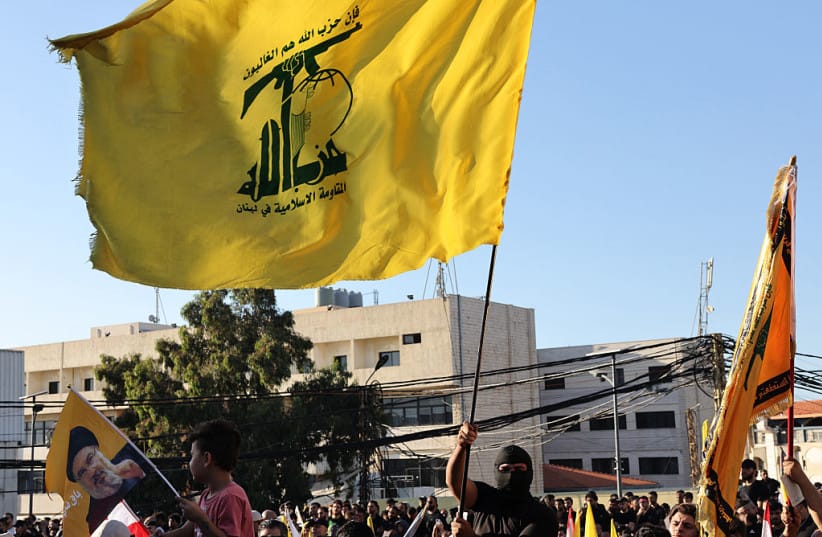
Lebanon pursues Hezbollah members in Bsharri case
Meanwhile, Lebanese authorities have reportedly stepped up efforts to pursue Hezbollah members implicated in the Bsharri case. This Is Beirut reported over the weekend that new checkpoints had been established in Bnahran, northern Lebanon, to apprehend wanted Hezbollah members Bilal Asaad and Ahmad Rashid.
The Bsharri case began last month when a Bsharri municipal patrol encountered five men affiliated with Hezbollah in the Bsharri and Jurd al-Batroun area, a predominantly Maronite Christian region, where the terror group has no known presence. The men were reportedly carrying maps and documents relating to the area, but had no mobile phones with them.
Beirut Time journalist Riad Tawk reported at the time that the documents contained lists of locations across the Koura, Batroun, and Bsharri districts, as well as references to weapons, including sniper rifles.
Military Court Government Commissioner Judge Claude Ghanem charged al-Assaad and two others last week with forming armed groups without state authorization and equipping them with light and medium weapons in an effort to undermine state authority, Lebanese media reported.
Lebanese MP Ghassan Yazbeck suggested on X/Twitter shortly after the initial arrests that, given the area where the men were detained was not close to Israel, the Iran-backed group could have been planning attacks against the nearby Christian population.
Though the aforementioned cases may suggest a shift in Lebanon's approach to Hezbollah, other cases this week have raised questions about whether Hezbollah's "era of impunity" is truly coming to an end, as Lebanese Prime Minister Nawaf Salam promised earlier this month.
Political activist detained over Nasrallah poster
Political activist Chafic Badr was summoned to court on the orders of Judge Ahmad Rami al-Hajj after removing a poster of former Hezbollah secretary-general Hassan Nasrallah from Beirut's Bechara El Khoury Street, according to Lebanese media.
Badr acknowledged removing the posters in a post on his Facebook page.
"Who exactly are we going to take revenge on? Is your revenge against the people of Beirut? Bishara al-Khoury Tunnel, Beirut. Where is the Lebanese Ministry of Interior and Municipalities' circular? Where is the decision by the #InteriorMinister to remove partisan pictures and flags? Where is the decision by Beirut Governor #JudgeMarwanAbboud?" he wrote. "To the head of the Guard, #BrigadierGeneralAbbasAlHusseini: All flags and pictures must be removed from Beirut, starting with this picture."
Israeli Kinder chocolate sparks outrage in Lebanon
The contrasting treatment of Hezbollah-related cases has also emerged in a separate controversy involving Kinder chocolate bars bearing Hebrew writing, discovered at a Charcutier Aoun supermarket branch in the eastern Beirut suburb of Sin el-Fil late last week.
Despite Lebanese polling indicating growing support for normalization, sources at Lebanon's Economy and Trade Ministry told Annahar that an investigation would be launched to determine how the chocolate products had made their way onto the Lebanese market.
Lebanon's restrictions on Israeli products are based on a 1955 law boycotting the Jewish state, which prohibits the entry, exchange, or trade of Israeli goods and products in the country and imposes significant penalties on violators. Those found guilty of violating the boycott law face three to 10 years in prison with hard labor, in addition to fines and other sanctions.
A source at Lebanon's Economy Ministry confirmed to L'Orient Today that the Hebrew writing did not mean the sale of the products violated the law, as it did not necessarily indicate that the chocolate had been manufactured in Israel.
While some Lebanese social media accounts said the confectionery had raised "questions and widespread criticism about normalization infiltrating our homes and markets," others mocked the authorities for devoting resources to investigating chocolate while Hezbollah has continued to defy Lebanese laws by smuggling weapons into and across the country.
Tzvi Joffre contributed to this report.