
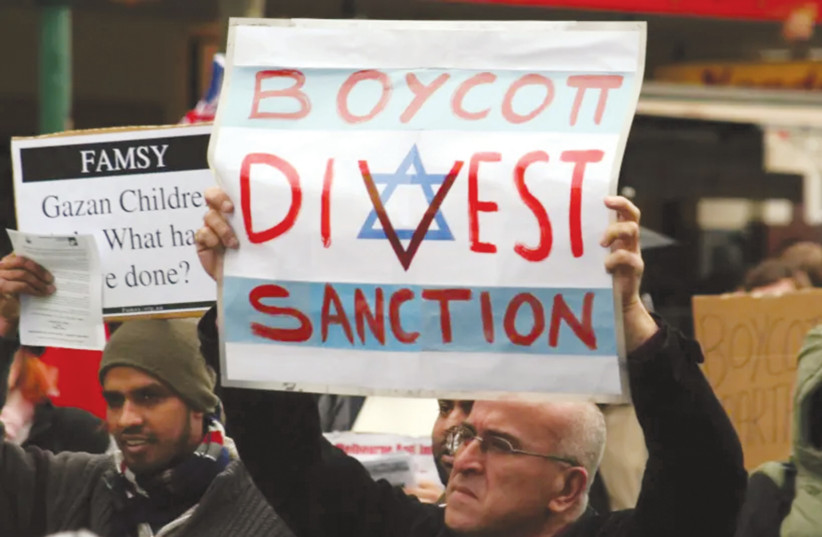
Anti-Israel boycott and divestment campaigns in the US may have limited immediate economic impact, but they risk normalizing boycotts and pressuring lawmakers toward sanctions that could severely harm Israel's economy, according to an Institute for National Security Studies (INSS) paper published last week.
The analysis, titled "In the Shadow of Western Sanctions: Israeli Commerce on the Precipice of BDS," was written by INSS's Alec Mauer. Mauer writes that the relationship between Israel and the Democratic Party "is quickly heading towards a point of rupture," adding that eight in 10 Democratic-leaning voters say they hold an unfavorable opinion of Israel.
Mauer told The Jerusalem Post, "Support for the BDS movement in the US has risen sharply since October 7, and yet the movement has thus far failed to translate increasing support into initiatives that meaningfully harm the Israeli economy. Local boycott and divestment campaigns, while receiving a great deal of press, have failed to produce substantial macroeconomic effects."
"However, anti-Israel discourse has become increasingly normalized within progressive spaces, and we are only now beginning to see the effects of American politicians responding to anti-Israel and anti-Israeli sentiments within actual legislation," Mauer told the Post.
While common explanations point to sympathy for Palestinians, online disinformation, or perceptions regarding President Donald Trump and "Operation Epic Fury," the joint US-Israeli military campaign against Iran launched in February, Mauer argues those arguments miss antipathy toward Israelis themselves.
Citing Pew polling from May, he notes that only 26% of young Democrats aged 18 to 29 held a favorable opinion of Israelis as a people, compared with 72% viewing Palestinians favorably. He also cites 2024 Anti-Defamation League data indicating that respondents who at least somewhat agreed that global problems come down to "oppressor vs. the oppressed" were 2.6 times more likely than the general population to endorse six or more modern antisemitic tropes.
Mamdani supporting BDS movement emboldens far-left
Mauer writes that shifting sentiment has emboldened far-left candidates and the Democratic Socialists of America since New York City Mayor Zohran Mamdani took office, noting that Mamdani is the only mayor among the five largest US cities who openly supports the boycott, divestment, and sanctions (BDS) movement.
Still, Mauer states that legal, political, and financial guardrails limit immediate municipal divestment, pointing to New York State's 2016 Executive Order 157, nearly $8 billion in financial assistance over two years in a proposed budget agreement with Governor Kathy Hochul, and long-term commitments such as the 99-year lease for Cornell Tech.
Even so, Mauer writes that Mamdani's first-day reversal of a ban on BDS-related acts has already hurt Israeli food exporters, albeit marginally. Meanwhile, he notes that the Brooklyn Park Slope Food Coop's halt on Israeli products in May shows how unencumbered businesses can act, with legal challenges facing standing, jury, and free-speech hurdles.
Citing trade and economic figures in his analysis, Mauer states that Israel's exports of goods and services to the US reached a record $30.8 billion in 2025, led by electronic integrated circuits and micro-assemblies at $4.42 billion and pharmaceuticals at $2.90 billion, whereas food and agriculture generated $400 million.
Sanctions more effective at devaluing shekel than boycotts
Mauer warns that US sanctions would be far more damaging than consumer boycotts because "sanctioned Israeli banks would have limited access to US dollars, be unable to receive payments from US bank accounts, and lose their ability to transfer funds between domestic banks in cases where the intermediary lender is an American-owned financial institution."
According to Mauer, sanctions would also be apt to induce capital flight, devaluing the shekel, chill venture capital investment in Israel's high-tech sector, and send a strong signal to European nations yet to publicly commit to similar measures. He points in particular to September moves by 11 European states and Canada on settlement goods and the September introduction of the Stop the Settlements Act (H.R. 10642).
In his recommendations, Mauer writes that "winning back the support of the youngest cohort of Democratic-leaning voters is likely unattainable, at least in the short term," as social media narratives and campaigns by "the Russian Federation, the CCP, the IRGC, and Qatari state media" shape views beyond what a country of 10 million can counter alone.
Instead, Mauer argues that "to revive support among moderate Democrats, Israel must attempt to re-establish the historic pillar of this relationship: an alliance upheld by shared values." According to Mauer, that includes showing a "commitment to combating Jewish vigilantism in the West Bank" to demonstrate "that Israel is indeed a democracy committed to upholding the rule of law."
Mauer concludes in his paper that "Israeli lawmakers must be ready to respond preemptively to future American policy that gives rise to a costly cycle of boycotts, divestments, and sanctions," and told the Post, "If the Israeli government fails to fundamentally recalibrate its relationship with the Democratic party, there is a real risk that a future Democratic president will support legislation that seriously harms the Israeli banking sector and the pocket books of the average Israeli."