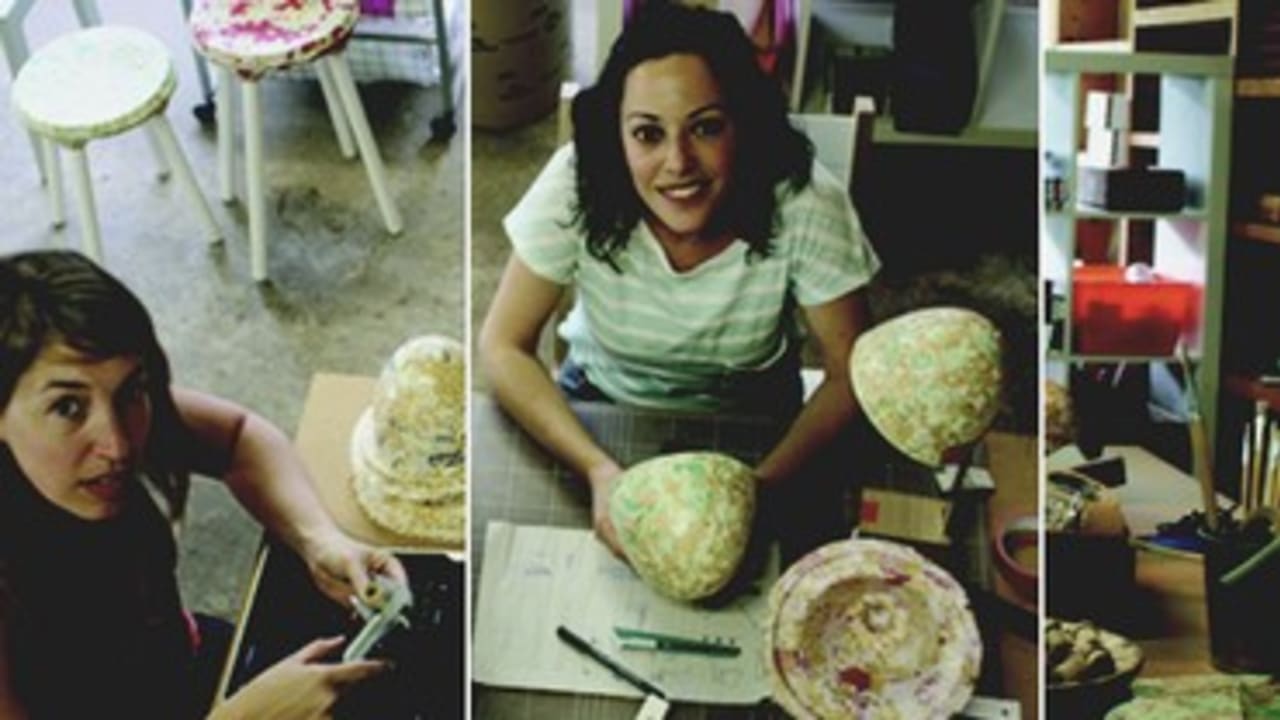
Einat Kayless Argaman founded DesignBreak in 2009 and since then has gained a large community of daily readers celebrating the design scene in Israel and beyond. Two's company (photo credit: Aviv Kurt ) Three's a crowd (photo credit: Rani Lurie) Last one standing (photo credit: Aviv Kurt ) Recycling is the name of the game (photo credit: Aviv Kurt ) Smooth finish (photo credit: Yaniv Schwartz) Last one hanging (photo credit: Aviv Kurt) Take a break (photo credit: Rani Lurie) Plate it up (photo credit: Courtesy) Who's coming for dinner (photo credit: Rani Lurie) When you eat, breath and sleep material research and develop new design methods, it means you can never go wrong. The two young designers behind Kulla Design, Adi Shpigel and Keren Tomer, understood early on that their design process should be fun, playful and stimulating.Mixing, stirring, boiling, gluing and sawing… It almost feels like the industrial version of a fairytale witch, who cooks up her next potion. It’s no wonder the two came up with the name “Kulla Design”, as the word “kulla” is slang often used to describe something we don’t take too seriously and in their case they surely don’t take design as heavy duty.Can you tell me a little bit about your background? How did your partnership start?The first time our paths crossed was during high school, we had many common friends, but we were never really up close and personal. The second time was at Shenkar Collage. During school we became close friends and discovered we work well together. When we graduated we knew that we wanted to keep on working together and after a while working in different studios we decided it was time to open a studio of our own.What’s it like working as a duo? How does it work and who does what?It's a lot of fun working and creating while constantly brainstorming together. We share similar tastes but we have different abilities. Keren has the technical expertise. If something needs sawing, it's better she does it. Finding creative solutions for technical matters is what makes her tick. Adi's strength is developing the concept and seeing it through. She is a design enthusiast, always focusing on the smallest details and never backing down until things are perfect.Give us a glimpse into a normal day in your lives.The most exciting thing about working in the studio is that no day is the same as the previous one and that's what makes us happy and drives us in the morning. First things first, we begin our day with a studio meeting, which includes breakfast and coffee while catching up on all the things that happened the day before. We think about what needs to be done and we talk about new possibilities and directions and we sail off to a new day. This could include working on some sketches and models, conceptual research, meetings with clients and professionals and so on. Each one of us has our own tasks and at the end of the week we have our briefing meeting in which we catch up and prepare what our next steps will be. We work everyday until we need to pick the children up from kindergarten and then we go back to being mothers, which we enjoy deeply. In the evening, when the children are asleep, we return to the computer and keep on working till the early hours.Can you briefly describe your process for creating a new design?Our studio works as a sort of design lab. We mainly focus on material research and developing new working methods with recycled materials and industrial waist. In most cases, the process begins with finding an interesting raw material which leads to a series of research, models and experiments. Working with recycled materials that already have some sort of context in the world is what challenges us to think more creatively on how to take it out of the original context. We love stretching the boundaries of the materials we work with, create something new out of them and introduce something new. Is there anything in particular that fuels your creativity as designers?Vacations, going abroad, good music, design magazines and exhibitions.Which place in the world most inspires you and why?The south end of Tel Aviv, the Levinski Market and its surroundings, as well as the flea market. What are some other passions you have besides art and design?Music and delicious food.What challenges have you overcome as designers?Our biggest challenge as designers is developing our business skills. Dealing with business development, marketing and sales forced us to be even more creative and self motivated. In addition, combining our profession with motherhood is not an easy task and is very challenging. The ability to drop everything in the middle of a creative breakthrough and then come back to the same state of mind in the evening is something which takes time to learn.What advice do you have for young designers who want to follow in your path?We know it may sound like a cliché but... believe in yourself and don't give up. We believe in the freshness that comes with newly-graduated students that open their own studio. It can be more challenging business-wise, but creatively there is nothing like it.Describe one thing or person that has influenced your designs the most.It's really difficult to think of one particular thing but there are a few professors at Shenkar whose mantras and words of wisdom still live in our heads and from time to time guide us while designing. Do you listen to music while you work? What’s playing in your studio right now?88FM is the studio's official radio station. We always work while listening to music, we can’t work in silence.If you weren't designers, what would you be?Adi: If I wasn't a designer I would be a designer. Keren: I probably would be a midwife.What are you working on at the moment?At the moment we are working on a series of light fixtures that combine working with wood and paper. We recently introduced our first model during Holon's Design Week and now we are in the middle of working on developing other models.Read Einat’s blog and follow her designed journey at http://www.designbreakonline.com/Follow @JPost_Lifestyle