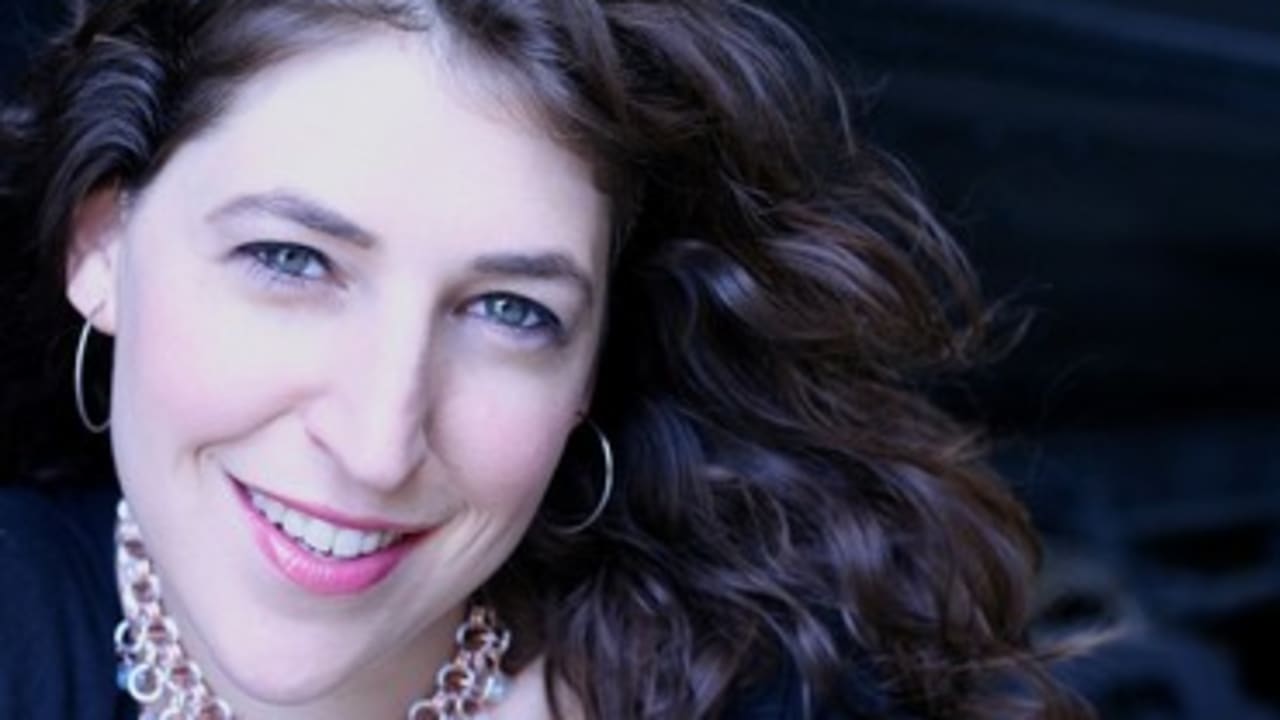
A regular on the CBS hit sitcom “The Big Bang Theory”—in which she plays Sheldon’s friend who is not his girlfriend Amy Farrah Fowler—actress Mayim Bialik is also widely known for her lead role in the 1990s NBC sitcom “Blossom,” as well as for her portrayal of the young Bette Midler in “Beaches.” She has also appeared in Woody Allen’s “Don’t Drink the Water” and HBO’s “Curb Your Enthusiasm”—as well as a slew of 1980s and 1990s TV series and late-night talk shows. Her recent appearances include recurring roles on “Secret Life of the American Teenager” and FOX’s “Til Death.” She portrayed 1960’s activist Nancy Kurshan in “Chicago 8.”But, her estimable acting credits aside, Bialik’s real-life role as an observant Jew also garners attention. Born and raised in Los Angeles, Bialik received a B.S. and Ph.D in neuroscience from UCLA, where she also minored in Hebrew and Jewish studies. The mother of two sons, she is a Certified Lactation Educator Counselor and is devoted to a lifestyle of attachment parenting, home schooling, natural family living, and vegan cooking. She is currently writing a book on holistic parenting, to be released by Simon & Schuster in early 2012.Bialik is also co-founder and chair of the youth branch of the Jewish Free Loan Association (Genesis) and speaks frequently on a variety of topics, including her journey to embracing traditional Jewish values. She studies Jewish texts weekly with two study partners.Q: Tell us a bit about your Jewish background… A: Three of my four grandparents are immigrants to this country and my mom was raised Orthodox, but left Orthodoxy when she was a teenager. My dad had a more assimilated Jewish experience. They moved from the Bronx to Long Island. My parents were not at all observant; they raised me in a Reform congregation, which actually was a very positive experience. There were some remnants of my mom’s Orthodoxy, but for the most part we were a traditional Reform family.I minored at college in Hebrew and Judaic studies. I was active in Hillel at college and when I met the rabbi there, I told him I wanted to study Yiddish. He said “Study Hebrew first and then you can study Yiddish.” And I did. I studied Hebrew and I actually fell in love with Hebrew grammar and ended up doing two full years of Hebrew, then took a year of Yiddish. By then I was half way through the minor, so I added classes in history and sociology, and that’s how I added Judaic studies to my minor. I’ve visited Israel many times. I have family that made aliyah in 1976 – my aunt and uncle and five of my cousins. They live in the West Bank. I also have family on Kibbutz Gezer. I’ve been to Israel about a dozen times since I was 16.Q: Why didn’t you pursue a career in neuroscience instead of returning to acting? A: My husband and I met in college and we had our first son in grad school after we got married. We fell in love with parenting and with being parents, and specifically with me being the primary caregiver. Being a research professor just wasn’t going to be compatible with that. So, the plan was that we would try to take turns teaching and sort of figure it out. And I went back to auditioning. I had never done acting as an adult and I thought, well, maybe I’ll work here and there. I didn’t anticipate that I’d be a regular on a TV show. But I’ve also been teaching neuroscience in the home school community since I got my degree.Q: You’re a major voice in parenting issues, especially what is known as “attachment parenting.” Has your Jewish background informed or influenced your parenting views at all?A: In some ways. I think that the style of attachment parenting is a very traditional kind of parenting – it’s not new and trendy. If you speak to women from previous generations you will find that things like keeping the baby close to you and breast feeding on demand – kind of intuitively wanting to be with your child — are very traditional.Margaret Mead had written a very, very interesting analysis of a Jewish family that she observed and it sounded a lot like the style of parenting that attachment parenting is. She described women constantly rocking their babies and breast-feeding every time the baby opened its mouth. She said that perhaps the men shuckling while they’ve davening is to recreate all the rocking that their mothers did for them. So there is absolutely a traditional ethnic aspect to parenting the way your body was made to parent. There is an Orthodox attachment parenting community. There are definitely Jews who believe that the way God made our bodies was to give birth and to nurture that child — there are many references to things like extended breast feeding and even co-sleeping in our heritage and in the Torah.Q: How would you describe yourself at this point of your life Jewishly? A: I’m supposed to say that I’m “aspiring Modern Orthodox” — meaning I identify most strongly with the Modern Orthodox community. That’s the community I daven in; that’s the community that most fits my sensibilities. The reason that I don’t take that moniker on is because of my unusual work situation. I’m not able to say that I completely do it the way that I want to.Q: It’s hard to be an observant Jew in Hollywood? A: I would say that it’s close to impossible. There are Orthodox writers that I know and there are a couple of Orthodox producers. I think it’s very hard being female and being in acting – largely because of the publicity and the public aspects of it that revolve around a sense of fashion.Q: Oh, I thought you were talking about time-related problems – like observing Shabbat, etc.A: No. That actually is okay. We tape our show on Tuesday nights. We’ve got a very flexible schedule, so I’m home and able to do those things – of course, I obviously have to plan my challah baking… Yontifs are hard because they often fall in the middle of the week. For me, though, it’s more the aspects of the ‘red carpet’ and needing to wear designer clothes that are strapless, and all those things that I don’t do and that are actually extremely stressful and difficult to work around because it is a big part of the industry. The goal is to be competitive. I write very publicly about these issues related to tzniut (laws of modesty) – I write for Kveller.com, a Jewish parenting site. I wrote last year four articles about trying to find a tzniut designer Emmy dress.Q: Are issues related to women in Orthodoxy a particular concern of yours? A: Yes, I narrated a film on agunot (women whose husbands refuse to grant them a Jewish divorce) called “Women Unchained.” Especially as a woman who was not raised religious and who is identified as a feminist, I think it’s important to show that there are absolutely aspects of traditional Judaism that are theoretically problematic, but not insurmountable.Q: Is it difficult bringing up your children in Hollywood? A: Well, I live in L.A., but I don’t consider them as being raised in Hollywood. They don’t watch television; they’ve never seen me on TV. We home school – we’re a part of a large home schooling community; there’s a Jewish home schooling community and a secular home schooling community – that we’re part of.Q: Are you related to the Jewish poet, Chaim Nachman Bialik? A: Yes. He was my great-grandfather’s first cousin. He and my great-grandfather shared a bubbe and zaide.Q: I have to ask you this – how did you come to be named “Mayim,” which, of course, means water in Hebrew? A: My great-grandmother’s name was Mariam and it was simply an abbreviation of that name – they took out the middle syllable because it was hard for some of the grandchildren to pronounce. So, instead of Mar-ee-am she became Mayim and she was called Bobbe Mayim. My family didn’t speak Hebrew, but when I was born…you know, it was 1975 and I guess my parents thought it sounded really groovy. My middle name is Chaya. They knew my name meant water, but it didn’t have anything to do with that.