Global Agenda: Just get yourself free
By PINCHAS LANDAU
01/31/2013 22:46
It might be useful to remind people of the decisions that made Fischer so important in the Israeli economic context – and why his impending absence is likely to be so sorely missed.
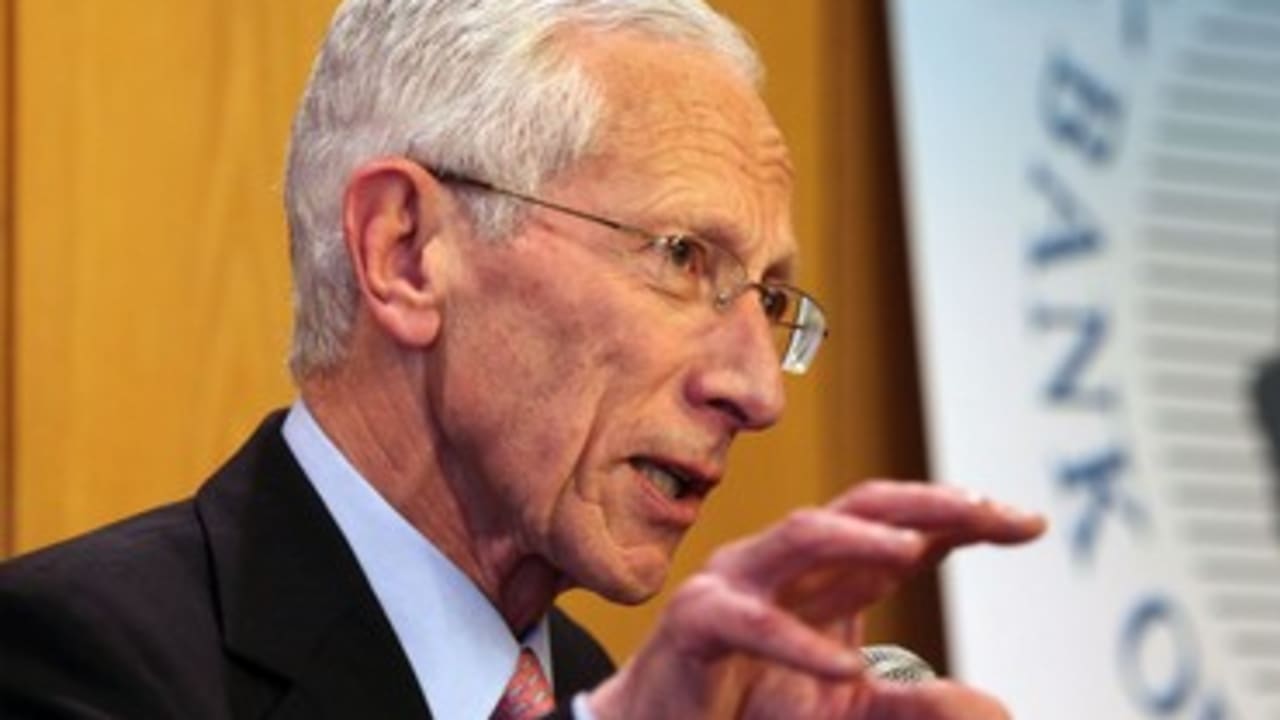
Bank of Israel Governor Stanley Fischer following his resignation, January 30, 2013. Photo: Sasson Tiram
“You can slip out the back, Jack
Make a new plan, Stan
You don’t need to be coy, Roy
Just get yourself free.”
– Fifty Ways to Leave Your Lover, by Paul Simon
Stanley Fischer’s announcement that he was quitting as governor of the Bank of
Israel has made waves around the world. Anyone who follows the Israeli economy,
or is even remotely involved in Israel-connected matters, has pricked up their
ears. Most of them, perhaps inevitably, have asked why he is quitting – and more
especially why now? The suspicion that Fischer has some deep-seated reason is
amplified by the timing of the announcement, after the elections and before the
next government is formed.
In an exquisite twist on reality, it has even
been suggested that Fischer is angling for the post of foreign minister in the
next government, or of president of Israel when Shimon Peres’s current term
expires next year. The former idea is weird, given the huge gulf between
Fischer’s political views, which have remained under wraps during his
governorship, and those of Netanyahu and most of his likely coalition
partners.
True, nothing is impossible, as Fischer’s agreement to accept
Netanyahu’s offer of the governorship in 2005 illustrated so clearly, but some
possibilities are nonetheless extremely remote. As for the presidency, if he is
interested in that, Fischer does not need to quit his current job a year ahead,
creating some bad feeling as he does so.
Despite the fact that Fischer
has always indicated that he would not serve a full second term, the idea that
he might be telling the truth – although perhaps not the whole truth, that at
his age (in his late sixties) and after eight years on the job he wants to do
something less stressful and maybe even do less, generally – is not given much
credence.
We shall see, as they say. But since the announcement of his
retirement has triggered a round of responses stretching from eulogies to
settling old scores, it might be useful to remind people of the decisions that
made Fischer so important in the Israeli economic context – and why his
impending absence is likely to be so sorely missed. Interestingly, each of these
decisions came around this time of year, making his resignation announcement
apposite and even timely.
The first was in March 2008, when he began what
soon became a systematic intervention in the foreign-exchange market to prevent
the rapid rise in the value of the shekel. This was an act of rebellion, indeed
rank heresy, against the set of “policy prescriptions” known as “the Washington
Consensus,” which Fischer had been a prominent figure in formulating and
imposing on other countries in his period at the International Monetary
Fund.
However, as the global economy spun out of control in 2008, and
from his new vantage point as the governor of a central bank in a small, open
economy buffeted by financial winds entirely out of its control, Fischer
adjusted to a new reality – first giving excuses for his seemingly outrageous
behavior, but eventually “coming out” and overtly distancing himself from the
old, and now outmoded, verities that he had formerly championed.
A year
later, having successfully steered the Israeli economy through the upheaval that
followed the collapse of Lehman Brothers and AIG, Fischer found himself handing
over command to a newly elected government, in which his “patron,” Netanyahu,
was prime minister and had made cutting direct taxes a cornerstone of his
economic program. Fischer expressed open opposition to this approach, urging
instead that the higher tax revenues being generated by Israel’s rapid growth
should be used first and foremost to pay down debt and reduce the country’s debt
burden. Within two years, after the wave of social protests in the summer of
2011, Netanyahu had backed down, reversed course and effectively admitted that
Fischer had been right all along.
The following year, Fischer fought a
tough, lonely but critical battle against the most senior echelons in Bank
Hapoalim in an intervention that not only rewrote the rule book for how central
banks should relate to problems at major commercial banks, but may well have
saved the wider Israeli economy from a major disaster.
Softly spoken, but
not coy, Fischer has chosen not to slip out the back, as one of his predecessors
disgustingly did on two weeks notice. Maybe Stan does indeed have a new plan,
but for the moment his aim seems just to be to get himself
free.
landaup@netvision.net.il