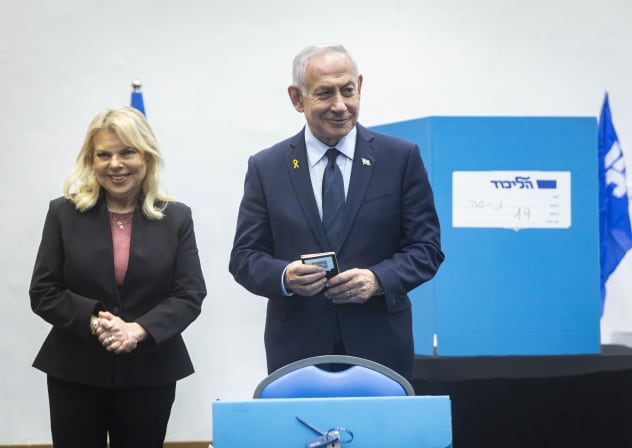
Prime Minister Binyamin Netanyahu ignited an expedited election campaign Tuesday
night when he called for early elections to take place.
In a statement
delivered at the Prime Minister’s Office in Jerusalem, Netanyahu said that after
completing a round of meetings with his coalition partners, he concluded he
could not pass the 2013 state budget and has no choice but to initiate
elections.
“My obligation as prime minister is to put the national
interest above all else, and therefore I decided that the good of Israel
requires going to elections now, as soon as possible,” Netanyahu said.
“A
three-month election campaign would be more preferable for Israel than a long
campaign that would last an entire year and harm the economy. So after four
years, we will go to elections. I will seek a new mandate to continue to
lead the people of Israel.”
Netanyahu did not provide an election date
and he was vague about the timing. The earliest possible election date by law
would be January 15 – three months after the Knesset resumes next Monday – while
the first date that would be four years after the last election would be
February 12.
United Torah Judaism leader Ya’acov Litzman pleaded with
Netanyahu on Tuesday not to hold the election on February 12, because it is the
35th anniversary of the death of long-time Gerrer Rabbi Yisrael
Alter.
Sources close to the prime minister said the meeting with Litzman
finalized Netanyahu’s decision to seek elections. The officials said that when
Netanyahu saw that Litzman would not agree to lower any child welfare payments
by even a small amount, he knew he could not pass the budget.
Netanyahu
blamed all his coalition partners in his speech for their unwillingness to make
sacrifices on behalf of the nation. He said his government’s main
accomplishments were maintaining the country’s security and economic and
political stability.
Prior to his announcement, Netanyahu briefed
President Shimon Peres, top politicians in his Likud party and the heads of the
coalition and opposition factions.
Politicians in the Center- Left began
efforts to try to unite the bloc immediately after Netanyahu’s announcement.
Sources close to former prime minister Ehud Olmert said he was under tremendous
pressure to make a political comeback.
“[Olmert] knows he only has a few
days to make a decision,” a source close to him said. “People are pushing him,
but he has told everyone, including the people close to him, that he has not
decided yet.”
Yesh Atid leader Yair Lapid, who has repeatedly denied any
intention of running with Olmert, said he would reveal his party’s list of
Knesset candidates within the next 10 days. He declined to say whether the list
would include former Kadima leader Tzipi Livni, who was mum about her political
future Tuesday night.
Efforts intensified Tuesday to enable current and
former Shas leaders Eli Yishai and Arye Deri to run together.
Spokesmen
for both men declined to comment on reports that Deri had offered to give Yishai
the party’s top portfolio if he would agree to let him head the
list.
Yishai said Shas spiritual leader Rabbi Ovadia Yosef would make any
decisions.
Habayit Hayehudi will be the first party to hold a
primary.
Its election committee decided Tuesday night to hold its vote
for both its leadership and Knesset slate on November 13, but retired judge Sara
Frisch, who is overseeing the primary, disqualified the
decision.
Leadership candidate Zevulun Orlev praised the decision to
unite the two races on one date, while his competition, Naftali Bennett,
condemned it.
Knesset Speaker Reuven Rivlin called for the Knesset to be
dissolved as soon as possible after its winter session opens on October 15
Knesset Legal Adviser Eyal Yinon said that the bill to dissolve the Knesset
proposed when Netanyahu considered calling an election in May cannot be
“revived.”
Yinon pointed to the “far-reaching repercussions on the
political system and members of Knesset” of bills dissolving the Knesset, and as
such said the steps of the legislative process may not be skipped, as they take
away MKs’ right use their judgment.
“Laws having to do with elections
need to be clear and clean of all doubt, and when a doubt arises, like in this
case, we must be meticulous in removing all doubt,” Yinon explained, adding that
either a private member bill or government legislation must be brought to a
first reading in the plenum.
Lahav Harkov contributed to this report.