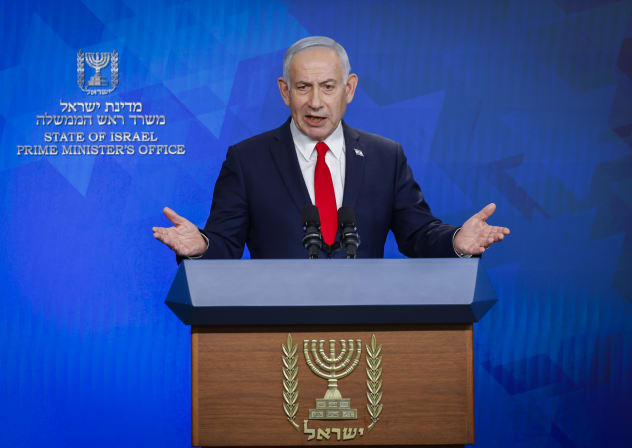
Prime Minister Binyamin Netanyahu’s decision Tuesday night to call for new
elections should force a revision of recent history.
By recent history I
am not talking about four years ago, but rather four weeks ago. In light of the
prime minister’s move to call for elections, there is a need to reassess anew
all his talk the last few weeks about red lines on Iran and the public
squabbling with the US.
Conventional wisdom – the wisdom spread by so
many here and abroad – was that Netanyahu was manufacturing a crisis with the US
administration just two months before US elections.
Many said he was
publicly talking about red lines on Iran and criticizing Washington for not
setting them because he was trying to intervene in their elections, and bend
them toward Republican candidate Mitt Romney.
Wrong. Netanyahu’s comments
were aimed not at the US electorate, but at the Israeli one. He too realized
what it did not take a PhD in political science to figure out: It is a huge
gamble to place all bets on Romney, perchance he lose.
Netanyahu was not
trying to shake US President Barack Obama, but rather trying to solidify his own
position as this country’s unrivaled leader.
That Netanyahu was headed
for elections became clear during a Rosh Hashana interview with The Jerusalem
Post, though he didn’t explicitly state it. It became clear in the way he kept
talking about how he stands up to the world, even when it is not popular; and
about how he has the experience that the two people he views as his main
challengers – Labor head Shelly Yacimovich and Yesh Atid leader Yair Lapid –
lack.
Those were not answers to direct questions, but rather election
talking points.
Netanyahu, it became clear from that interview, believes
that what the country wants – what it respects – is a leader who stands up to
the world, and, yes, even to Obama. And he was intent on sharpening the image
that he is just such a leader.
While many of Netanyahu’s critics around
the world mocked his propaided speech at the United Nations two weeks ago, in
Israel that speech went over well. There was the country’s leader, speaking
perfect English, lecturing the world, standing up for Israel’s inalienable right
to defend itself and laying out exactly the point beyond which there would be
military action.
The question was not whether certain columnists in
Yediot Aharonot or Haaretz liked the speech or the bomb cartoon, but how it came
across to the common folk (amcha) – and judging by anecdotal evidence and random
conversations, amcha liked it.
Anecdotal evidence and random
conversations, obviously, are not scientific.
But the polls are, or at
least purport to be. And in the polls, Netanyahu has not been hurt at all – in
fact has been helped – by the tough talk on Iran and the willingness to go
head-to head with even the US over the issue.
For instance, a Haaretz
poll taken at the end of September following the screaming headlines about
conflict with Obama, had Likud winning 28 Knesset seats, eight more than Labor,
its nearest competitor.
That was three seats more than a Haaretz poll had
Netanyahu winning at the beginning of August, when no one had yet heard about
red lines.
A more important indication is that according to an aggregate
of polls called Israel Poll Trends that appears on Israeli journalist Shmuel
Rosner’s blog, the Likud/Right/religious party bloc went from 65 seats in the
beginning of August to over 67 seats in September.
Netanyahu’s assertive
talk, those polls indicate, is good domestic politics.
Those around the
world who view everything Israel-related recently through the prism of an
imminent attack on Iran will be asking one question this morning: How will the
early elections impact on a possible IDF strike on the Fordow enrichment
facility? There will be those who will draw parallels with the 1981 attack on
the Iraqi reactor, inasmuch as that attack did take place just three weeks
before Knesset elections in which prime minister Menachem Begin and Likud
defeated (current President) Shimon Peres and Labor for a second time. Surely,
the argument will run, Netanyahu will attack – or Defense Minister Ehud Barak
will urge an attack – to improve their chances at the ballot box.
While
Netanyahu looks certain, according to the polls, to win the next elections,
Barak – according to this argument – will need something dramatic, like an
attack on Iran, to prolong his political life. He will press for an attack for
this purpose, some will argue.
These arguments, however, should be put in
perspective.
Various pundits have been saying for months that Barak was
itching for an attack to improve his political prospects. Yet no attack
came.
The same people who have been warning about Israeli military action
for months, said last May – when it seemed as if the country was going to new
elections – that this was in order to make it easier to attack Iran. And then,
too, when Netanyahu reversed fields and formed a short-lived coalition with
Kadima head Shaul Mofaz, they said that was only to ease an attack on Iran as
well. And when that coalition fell apart, it – of course – was only to pave the
way for an attack on Iran.
It’s all about Iran, this argument has run for
months, if not years. Just as the ceaseless chatter about how Netanyahu has been
interfering in the US elections on behalf of Romney presupposes that it is all
about the US elections.
It isn’t. What it has been about for the last few
months, and what it will definitely be about for the next 12 weeks or more, is
the Israeli electorate and what Netanyahu believes will build him up in the
public’s eyes. What Netanyahu has said and done for the last few months – from
red lines to publicly calling out the US to his diagram at the UN – must be seen
within that context.