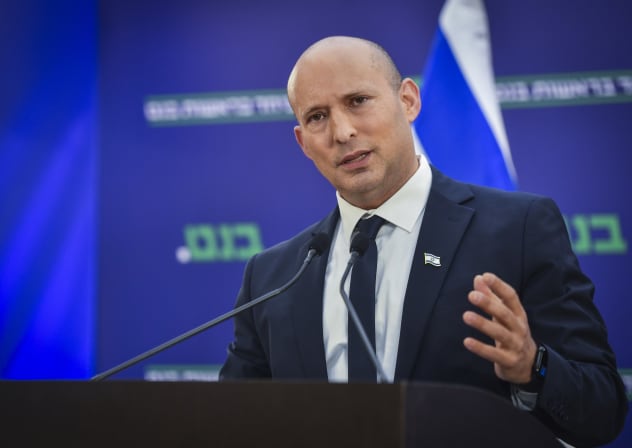
Four more years of Avigdor Liberman in the foreign ministry would harm the
country’s interest because he is irrelevant abroad and viewed as unnecessarily
belligerent, Liberman’s former deputy, Danny Ayalon told The Jerusalem Post this
week.
Ayalon, whom Liberman unceremoniously left off the Israel Beytenu
party list before the recent elections, said he and others in the foreign
ministry tried, from Liberman’s first day in office, to make the new foreign
minister palatable abroad.
Ayalon will be one of the prosecution’s key
witnesses called to testify in Liberman’s upcoming fraud and breach of trust
trial.
According to Ayalon, one of the first things he did as Liberman’s
deputy was to try to alter the negative image of him abroad. Ayalon said that
soon after the 2009 elections he arranged an interview with Liberman by
Newsweek/Washington Post reporter Lally Weymouth, who Ayalon said was “quite
impressed.”
“He said some things she did not expect,” Ayalon
said.
“He talked about the evacuation of settlements, and said that for
peace he would even leave his own house in Nokdim. That was supposed to open the
door for him to the capitals of the world and turn him into a
statesman.”
Ayalon, sitting over coffee in a Tel Aviv cafe, recalled how
he and others in the foreign ministry “worked together to promote Liberman, and
to explain to the world that not only is he the democratically elected foreign
minister, but also that he is a worthy interlocutor with leadership
capabilities, decision-making capabilities, political courage, and with the
creativity to sometimes think out of the box.”
Ayalon said he felt at the
time that it was his duty to open doors around the world for Israel’s number one
diplomat, the “face of the country.”
“Unfortunately, four years after the
fact, we collectively did not succeed in making him a relevant figure
internationally, and in making him – along with the prime minister – a foremost
representative of Israel overseas.”
Ayalon, who claimed not to be
motivated in his comments by vengeance, but rather by professional obligation,
said it was necessary to analyze what went wrong and correct it for the
future.
“In four years there was a failure,” he said, “and it would be
wrong for the country, for the foreign ministry and also for Liberman, to put
him in that position again.”
Ayalon suggested that Prime Minister
Binyamin Netanyahu appoint Liberman finance, not foreign, minister in the next
government.
“The finance minister is not less important than the foreign
minister, and maybe even more important. It would be better for him, and better
for the country.”
A spokesman for Liberman responded to Ayalon’s
criticism by saying that the former deputy foreign minister praised the job
Liberman was doing as foreign minister dozens of times, including in a radio
interview on the very morning of the day when he was left off the Israel Beytenu
list.
“It is therefore clear that Ayalon’s remarks flow from vengeance
and frustration, and do not deserve a response,” the spokesman
said.
Ayalon said the main reason for Liberman’s ineffectiveness as
foreign minister was because at the very outset he recused himself from the
Palestinian issue, saying that because he lived in Nokdim, it would be a
conflict of interest for him to work on this issue.
The world, Ayalon
said, interpreted this as an excuse, and believed he simply did not want to deal
with an issue that was not politically popular. This hurt Liberman’s
credibility, he said, and he was seen “more as a politician who did not want to
go against his constituency in Israel than as a statesman.”
Ayalon said
the impression that Liberman was more politician than statesman was further
hammered home to the international community when he addressed the United
Nations in September 2010, and essentially contradicted policies Netanyahu
espoused at the time.
This was during that brief period when Netanyahu
and Palestinian Authority President Mahmoud Abbas were actually talking.
Liberman, addressing the world body, called for a long term interim agreement
and said the guiding principle in drawing up an agreement with the Palestinians
should not be land for peace, but rather redrawing the borders and swapping
populated territory.
“This speech put him in an awkward position, because
it looked as if he did not represent the government,” Ayalon said, adding that
the speech was seen as a political address directed at his own
constituency.
“It gave the wrong perception that Israel is belligerent,
aggressive, and most of all that it does not speak in one voice,” he said. He
added that Israel was hindered by the impression that it had neither a clear
strategy, nor a direction.
Ayalon deflected the notion that Israel is
isolated internationally because of Liberman.
“I believe that in this
case the international community has a chip on its shoulder. It expects
more from Israel than [from] the Palestinians, and it doesn’t give us enough
credit for what we do – like the Bar-Ilan speech [where Netanyahu accepted the
two-state solution], like the settlement freeze, like the offers made by
[Defense Minister and former prime minister] Ehud Barak and [former prime
minister] Ehud Olmert.”
But, Ayalon added, Liberman’s conduct and
statements and “the conduct of our diplomacy in the last four years, did not
ameliorate the situation. We played according to the stereotype: that we are the
belligerent side.”
In order to reverse the trend, Ayalon – who met
Netanyahu the day after he left his post as deputy foreign minister earlier this
month – said it was important for Israel to take the initiative, recommending
“recognition for recognition”: The Palestinians recognize Israel as the Jewish
state, and Israel recognizes the Palestinians as “a member state of the UN
without final borders.”
“I’m not giving them anything regarding
territorial control – they already have Areas A and B,” he said. “But this way
we could negotiate from parity on the other issues.”
He said that Israel
would retain overall security responsibility in order to keep Hamas from taking
over the West Bank.
Right now, Ayalon said, the Palestinians are
concerned that any interim agreement would become permanent, while Israel is
worried that any permanent agreement will in reality only be an interim
one.
Recognizing a Palestinian state now, and then negotiating on the
core issues, would “change their own perceptions, and make them feel masters of
their own destiny,” Ayalon said. “It could also create a basis for much deeper
economic cooperation and change the atmosphere and the dynamics of the
conflict.”
Such an initiative, Ayalon argued, “could rattle the cage and
change some things.” It would also “show the international community that we are
serious. We are accused of talking about two states, and not meaning
it. This will put that notion to rest.”